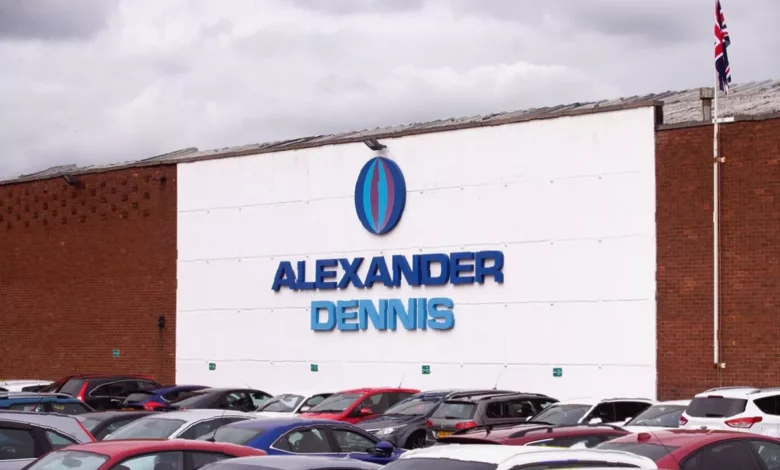
Up to 115 jobs are at risk as bus manufacturer Alexander Dennis proposes shutting its Falkirk site and converting its Larbert facility, in a move the company states is necessary to safeguard around 200 other skilled roles.
The proposal, now subject to consultation, marks a significant shift from plans announced in June 2025 to close both Scottish sites, which would have put 400 jobs at risk. The company, a subsidiary of NFI Group Inc., said the new approach would “better align with the current market” and improve efficiency. If enacted, it would see the Larbert plant become a dedicated chassis manufacturing site supporting all of Alexander Dennis’s low and zero-emission bus products.
Company Cites Market Pressure and Overseas Competition
Paul Davies, Alexander Dennis president and managing director, framed the decision as the “best possible outcome” in a challenging climate. The company’s rationale hinges on what it describes as a severe loss of market share for UK domestic bus manufacturing in 2025, driven by overseas competition.
Alexander Dennis stated that more than half (51%) of all zero-emission buses purchased in the UK are now sourced from overseas manufacturers, a 25 percentage point increase from 2024. Mr Davies repeated calls for both the Scottish and UK governments to “level the playing field” and recognise the higher costs of manufacturing in Britain.
“Manufacturing in this country needs to be better supported if we are to generate the economic benefit that the country so badly needs,” he said. The company indicated that the Larbert site would retain the flexibility to reintroduce full bus body manufacturing in the future should market demand justify it.
This restructuring follows a Scottish Government intervention in September 2025, which funded a first-of-its-kind, 26-week furlough scheme to protect jobs while the firm pursued orders. The scheme, which ended on March 22, 2026, had approximately £4 million allocated. The Scottish Government confirmed the company retains the option to claim up to £4.1 million of this funding, subject to conditions being met, but no claim has yet been received.
It is understood that around 85 employees have left the business since the initial consolidation threat last year. The company had previously indicated that securing orders for at least 300 buses per year was necessary to safeguard long-term production in Falkirk.
Political Reactions and Funding Controversy
The announcement drew immediate and sharp political reactions, amplified by a controversy over recent government funding. Just days earlier, Transport Scotland announced £45 million through its third Scottish Zero Emission Bus Challenge Fund (ScotZEB3), with Alexander Dennis set to receive orders for more than 100 zero-emission vehicles from operators Lothian Buses and Rock Road.
However, a larger portion of that same funding round was awarded to a Chinese manufacturer, Yutong, with Edinburgh coach operator Ember receiving £13 million to buy 100 Chinese electric coaches. This allocation became a focal point for criticism.
First Minister John Swinney said he was “very concerned” by the job risk news. He pointed to the recent bus award and called on the UK Government to reform procurement rules. “I would encourage the UK Government to fulfil their promises and their commitments to Alexander Dennis,” he said.
Deputy First Minister Kate Forbes called for UK Government action on creating a long-term order pipeline and suggested changes to the Subsidy Control Act 2022. A Scottish Government spokesperson said it remained in regular contact with the company and unions and was ready to discuss all options to protect jobs.
Opposition parties levelled blame at the Scottish Government. Scottish Labour leader Anas Sarwar said it was “devastating” to see the company downscale, accusing John Swinney of using taxpayer money to “subsidise jobs halfway around the world” instead of supporting Scottish workers. He referenced the government’s “ferry fiasco” as another example of poor economic leadership.
Scottish Conservative candidate for Falkirk West, Neil Benny, called the potential closure a “devastating blow,” stating SNP ministers had “overpromised and underdelivered.” Scottish Liberal Democrat candidate Lucy Smith said it was “ridiculous” that SNP funding was going to Chinese manufacturers while Scottish jobs were at risk.
In response, a UK Government spokesman highlighted the country’s role as a global leader in bus manufacturing, noting that around 60% of buses funded through its zero-emission bus programme are built by UK-based companies. They pointed to a £15.6 billion commitment for transport improvements and the work of the UK Bus Manufacturing Expert Panel, which ran from March 2025 to March 2026 to provide greater certainty for the industry.
Unions Condemn “Shattering” Decision
Trade unions reacted with anger, disputing the company’s claim that the move was unavoidable. Unite general secretary Sharon Graham described the news as “shattering” and “an economic shock which the company has chosen to inflict on the workforce and the wider community when it has other viable options.”
Unite also criticised both governments, describing them as “woeful” for enabling the decision by awarding half of new bus orders to a Chinese company. The union highlighted the wider supply chain impact, estimating that for every job in bus manufacturing, three to four jobs in support services are at risk, potentially putting hundreds of further roles in the Falkirk and Grangemouth area in jeopardy.
Robert Deavy, GMB senior organiser in manufacturing, said, “How many Scottish jobs must be lost and factories closed before our governments understand the risks of sending contracts around the world?” He warned the loss represented “economic madness,” stripping away crucial skills and supply chains.
The proposed changes at Alexander Dennis occur against a backdrop of other significant industrial concerns in Scotland, including the ExxonMobil plant and the Grangemouth oil refinery. The company’s Larbert site had previously been repurposed in 2023 to focus on zero-emission bus chassis, as part of a wider modernisation plan.