UK retail sales unexpectedly rose in March, driven by a sharp increase in fuel purchases as surging oil prices pushed motorists to fill up. The volume of retail sales jumped 0.7% month-on-month, the Office for National Statistics reported, comfortably beating market expectations for no growth. Automotive fuel sales soared 6.1%, reflecting the impact of rising petrol and diesel costs. Excluding fuel, total retail sales rose by just 0.2% on the month, in line with forecasts cited by FXStreet. Danni Hewson, head of financial analysis at AJ Bell, said the figures showed climbing pump prices were “eating into household budgets”, leaving consumers with less to spend on other purchases. Despite the rebound, the ONS noted that sales volumes remained 1.2% below pre-pandemic levels seen in February 2020.
Market Performance
London’s blue-chip index ended the week on the back foot, with the FTSE 100 closing down 77.93 points, or 0.8%, at 10,379.08. The FTSE 250 fell 181.71 points, also 0.8%, to 22,582.81, while the AIM All-Share dropped 5.73 points, or 0.7%, to 796.40. For the week, the FTSE 100 lost 2.7%, the FTSE 250 declined 2.7% and the AIM All-Share slipped 1.7%.
European markets also struggled. The CAC 40 in Paris ended down 0.8%, and the DAX 40 in Frankfurt closed 0.1% lower. In contrast, sentiment was brighter on Wall Street. The Dow Jones Industrial Average edged down 0.4%, but the S&P 500 rose 0.5% and the Nasdaq Composite gained 1.2%. The standout performer was Intel, which soared 23% after reporting better-than-expected first-quarter results and guidance. The chipmaker said it saw “unprecedented” demand, with first-quarter revenue of $12.7 billion, up 9% year-on-year, and non-GAAP earnings per share of $0.18. Intel forecast second-quarter revenue of $12.5 billion to $13.5 billion.
| The yield on the US 10-year Treasury stretched to 4.32% from 4.29% on Thursday, while the 30-year Treasury yield widened to 4.92% from 4.89%. The pound eased to $1.3497 from $1.3500, and against the euro sterling fell to €1.1532 from €1.1551. The euro traded lower against the dollar at $1.1703, and the dollar was at ¥159.55 against the yen. Gold dipped to $4,718.34 an ounce from $4,731.39, though it has risen 4.28% over the past month and 42.25% compared with a year earlier. |
Middle East Crisis and Energy Prices
The oil price continued to tick higher, with Brent crude trading at $105.78 a barrel on Friday afternoon, up from $103.25 at the time of the London equities close on Thursday. The persistent rise reflects the deadlock in the Middle East crisis, with the Strait of Hormuz effectively closed, snarling energy exports. Iranian Foreign Minister Abbas Araghchi was expected to arrive in Islamabad on Friday night for talks described by Iran as bilateral consultations with Pakistan and regional coordination, not a meeting with US officials. Araghchi wrote on X that his trip was to “closely co-ordinate with our partners on bilateral matters and consult on regional developments”. Pakistan has been gearing up for an anticipated second round of US-Iran talks, but Iran has suggested these are bilateral. Araghchi’s regional tour also includes Oman and Russia.
US Defence Secretary Pete Hegseth said Iran has a chance to “make a good, wise deal”, adding that the US naval blockade of Iranian ports “is growing and going global”. He said the US is not “anxious” to make a deal and that “the ball is in [Iran’s] court”.
David Morrison, senior market analyst at Trade Nation, explained that the war in the Gulf is hitting Europe and the UK harder than the US. “The former are reliant on imported energy in a way the US isn’t. While the US still must deal with higher crude oil prices, it has few worries over supplies drying up,” he said. The conflict has driven up supply chain, fertiliser and energy costs for the UK food sector, with the Food and Drink Federation warning the government to act urgently to mitigate rising costs.
UK Economic Indicators
Beyond retail sales, separate data from the Bank of England showed that the Middle East conflict has “eroded” confidence that the UK economy will improve later this year. The Bank’s Decision Maker Panel survey, covering the three months to April, revealed that firms expect to increase prices by 3.8% over the next 12 months – 0.3 percentage points higher than the forecast in the three months to March. Firms also anticipate food inflation could jump as high as 7% this year, a significant upward revision.
Bank of England Deputy Governor Sarah Breeden, who also serves as head of financial stability, told the BBC on Friday that the central bank expects stock markets around the world to fall. “There’s a lot of risk out there and yet asset prices are at all-time highs. We expect there will be an adjustment at some point,” she said. The Bank of England is expected to hold interest rates at 3.75% at its upcoming meeting.
Corporate Movers
On the FTSE 100, packaging firm Mondi slumped 11% after missing profit forecasts for the first quarter. Underlying earnings, including forestry fair value, fell 27% to €212 million for the three months to March 31, from €290 million a year earlier.
JD Sports Fashion fell 1.9% after the Financial Times reported that a boardroom rift sparked the departure of chairman Andrew Higginson. According to the FT, Higginson quit after pushing for chief executive Regis Schultz to be ousted and failing to win unanimous backing for the move. JD Sports told Alliance News that Schultz has the “continued support” of its board. A JD Group spokesperson said: “It was mutually agreed between Andy and the board that this is the right time for a change of chair; there has been no disagreement about the board’s continued support for the CEO.” Higginson is set to step down after the July 21 annual general meeting, with Darren Shapland taking over as interim chair. Shares in JD Sports were down 1.5% at 71.04p on Friday, having fallen around 4% on Wednesday after the initial announcement.
Airlines headed south amid higher oil prices and fears over jet fuel supplies. Wizz Air fell 6.0%, easyJet fell 2.3% and British Airways owner IAG fell 1.4%.
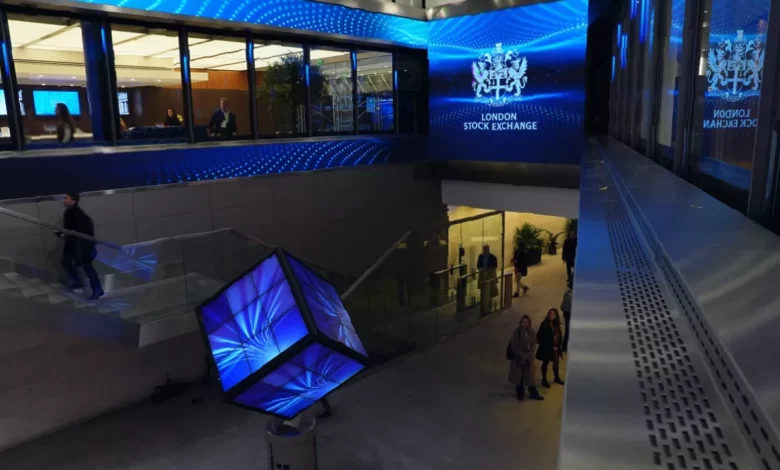
Among the biggest risers on the FTSE 100 were British American Tobacco, up 96.00p at 4,302.00p; Intercontinental Hotels Group, up 3.10p at 146.00p; London Stock Exchange Group, up 180.00p at 9,992.00p after reporting a “record performance” in the first quarter and raising annual guidance, with total income up 9.8%; Sage Group, up 14.60p at 902.80p; and Marks & Spencer, up 5.35p at 347.00p.
The biggest fallers, aside from Mondi, were Babcock International, down 54.50p at 1,131.50p; Antofagasta, down 145.00p at 3,686.00p; AstraZeneca, down 536.00p at 13,956.00p; and JD Sports Fashion, down 2.12p at 69.94p.
Monday’s global economic calendar features German consumer confidence data. Later in the week, interest rate decisions are due in the US, Europe, the UK and Japan, while inflation prints are scheduled for Australia and the euro area. Next week’s local corporate calendar includes first-quarter results from oil majors BP and Shell, pharmaceutical firms GSK and AstraZeneca, and banks Barclays, NatWest and Lloyds.