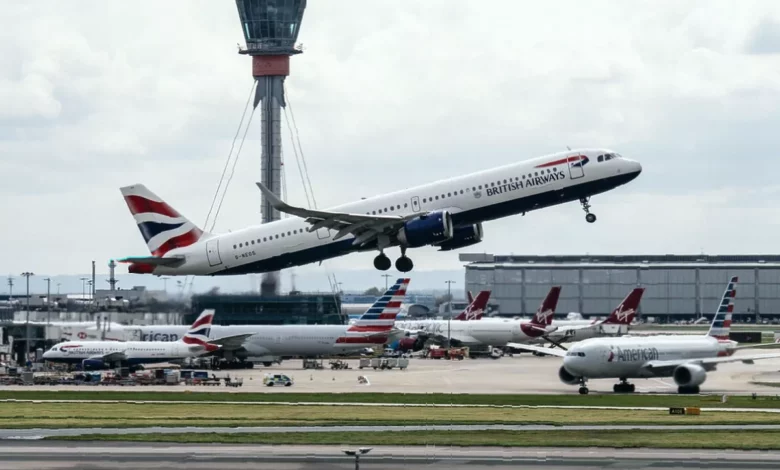
British Airways’ parent company International Airlines Group (IAG) has warned that its full-year profits will be squeezed after it forecast an additional €2 billion (£1.72 billion) in fuel costs for the current year, bringing its total expected fuel bill to around €9 billion (£7.78 billion). The warning, issued alongside a better-than-expected first-quarter performance, sent IAG shares down 4% in early trading on Friday as investors digested the impact of the Iran oil crisis on the aviation industry.
The company’s chief executive, Luis Gallego, said the increase in fuel prices – which already account for roughly a quarter of airline costs – meant that “all airlines need to increase fares in order to mitigate the impact”. He acknowledged that the higher fuel bill would “inevitably lead to lower profit this year than we originally anticipated”, but expressed confidence in IAG’s business model and strategy. Analysts had previously forecast earnings growth of up to 10% for the year, but that projection is now subject to revision.
Financial blow after a strong start to the year
The profit warning comes despite a strong first quarter for IAG. In the three months to the end of March, the group recorded a pre-tax profit of €422 million (£365 million), a 76.6% increase from €239 million (£207 million) a year earlier. Revenue for the period rose nearly 2% to €7.1 billion. Mr Gallego attributed the “strong first quarter” to “continued strong demand for our networks and airline brands”.
Yet the outlook for the remainder of the year has darkened. IAG now expects its full-year fuel cost to reach €9 billion, up from a previous forecast of €7.1 billion. The group said this would weigh on profits and free cash flow. The scale of the increase is underscored by the fact that IAG has hedged approximately 70% of its expected fuel needs for the rest of the year through forward contracts and financial instruments – a strategy that provides some insulation but does not eliminate the impact entirely.
The broader financial toll on the industry is severe. American Airlines said the soaring price of jet fuel would cost it $4 billion this year. Lufthansa has indicated it expects a €1.7 billion fuel bill increase, though it believes robust demand will offset that. Air France-KLM has cut its capacity growth forecast after forecasting a $2.4 billion rise in its fuel bill. Fuel typically constitutes 30-40% of an airline’s operating expenses, making the sector acutely vulnerable to price swings.
How the Iran oil crisis is driving jet fuel prices and supply fears
The root cause of the surge in fuel costs is the ongoing crisis centred on the Strait of Hormuz, a narrow waterway through which a substantial share of the world’s oil and gas passes. Iran continues to exert a stranglehold on tanker traffic in the strait, leading to a sharp rise in global oil prices and mounting anxiety over jet fuel shortages. Global oil prices have hit peaks of $126 a barrel, having stood at $72 just before the conflict began. Jet fuel prices have more than doubled since the start of the crisis.
Jet fuel supply chains are under particular strain because, unlike crude oil, refined jet fuel has a limited shelf life and is often sourced from specific refineries. Europe, which relies heavily on the Persian Gulf for its jet fuel, is especially exposed. According to industry estimates, the continent now holds roughly six weeks’ worth of jet fuel supply. The disruption has laid bare the vulnerabilities of depending on a single chokepoint for a critical input.
IAG’s Luis Gallego acknowledged that less jet fuel is coming from the Middle East, but said there are “other places with record supply” such as the United States. He added that IAG does not believe there will be “any interruption for the summer”, but the broader picture remains precarious. Markets in Asia that previously had weaker fuel supply arrangements are now “building up reserves”, he noted.
The impact on global flight schedules has been tangible. Data from aviation analytics company Cirium shows that 13,005 flights planned for May were cancelled between April 10 and April 21 – equivalent to 1.5% of all planned flights. More broadly, two million airline seats have been cut from schedules across the industry because of soaring jet fuel prices. Airlines are also consolidating flights on popular routes and considering the use of smaller aircraft to manage capacity. In the United States, airfares rose by 14.9% in March compared to the same month a year earlier, reflecting the pressure to pass on higher costs to passengers.
IAG’s mitigation strategies: hedging, redeployment and fare adjustments
IAG has moved on several fronts to limit the damage. The group has hedged about 70% of its anticipated fuel requirements for the remainder of the year, using forward contracts and other financial instruments to cap its exposure to spot prices. This hedge, while not a complete shield, softens the blow from spot-market volatility.
On capacity, IAG has redeployed aircraft from routes heavily exposed to the Gulf region. At the start of the conflict on February 28, roughly 3% of the group’s capacity was tied to the Gulf, mostly through British Airways services. A large part of that capacity has been shifted to destinations where demand has risen, partly because Middle Eastern carriers have scaled back their own flights. IAG has boosted services to Bangkok, Singapore and the Maldives. British Airways has also announced additional flights this summer on routes with higher demand for direct services, such as India – with extra capacity to Bengaluru, Delhi and Hyderabad – and Nairobi, Kenya.
Conversely, British Airways is reducing services on some Middle Eastern routes. From July 1, it will cut flights to Dubai, Doha and Tel Aviv to one daily service. Riyadh will be reduced from two flights a day to one from mid-May, and Jeddah will be dropped as a destination permanently. The airline is also adjusting its summer 2026 schedule with increased flights to Miami and Jamaica, along with changes to services for Costa Rica and Tampa.
Mr Gallego said IAG has been “planning for situations like this for many years” and has invested in its own jet fuel supply infrastructure at its main hubs. He added that the company is “uniquely positioned to navigate the current headwinds created by the Middle East conflict thanks to our leading positions across diverse markets, strong brands, structurally high margins and strong balance sheet, as well as a strong track record of execution”. The group is also proceeding with a €1.5 billion share buyback programme, a sign of confidence in its longer-term health.
Outside IAG, Emirates – a Middle Eastern carrier heavily affected by the disruptions – reported a record pre-tax profit of 24.4 billion dirhams (£4.88 billion) for the year to the end of March, up 7% from the previous 12 months, and described itself as “the world’s most profitable airline”. Aarin Chiekrie, an equity analyst at financial services company Hargreaves Lansdown, described IAG’s results as a “strong showing” and said: “On the whole, IAG remains in good shape. We think it’s much better positioned to navigate the current market challenges better than most of its peers, thanks to its tilt towards more premium passengers.”