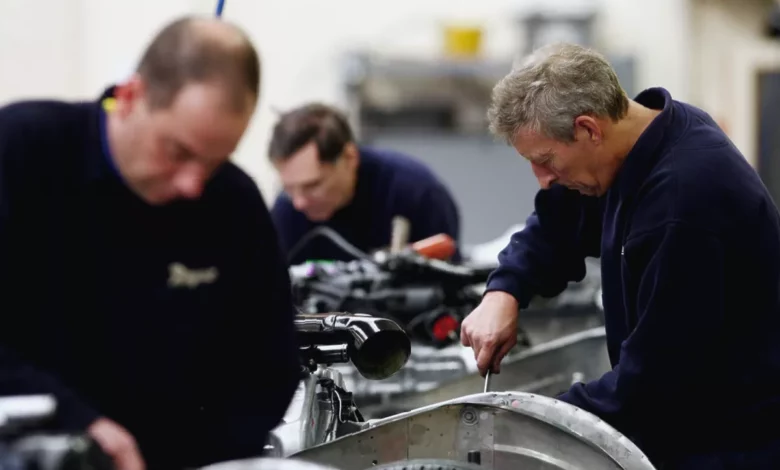
Thousands of UK manufacturers are set to receive substantial cuts to their electricity bills as the government significantly expands its flagship support scheme, a move framed as a direct response to the severe economic pressure caused by the conflict in the Middle East.
Chancellor Rachel Reeves announced the expansion while attending the International Monetary Fund spring meetings in Washington D.C., where she warned that the instability is pushing up energy costs, fuelling inflation, and damaging growth. The IMF has warned the UK faces the sharpest growth downgrade among G7 nations this year, forecasting just 0.8% growth, with the OECD also cutting its forecast to 0.7%.
The government’s intervention centres on the British Industrial Competitiveness Scheme (BICS), a central pillar of its ten-year modern industrial strategy. Originally announced last summer to support over 7,000 businesses, the scheme will now be expanded by 40%, reaching over 10,000 manufacturing firms from April 2027.
How the BICS scheme will cut costs for industry
The core mechanism of BICS is designed to directly tackle a major component of UK industrial electricity costs that puts firms at a competitive disadvantage internationally. From 2027, eligible businesses will be exempted from paying certain indirect policy costs added to electricity bills.
These are the charges that fund the Renewables Obligation (RO) and Feed-in Tariffs (FIT), which support green energy generation, and the Capacity Market (CM), which pays for back-up power supply systems to ensure grid reliability. By removing these costs, the government aims to reduce electricity bills for qualifying firms by up to 25%, equivalent to savings of up to £40 for every megawatt-hour used.
In a significant concession to businesses facing immediate cost pressures, the support will be effectively backdated. The government has stated it will cover the support firms would have received if BICS had been active from April of this year, delivered via an additional one-off payment in 2027. This expansion will bring an extra 3,000 businesses into the scheme, including companies in key sectors such as automotive, aerospace, steel, and pharmaceuticals.
Eligibility is targeted at manufacturing businesses within specific “IS-8” industrial strategy sectors and foundational supply chain industries that meet a threshold for electricity intensity. The government has clarified that businesses cannot receive support through both BICS and the separate British Industry Supercharger scheme, which offers higher discounts for the most energy-intensive industries. A consultation on the final eligibility criteria ran from late November 2025 to January this year.
The scheme, set to run until 2035 with a review in 2030, is expected to be worth up to £600 million per year from April 2027. The Treasury states it will be funded from general taxation and broader energy system reforms, with assurances that the cost will not be passed on to household energy bills or other businesses. Full funding details are to be set out in the Autumn Budget.
The policy comes against a stark backdrop for UK industry. Manufacturers are experiencing the sharpest one-month acceleration in costs since 1992, driven by rising oil prices stemming from Middle East volatility. This impacts fuel, transport, and raw material costs, with consultancies projecting businesses renewing energy contracts could face increases of 10-30% for electricity and 25-80% for gas. The manufacturing sector, which contributed 8.2% of UK GDP in 2022 and employs 2.6 million people, has seen five years of growth but faces pressure from what the Chancellor has termed “global instability”.
Chancellor Rachel Reeves said: “This Government has the right plan for the economy: backing British industry, cutting electricity costs, and building a stronger, more resilient future. Today’s announcement will cut energy bills for over 10,000 manufacturers, helping businesses to compete, win and create good jobs across the country, and to deliver our modern industrial strategy.”
Business Secretary Peter Kyle added: “We are a government of action, and when global instability puts businesses under pressure we’ll always do what’s needed to support them and ensure Britain’s resilience. By extending the reach of BICS by 40%, we’re acting decisively to tackle the number one issue that businesses face head-on.”