The UK economy kicked off the spring with a stronger-than-anticipated performance, as official data showed economic growth accelerated to 0.5% in February, comfortably surpassing forecasts of a 0.1% rise.
The Office for National Statistics reported that growth was driven by broad-based strength, with the services and production sectors both expanding by 0.5% and construction output growing by 1.0%. Furthermore, the estimate for January was revised upwards to show 0.1% growth instead of no growth. The data means the economy expanded by 0.5% in the three months to February, an improvement on the 0.3% growth recorded in the three months to January.
Bank of England’s “Very Difficult” Judgement Call
This positive economic news arrived amid a backdrop of significant uncertainty, placing the Bank of England in a delicate position. Governor Andrew Bailey, speaking at the International Monetary Fund spring meeting in Washington, stated that policymakers would “not rush to judgments” on interest rates in response to the ongoing energy crisis triggered by Middle East tensions.
Mr Bailey described the upcoming interest rate decision on April 30 as “very, very difficult,” citing numerous uncertainties around how the geopolitical situation would play out and pass through into the UK economy. This caution underscores the central bank’s balancing act, as stronger growth data could argue for tighter policy, while the looming shock of higher energy prices threatens to dampen consumer spending and inflation prospects.
Economists echoed this note of caution. Sanjay Raja, chief UK economist at Deutsche Bank, said the February GDP figure “smashed expectations” and suggested the UK entered the energy shock on a stronger footing than many expected. However, he warned the upward momentum was unlikely to last. “Households will have already started to feel the impact of the Iran energy shock, impacting disposable incomes and discretionary spending,” he said, pointing to a 20% rise in pump prices and predicted similar increases in dual fuel bills over the summer.
Markets React to Growth and Geopolitics
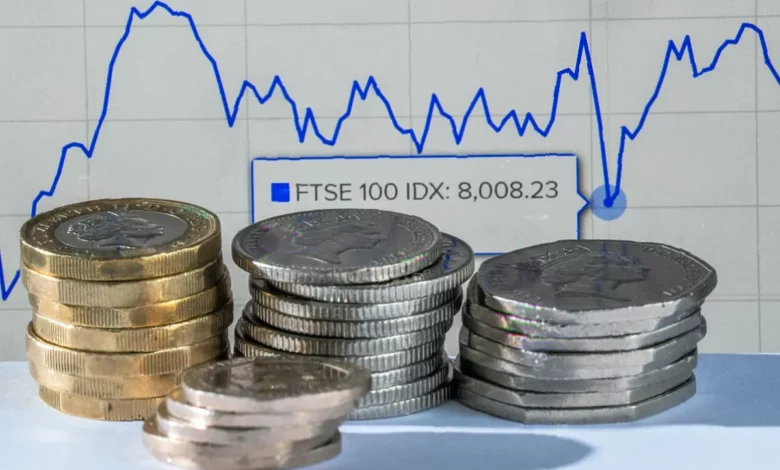
Against this mixed backdrop, UK equity markets advanced. The FTSE 100 rose 0.3% to close at 10,589.99, while the FTSE 250 gained 0.5% to 22,779.50. The performance was buoyed by the robust growth data and a slew of positive corporate updates.
In European equities, the DAX 40 in Frankfurt rose 0.4% while the CAC 40 in Paris ended flat. Across the Atlantic, Wall Street’s S&P 500 and Nasdaq Composite reached fresh record highs, spurred by hopes of a potential breakthrough in US-Iran talks, despite ongoing tensions. Joshua Mahony at Scope Markets noted the rally seemed “somewhat unbelievable” given the significant disruptions and risks, calling it a “very uneven rally indeed.”
The geopolitical crisis continued to ripple through commodity markets. Brent crude oil traded higher at $98.39 a barrel, resuming its upward trajectory. US Defence Secretary Pete Hegseth warned that the US would blockade Iranian ports for “as long as it takes,” threatening renewed strikes on infrastructure if Tehran does not make a deal. “If Iran chooses poorly, then they will have a blockade and bombs dropping,” he stated at a Pentagon news conference.
Corporate Highlights Drive Individual Shares
A number of major companies provided significant updates. Supermarket giant Tesco saw its shares rise 4.7% after reporting annual results that topped forecasts. For the year to February 28, pre-tax profit grew 8.5% to £2.4 billion, while group sales excluding VAT and fuel rose 4.6% to £66.6 billion. The retailer raised its medium-term free cash flow guidance to a range of £1.5 billion to £2.0 billion and announced a £750 million share buyback programme. Chief Executive Ken Murphy highlighted that sustained investment had led to Tesco’s highest UK market share in over a decade.
Assurance firm Intertek was the FTSE 100’s top performer, soaring 9.0%. The company confirmed it had rejected an unsolicited takeover proposal from the EQT X fund at 5,150 pence per share, which would have valued it at approximately £8 billion. Intertek’s board stated the proposal “fundamentally undervalues” the company and its future prospects.
Elsewhere, Ladbrokes owner Entain jumped 6.0% as it backed its annual guidance, reporting strong first-quarter momentum with UK & Ireland online revenue surging 13%. Oil major BP firmed 3.9%, supported by the rising oil price and an upgrade to “buy” from UBS, which cited new management and accelerating deleveraging.
On the FTSE 250, Morgan Sindall leapt 7.5% after raising its 2026 profit outlook for the second time in three months, citing strong trading in its Construction and Fit Out divisions. In a takeover move, Animalcare Group accepted a £235.2 million approach from Charterhouse Capital Partners, sending its shares up 35%.
Not all news was positive. Budget airline easyJet warned of a larger-than-expected first-half loss due to higher fuel costs, sending its shares down 5.0%. The company expects a headline pre-tax loss between £540 million and £560 million for the six months to March.
In currency markets, the pound ebbed to $1.3532 against the dollar and was lower against the euro at €1.1489. The yield on the US 10-year Treasury was unchanged at 4.29%.