Like the rest of the western world, our household is currently binging medical drama The Pitt, revelling in its visceral depiction of life in a modern emergency department. So far the series has yet to inspire a video game tie‑in (though there has been an amusing parody), but fans wishing to try their hand at tense medical (mal)practice should not despair. Hospital games offer tense interactive surgery, not just TV drama. Here are eight of the best, spanning more than 40 years of gruesome interactive operations. Squirt some hand sanitiser and come this way.
From the bloodstream to the morgue: a history of medical gaming
It all began with Microsurgeon (1982, Mattel Intellivision), created by lone developer Rick Levine. The game shrank players down and put them into the bloodstream of a sick patient, where they had to blast diseased cells and unclog arteries. Clearly inspired by the movie Fantastic Voyage, the title features strange, colourful, almost psychedelic depictions of human anatomy. Players controlled a “Robot Probe” to combat ailments such as bacterial infections and tumours, using treatments including ultrasonic rays, antibiotics and aspirin. It was one of the earliest published video games focused on health or health education, and its graphics and unique theme earned it a place in the Smithsonian Institution’s “The Art of Video Games” exhibit. Levine, one of the original programmers at Mattel, also worked on PBA Bowling. Publisher Imagic did not plan to port Microsurgeon to the Atari 2600 – a decision that preserved its quality on the Intellivision. An Atari 2600 copycat, actually entitled Fantastic Voyage, turned up a few months later. Developed by David Lubar for Sirius Software and published by Fox Video Games, it was a vertically scrolling shoot‑’em‑up in which players piloted a miniature submarine through a patient’s bloodstream, shooting bacteria and blood clots while avoiding beneficial cells. Reviews at the time were mixed, with critics finding the gameplay and graphics mediocre, but the patient’s health was directly linked to the player’s success. With its comparatively dull, simple visuals, however, it was dead on arrival.
Life & Death (1988, PC, Mac, Atari ST, Amiga etc.) marked a leap in realism. This point‑and‑click abdominal surgery simulation from The Software Toolworks was groundbreaking for its time. Players had to diagnose a variety of conditions – kidney stones, aortic aneurysm – before ordering tests and scans and finally operating while an ECG display showed your victim’s – sorry, patient’s – heart rate. The game was noted for its educational value, though some critics pointed out its difficulty and gore. The original packaging even included a surgical mask and gloves. Modern critics continue to praise its depth and detail, especially considering it was primarily mouse‑controlled. If you felt it wasn’t challenging enough, the sequel, Life & Death II: The Brain (1990), moved on to neurosurgery.
Moving into the late 1990s, Sanitarium (1998, PC, smartphones from 2015) offered a different kind of medical horror. Developed by DreamForge Entertainment and published by ASC Games, this psychological thriller was a commercial success, selling around 300,000 units. A patient wakes up in a seemingly abandoned sanatorium, his memory gone, his face completely bandaged. While searching the creepy corridors, snippets of his life return in playable hallucinations. The game is lauded for its disturbing atmosphere, intricate plot and surreal environments, blurring the lines between reality and delusion. It was later ported to iOS and Android devices in 2015 and received an award as Adventure Game of the Year.
In 1999 came Emergency Call Ambulance (1999, arcade), a less common Sega arcade game. You’ve no doubt heard of Crazy Taxi, Sega’s hectic arcade game about careering around a city picking up annoying passengers. This stablemate was almost the same, except you’re driving around a city picking up desperately ill passengers and taking them to hospital rather than Pizza Hut. Every time you hit the pavement, or another car, their vital signs fade and eventually collapse, bringing new depth to the phrase “game over”.
If you thought the Nintendo DS was all about cosy puzzle games, Trauma Center: Under the Knife (2005, Nintendo DS) proved you wrong. Developed by veteran publisher Atlus – a subsidiary of Sega known for franchises such as Megami Tensei, Persona and Etrian Odyssey – this fascinating game was part surgery sim, using the handheld’s touchscreen and stylus for realistic operations, and part visual novel as lead character Dr Derek Stiles navigated life in a futuristic hospital. The game spawned a series of decent sequels and a live‑action TV pilot, which tragically was never commissioned.
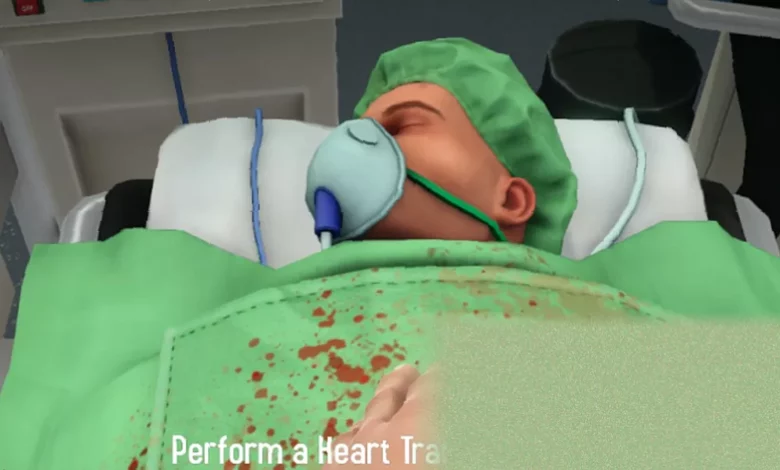
An unexpected smash hit on its release in 2013, Surgeon Simulator (2013, PC, PlayStation, Switch, Xbox) took a very different approach. This ridiculous surgery game has you attempting to operate on a series of patients while being thwarted by intentionally awkward controls and terrible physics. Crack open ribs with a hammer, drop vital organs on the floor, lose your watch in a body cavity – and not a medical malpractice suit in sight.
Management simulation fans were well served by Project Hospital (2018, PC), developed by Oxymoron Games. This incredibly deep, highly authentic offering gets you to run every aspect of medical care, from actually building the hospital to managing staff and caring for individual patients. It features a detailed diagnosis process and over a hundred real‑world‑based medical conditions. The game’s “Doctor Mode” DLC allows you to control individual doctors. You’ll be able to create your own Pitt, then wander about looking concerned while masking an imminent emotional breakdown – just like Dr Robby. Reviews on Steam have been “Very Positive”, with players praising its depth and realism. For those who prefer a lighter touch, there have long been more comedic alternatives such as Bullfrog Productions’ Theme Hospital (1997), known for its satirical ailments like “Bloaty Head” and “King Complex”, and Two Point Studios’ spiritual successor Two Point Hospital (2018), which also received “Very Positive” reviews for its depth, customisation and humour.
More recently, The Mortuary Assistant (2022, PC) gave players the chance to experience life as a young worker in a demonically possessed morgue. DarkStone Digital’s indie title requires players to carry out everyday tasks such as embalming while also conducting occult rituals in order to cleanse the souls of the departed. Dark, dingy and genuinely unsettling at times, it became a bestseller on Steam and received mixed to positive reviews. DarkStone Digital is the solo development studio of Brian Clarke, who also worked on other horror titles including Paranormal Activity: Threshold (cancelled due to licensing issues) and Our Secret Below. The game was adapted into a film earlier this year, which was OK, but not as good as The Autopsy of Jane Doe.