A new animated feature film is bringing the vast, interconnected history of the Silk Road to life for young audiences, aiming not just to educate but to fundamentally reshape how Muslim children see themselves on screen. ‘Time Hoppers: The Silk Road’, which has expanded to nearly 300 cinemas across the UK following a successful nationwide release in the United States, represents a landmark in representation as the first Muslim animated feature to achieve such theatrical reach.
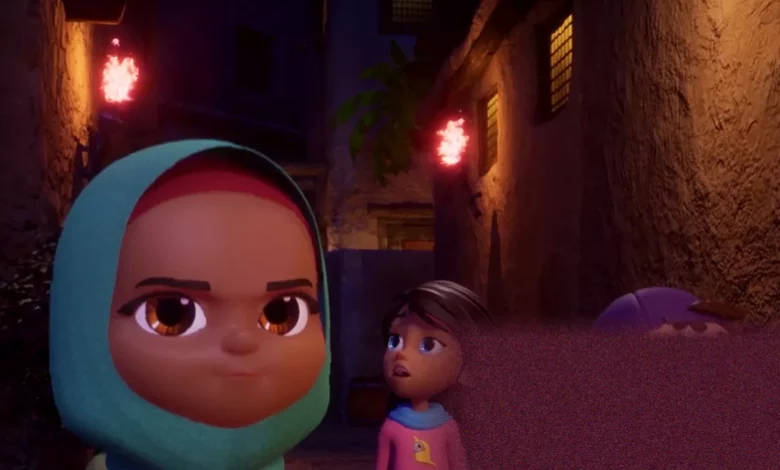
Co-created and directed by Flordeliza Dayrit and her husband Michael Milo, the film follows four gifted children from the futuristic Aqli Academy in 2050—Abdullah, Aysha, Khalid, and Layla. After stumbling upon a time-travel device in a lab, they are catapulted back to the medieval Islamic world, finding themselves in a cat-and-mouse chase with a rogue alchemist named Fasid, who seeks to erase the legacies of great historical scientists. The children’s mission is to retrieve the device and protect history from interference.
An Educational Adventure Through Time
At its heart, the project is a time-travel action-adventure designed to make learning about the era fun. “What we’re trying to do is make learning about that era fun and interesting,” Michael Milo says. The children encounter a roster of influential figures, carefully woven into the narrative. These include the Persian mathematician Al-Khwarizmi, credited as the father of algebra; the pioneering Arab scientist Ibn al-Haytham, whose work on the camera obscura led to the discovery of photography; and the legendary Malian ruler Mansa Musa.
A conscious effort was made to highlight the contributions of women scholars. The film features the 10th-century Syrian instrument-maker Maryam al-Astrulabi, who developed the astrolabe. “We wanted to showcase that it’s not only men that were scholars or scientists – there were also a lot of women who were at the forefront,” Dayrit notes. The production worked with researchers to build detailed period authenticity, from architecture to costume, aiming to introduce a broader cast of historical figures than typically found in school curricula.
A Mission Forged From Personal Experience
The drive behind the film extends far beyond entertainment. Dayrit and Milo, who each independently converted to Islam in 1995 and married the following year, founded the Muslim Kids TV platform nearly two decades ago. It began as a resource for their own children and has since grown into a vast, ad-free streaming service offering over 15,000 educational resources, described as a “Netflix” for Muslim children. ‘Time Hoppers’ itself began as an ebook before evolving into a game, an unreleased TV series, and finally this feature film.
Their work is a direct response to a stark lack of representation. A 2022 study by the USC Annenberg Inclusion Initiative found that Muslim characters are severely underrepresented in popular television, with nearly 90 non-Muslim characters for every one Muslim character, often accompanied by negative stereotyping. Earlier research, from 2007, indicated a significant percentage of British Muslims felt media portrayals were Islamophobic or racist.
“We’ve been making content for kids for close to 20 years,” Milo says. “And we knew that Muslim kids are really underrepresented.” Dayrit elaborates on the psychological impact: “When you’re constantly hearing that, in the news and in everyday life, you start to believe that you don’t belong in these spaces. It’s important for them to know they belong.” For the creators, representation is about “possibility” as much as visibility. “For us, it was really important to have a story where, first and foremost, the kids were the heroes,” Dayrit says.
Proving Commercial Viability and Looking Ahead
The film’s release strategy has proven its point about demand. In the US, it opened in over 680 theatres in February 2026, grossing $1.1 million and ranking number one in per-screen average on its opening day. In the UK, strong audience turnout propelled it from an initial 200 theatres to 299, where it opened to a box office of £219,142. Much of this momentum is attributed to grassroots community engagement. “We have local champions who are getting people excited and spreading the word,” Milo says.
This commercial response is a powerful part of the message. “What we’re showing the film industry is that Muslim stories are not niche. They can be globally relevant and commercially viable,” Dayrit states. The team is already working on a sequel, and the creators harbour a broader ambition for their platform. “We’ve always had the goal of becoming the Disney of the Muslim world,” Dayrit says.
The film has been praised for its positive representation and educational value, though some critical reviews noted that as an indie production, its animation and plot pacing sometimes veered closer to “edutainment” for younger children. Yet its landmark status is clear: a theatrically released animated feature created by and primarily for the Muslim community, aiming to counter negative narratives with a simple, affirming message Dayrit shares with young viewers: “Hands are for helping, words are kind, and ideas are brave.”