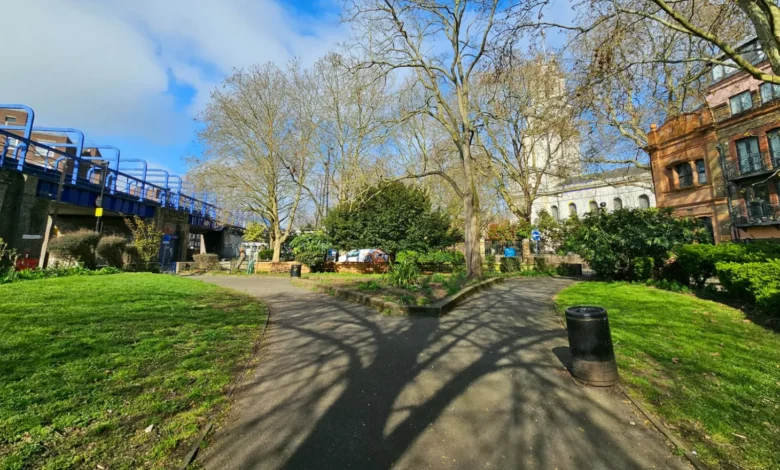
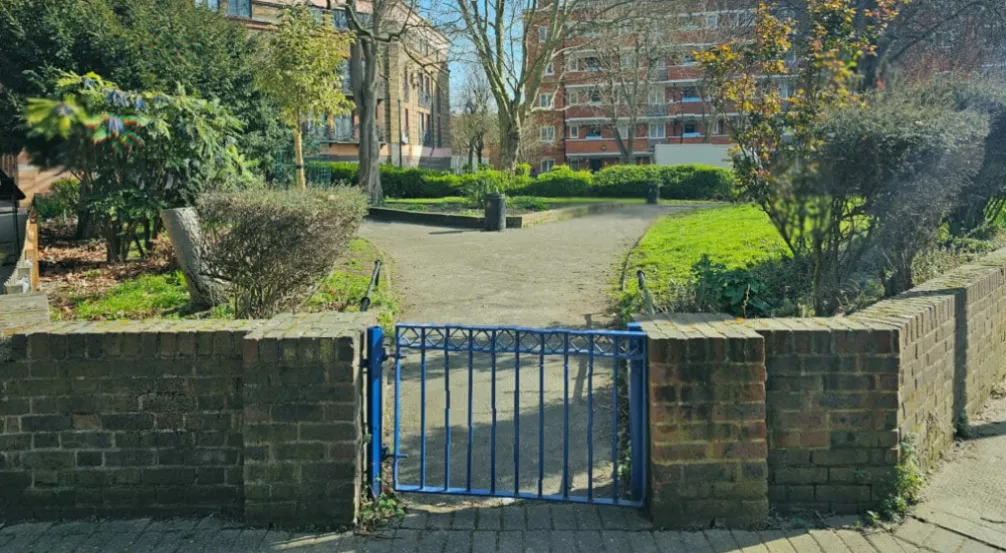
In the early 1980s, as the London Docklands Development Corporation (LDDC) set about regenerating a vast swathe of derelict industrial East London, one of its more modest interventions took shape on Limehouse’s back streets: a three-sided pocket park known today as Bate Street Green. The LDDC, established in 1981 with a remit to transform 22 square kilometres across Tower Hamlets, Newham and Southwark, cleared the site as part of a wider programme to build new housing and create public space. The corporation went on to oversee landmark projects including Canary Wharf, London City Airport and the Docklands Light Railway, but at ground level it also left a legacy of small, carefully designed parks. Bate Street Green, enclosed by a low brick wall and fitted with small blue gates in a colour and style characteristic of early LDDC work, was one of those.
The LDDC was formally wound up on 31 March 1998, having completed a staged withdrawal that began in 1994. Its regeneration of the docklands is widely regarded as a success, credited with bringing jobs and housing to an area that had seen a steep decline in trade from the 1950s onwards. Yet tensions between older and newer residents have persisted, and the pocket park itself now appears to have received little recent attention: it “may need a touch of TLC”, as one observer put it.
Long before the LDDC: Limehouse’s deep history
The land on which Bate Street Green sits has a much longer story. Three Colt Street, which runs alongside the park, first appears in historical records around the 1680s. Within a few decades it was lined with houses, including the spot where the green now lies. The street was recorded as early as 1362 and by 1841 was considered one of Limehouse’s better addresses, a middle-class thoroughfare with thriving businesses, set apart from the poorer districts around it.
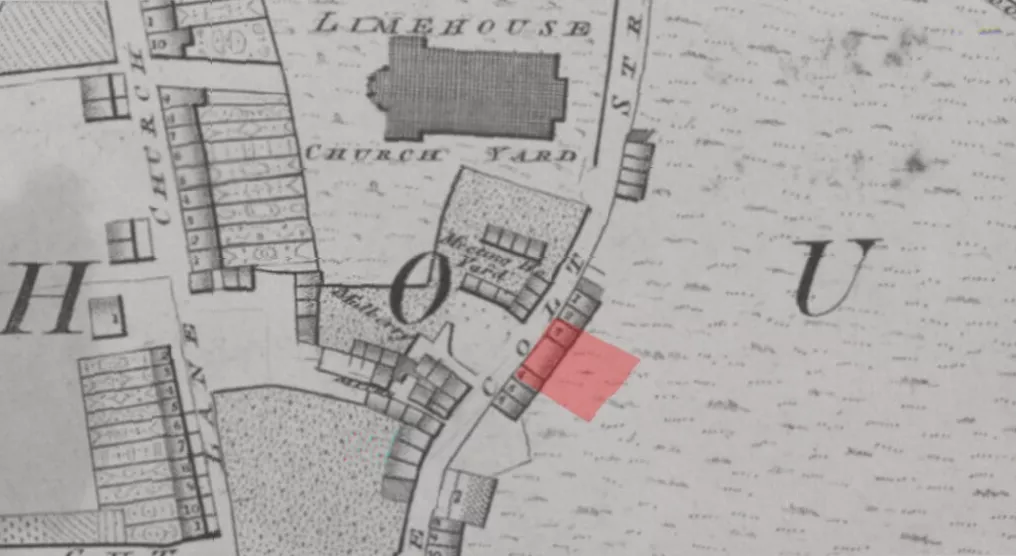
The park’s immediate predecessor was Batson Street, later shortened to Bate Street. The name almost certainly derives from Robert Batson, a significant local landowner who owned a substantial yard in Limehouse Hole, involved in shipbuilding and timber importation for warships and East Indiamen. The alignment of the modern park mirrors the old street pattern, with the triangular plot shaped by the junction of Three Colt Street and Bate Street.
Limehouse’s maritime and industrial heritage runs deep. The area’s name comes from the lime kilns that operated there, with early references dating back to 1335. The port origins go back to 1348, and by the early 1600s a large part of the population worked in nautical trades. Dominating the northern end of Three Colt Street is St Anne’s Church, a Grade I listed Anglican church designed by Nicholas Hawksmoor and consecrated in 1730. Its tower, capped with a golden ball, served as a navigational aid for ships on the Thames, and the church was granted the privilege of flying the White Ensign of the Royal Navy. The churchyard features a mysterious “Wisdom of Solomon Pyramid”, and the church has been referenced in works by Peter Ackroyd and Charles Dickens (who set part of Our Mutual Friend in the area). St Anne’s crypt was used as a bomb shelter during the Blitz, and a major restoration was completed between 2007 and 2009.
Railways, industry and wartime damage
In 1840 the London and Blackwall Railway opened, one of the capital’s earliest railways and the first to enter the City of London. It initially operated with cable haulage. The original Limehouse station, opened on 6 July 1840 as “Stepney”, stood at the junction of Bate Street and Three Colt Street – right next to what is now the pocket park. Passenger services were withdrawn on 3 May 1926, exactly a century after the station’s opening, though freight continued until the 1960s. The ground-floor ticket hall entrance under the arches still survives, incorporated into the viaduct that was later reused for the City branch of the Docklands Light Railway. The current Limehouse station, serving both DLR and National Rail, opened in 1987.
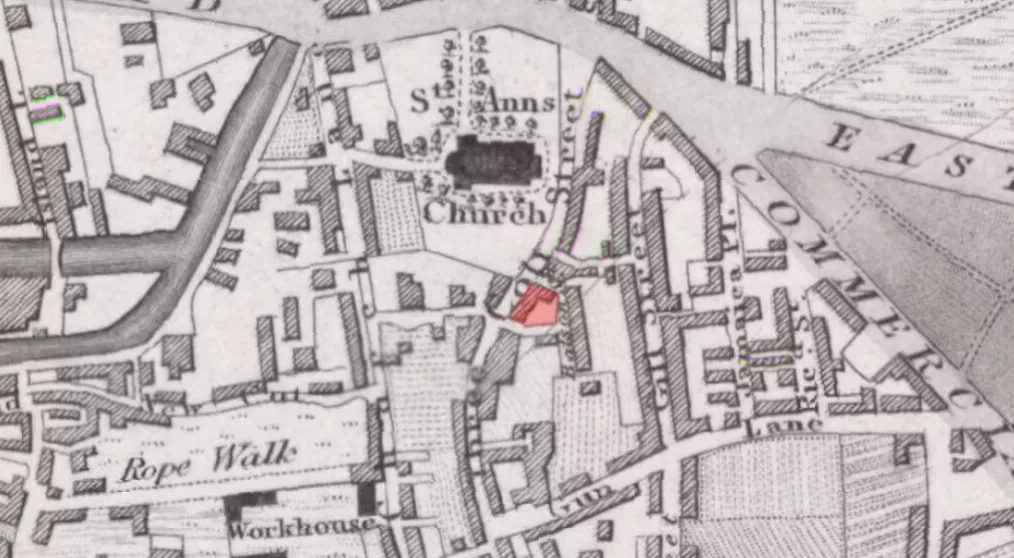
Behind the houses on Three Colt Street, a large building was constructed and marked as the “engine house”, though its purpose is unclear. It does not appear to have been in use for long: an auction notice from 1870 offered it for sale with an engineering workshop as tenant. It was still in use in the 1970s. Next door stood a small block, possibly a former corner shop, which in 1965 was occupied by W.H. De Ritter and Co., Machinists and Plant Engineers, at 43 Three Colt Street. That address is now covered by Joseph Irwin House, a block of flats, and the historic building no longer exists.
Limehouse suffered badly during the Second World War. The London County Council produced detailed bomb damage maps, colour-coding areas according to severity, with black indicating total destruction. The northern corner of the Bate Street plot took a direct hit. After the war the northeastern corner was cleared, but the rest of the houses were left intact and probably repaired. A V-2 rocket struck Chinatown, Limehouse, in March 1945. St Anne’s Church survived with minimal structural damage, though bomb blasts affected its stained-glass windows.
The park today
Bate Street Green is now a modest, three-sided pocket park surrounded by a low brick wall with small blue gates. At its centre is a triangular space with a tall tree and some bedding plants, flanked by open lawns on two other sides. More trees line the edges, with additional bedding along the Three Colt Street boundary. The design feels like a disconnected extension of the nearby churchyard, and the overall condition suggests it could benefit from maintenance.
In the post-war period the site remained largely untouched until the LDDC’s clearance in the early 1980s created the park for the new housing being built in the area. Three Colt Street still exists, but its buildings are vastly different from the rows of houses that once stood there. The park, quiet and unassuming, is a small remnant of a regeneration effort that reshaped an entire corner of the capital. Its blue gates, now a little faded, remain as quiet markers of that transformative era.