Harmondsworth Great Barn celebrates its 600th anniversary this year, and the public can still step inside this medieval masterpiece for free on selected days. Tucked away at the end of a narrow lane near Heathrow Airport, the barn is now open to visitors twice a month between April and October, offering a rare chance to stand inside the largest surviving timber-framed building in England.
The barn’s medieval origins
The story of the barn begins not with its construction but with the Norman Conquest. In 1066, William the Conqueror seized the estates of King Harold Godwinson, including the manor of Harmondsworth, which he granted to his ally William FitzOsbern. The land later passed to the Abbey of Rouen before being acquired in 1391 by William of Wykeham, Bishop of Winchester, who endowed it to Winchester College, the school he had founded. The college needed a barn to store grain from its demesne lands – approximately 240 acres of wheat, barley and oats – and so, between 1426 and 1427, paid two men, William Kypping (or Kipping) and John atte Oke, an estimated £50 to £100 to build one. Dendrochronological analysis confirms that the timbers were felled in the winter of 1424–25 and the spring of 1426, with the frame likely prefabricated that year and erected the following spring or summer.
For more than five centuries the barn served its original purpose, storing cereal crops and providing a vast, dry space where sheaves could be threshed during the winter months. It remained in agricultural use until the 1970s.
A cathedral of timber
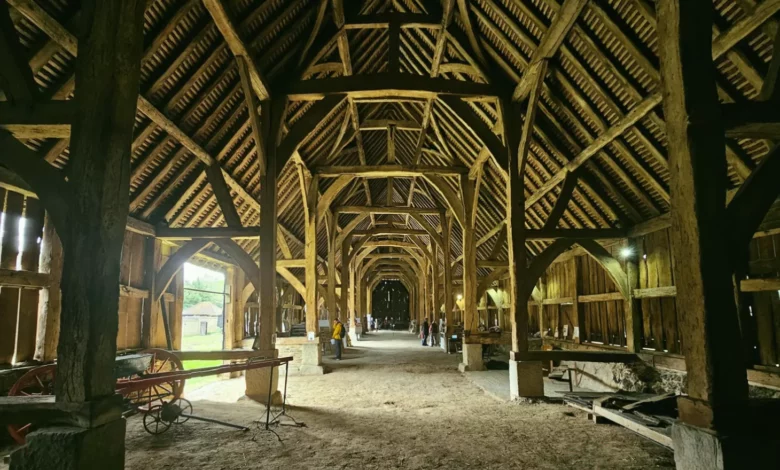
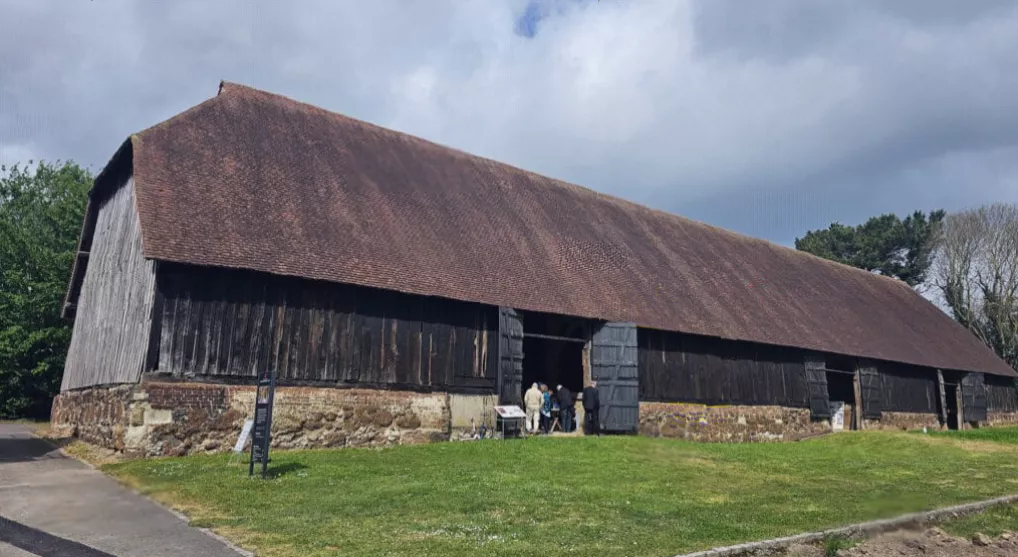
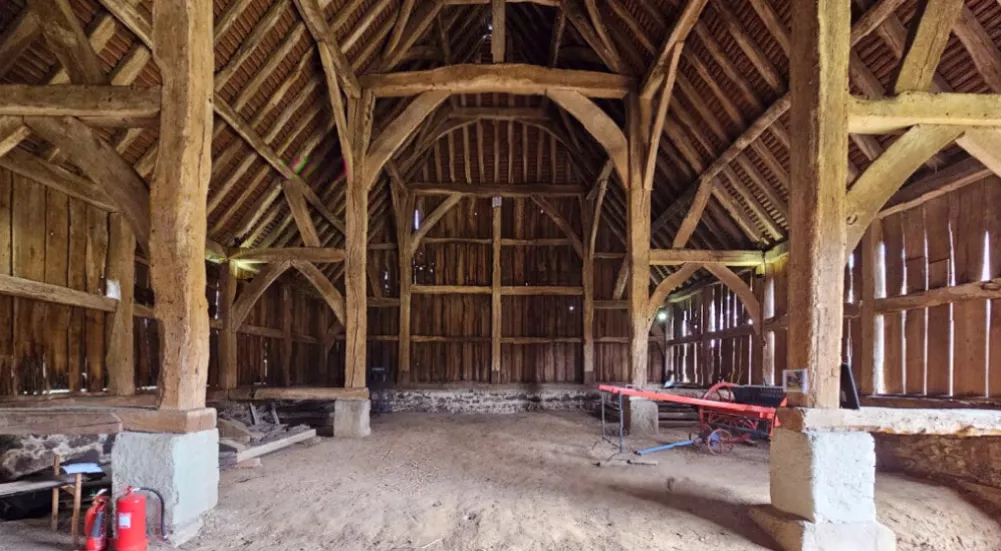
What strikes every visitor today is the sheer scale of the wooden structure. The barn measures approximately 58 to 60 metres (192 ft) in length, 11.4 metres (37 ft 6 in) across, and 11 to 12 metres (39 ft) high, with twelve bays supported by thirteen massive oak trusses. English Heritage describes it as “a supreme example of late-medieval craftsmanship – a masterpiece of carpentry containing one of the best and most intact interiors of its age and type in all of Europe.” The interior is arranged like a church: a central nave with lower aisles on either side, a shape that prompted the poet and conservationist Sir John Betjeman to call it “the Cathedral of Middlesex.”
Remarkably, around 95 percent of the original timbers survive, including the external weatherboarding. The walls rest on a low masonry sill-wall made of ferricrete – a local iron-oxide cemented gravel – and Reigate stone, while the roof was originally covered with clay tiles. The carpentry itself is notable for unusual features: the purlins of the nave are fixed to the main rafters, and a crown-strut sits between the collar and the tie-beam, a design described as “experimental, precocious and regionally unusual.” Scattered across the timber are apotropaic marks – symbols carved to ward off evil.
So impressive was the barn that the architect Sir George Gilbert Scott visited in 1850 and sketched it, reportedly using its design as inspiration for his proposals for ChristChurch Cathedral in New Zealand.
The barn’s survival has not been straightforward. After agricultural use ceased in the 1970s, a fire in 1972 destroyed the south elevation, though the oak frame remained largely intact. The building then entered a period of neglect. In the 2000s it was owned by a property development company and later by speculators who, according to reports, bet on its compensation value should Heathrow Airport be expanded; the barn was closed to the public for all but one day a year and fell into disrepair. English Heritage stepped in, using a legal procedure to carry out emergency repairs – including to the roof, costing around £30,000 – without the owner’s consent. In January 2012 the organisation purchased the barn outright. A meticulous two-year conservation and re-roofing programme followed between 2014 and 2015, costing more than £570,000. Owlsworth Conservation led the work, stripping and re-tiling the roof and conserving the external oak boarding. The scale and complexity of the timber repairs earned the project a nomination for the Wood Awards.
Visiting the Great Barn
Today the barn is managed by volunteers from the Friends of the Great Barn at Harmondsworth, acting on behalf of English Heritage. It opens on the second and fourth Sundays of each month from April to October, from 11am to 4pm, and is free to enter. In its 600th anniversary year, the 2026 open days are: Sun 10th May, Sun 24th May, Sun 14th Jun, Thu 18th Jun, Sun 12th Jul, Sun 26th Jul, Sun 9th Aug, Sun 23rd Aug, Sun 13th Sep, Sun 27th Sep, and Sun 25th Oct. The barn is also open for Heritage Open Days and London Open House, and can be opened by special arrangement for educational and other groups. It is accessible for wheelchair users, though there are no on-site facilities – public toilets are available in the nearby church hall.
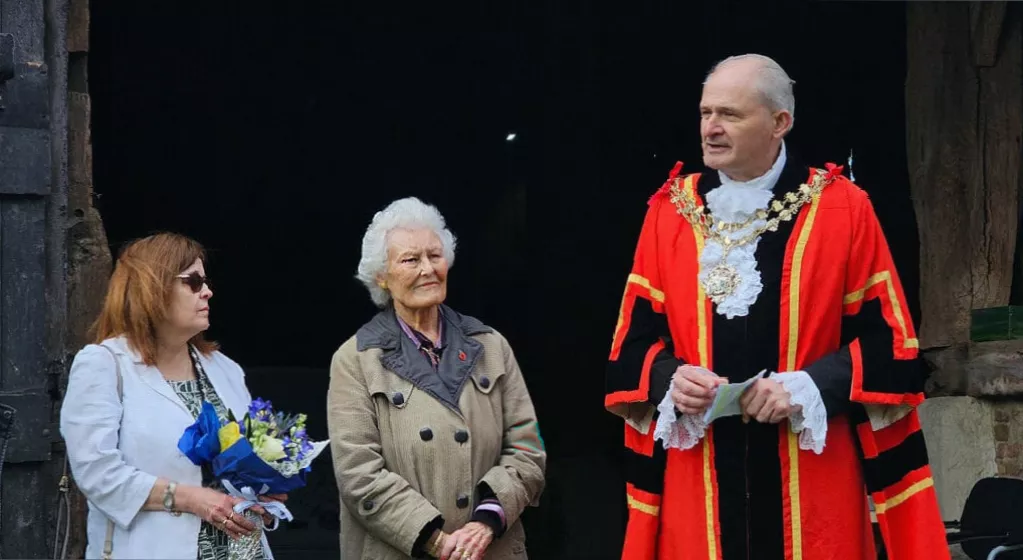
Inside, simple displays dotted around the building tell the story of the area’s agricultural history, the efforts made to preserve the barn during its neglected years, and the wider estate that surrounded it. Scale models of the original buildings – and some that still stand – help bring the past to life; a model of the barn itself has recently been conserved. Visitors are also advised to notice the warning sign about washing hands in the farmyard diorama. At the first open day of 2026, the Mayor of Hillingdon, Cllr Philip Corthorne, was on hand to welcome visitors and, recalling that hazelnuts were once farmed in the area, planted a hazelnut tree near the barn.
The barn’s setting is an ancient one. Harmondsworth village is recorded in the Domesday Book as “Hermodsworde” and has evidence of Iron Age huts and a Saxon settlement. But the landscape has been profoundly altered by Heathrow Airport, which after 1946 led to the demolition of the hamlets of Heathrow and Perry Oaks; more than half of the original parish is now occupied by the airport. The Great Barn itself is expected to remain standing even if a third runway is built, though its setting could be degraded by further expansion.
Getting there is straightforward. The 350 bus runs between Heathrow Terminal 5 and West Drayton stations, and the U3 bus runs between Heathrow Central and West Drayton; buses run roughly every 20 minutes and take about six minutes from West Drayton. It is also a 30-minute walk from West Drayton station. A free English Heritage car park is located to the rear of the barn. When in Harmondsworth village, head to the Five Bells pub; the barn is at the end of the lane.