The Church of Our Lady of the Assumption, a commanding brick structure on a Bethnal Green corner, owes its existence to a hard-fought victory over sectarian opposition in the early 1900s, its history reflecting the area’s complex social and religious evolution.
Cardinal Francis Bourne, the Archbishop of Westminster known for his assertive leadership and elevated to Cardinal in 1911, opened the church on 22 June 1912. Its total cost was £8,700, financed jointly by the Augustinians of the Assumption and the benefactor Florence Cottrell Dormer, in memory of her husband, Clement.
A Contested Foundation
The Augustinians of the Assumption, a French Catholic order founded in 1845, were invited to the UK in 1901 after their expulsion from France. They established their first mission in Bethnal Green that year, initially celebrating Mass in humble temporary premises, including a corner shop with a disused stable serving as a presbytery and church.
Their plans for a permanent church faced immediate legal challenge from the Protestant Alliance, a vehemently anti-Catholic group founded around 1845 by the 7th Earl of Shaftesbury. The Alliance cited old laws banning Catholic religious communities, court records show. After initially losing on a technicality for petitioning the wrong court, the Alliance properly pursued the case, but a magistrate ruled against them, finding that as other Jesuit ministries in England were legal, the Assumptionists could be too.
Building on Historic Ground
The church sits on the corner of what was originally called Jews Walk in the late 1700s, later renamed North Side, adjacent to Victoria Park Square, which was laid out as a park in 1830. The site was previously occupied by large houses, with the area having rapidly filled with smaller houses and shopfronts. A large Congregational Chapel built nearby, capable of holding 2,000 people and later a Mission Hall for 500, was not taken over; instead, housing was cleared for the new church, and a priory was built on the Mission Hall site a year later.
With their legal position secure, the Assumptionists commissioned architect Edward Goldie, son of the noted ecclesiastical architect George Goldie. Edward Goldie, known for his Gothic Revival work on Roman Catholic churches such as St. Paul the Apostle in Wood Green, designed a “plain but powerful” Gothic structure. Construction by Messrs Goddard & Sons of Farnham & Dorking began in 1911.
Architectural Contrast and Interior Symbolism
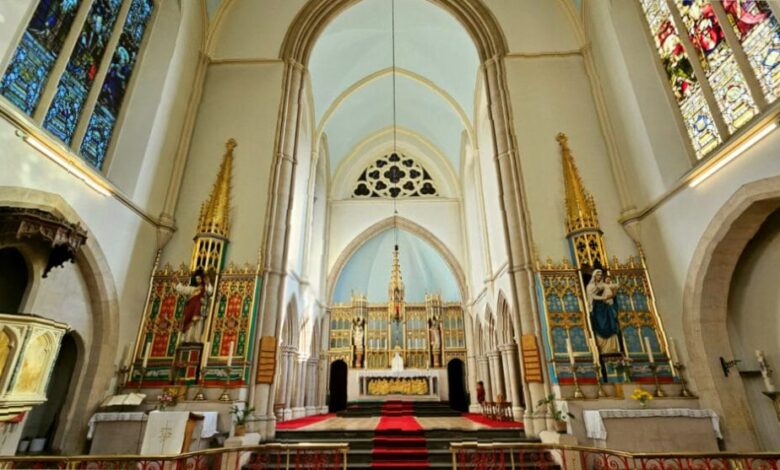
The church presents a solid, forbidding brick facade to the main road, with the main entrance around the side. Inside, however, the space is lofty and bright, with light flooding from high windows that are only partially stained glass, likely due to funding limits. The interior features confessionals, Stations of the Cross, and a shrine to Our Lady of the Rosary with a carved and painted Gothic reredos.
The arts-and-crafts-style pews have carved clover designs along the edges, a nod to the significant Irish population in the area when the church opened. A disused holy water stoup at the north of the church bears a tablet to the memory of Florence M. and Clement A. Cottrell Dormer.
Context and Consecration
Bethnal Green’s history provided a backdrop of religious and economic change. In the 17th century, it became a centre for French Protestant Huguenot weavers, but by the 19th century, the decline of the silk trade led to widespread poverty and overcrowding, making it one of London’s poorest districts. This context of prior Protestant settlement and economic hardship fuelled the sectarian tensions, rooted in the English Reformation and resistance to the 1829 Catholic Emancipation Act.
The church was not formally consecrated until 1962. A First World War memorial, a large crucifix with a marble tablet, stands beside the southwest entrance. Today, visitors exiting encounter a modern practical feature: a gift shop.
The Augustinians of the Assumption, whose global work includes education and publishing, have since established other UK foundations from this Bethnal Green mission, their enduring presence marked in a building born from controversy and designed for light.