On February 27, 2026, a new chapter in Cornwall’s centuries-old story of resource extraction began, not with pickaxes but with turbines and filtration units, as the United Downs deep geothermal plant near Redruth commenced operations. Inside a compact, 0.6-hectare site stands a modern facility that harnesses the earth’s heat for power and lithium, while outside, the hulking stone engine houses of the region’s tin and copper mining past stand as silent sentinels to this technological evolution.
Operated by Geothermal Engineering Ltd (GEL), a company established in 2008 after nearly two decades of development, this is the first plant in Britain to simultaneously generate zero-carbon electricity and extract battery-grade lithium carbonate from geothermal fluid. “To finally reach this point is exciting – and a bit of a relief,” said GEL’s chief executive, Ryan Law, marking the culmination of a £50 million project.
Engineering Depth and Dual Purpose
The facility’s prowess lies far beneath the surface. It draws naturally heated water exceeding 190°C – the hottest recorded in the UK – from the Porthtowan Fault Zone via the deepest well ever drilled on UK soil, plunging more than five kilometres. This geological fault zone is known to persist over a significant strike length, underpinning its reliability as a reservoir. The hot water is pumped up a production well; the steam drives a turbine in an Organic Rankine Cycle (ORC) system supplied by Italian partner Exergy International, generating a consistent 3 MWe of baseload power. Octopus Energy has a long-term agreement to purchase this output, enough renewable electricity for approximately 10,000 homes.
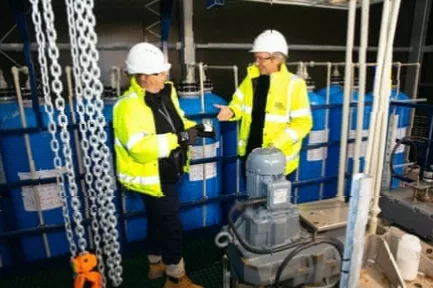
Once the heat is used, the water cools to an ideal 50°C, unlocking its second value. The geothermal fluid contains over 340 parts per million of lithium carbonate equivalent, described as one of the highest concentrations found globally in such wells. Charlotte Wilkins, in charge of the lithium plant, proudly showed off the result: tiny, needle-shaped crystals. “I can tell just by looking at them they are perfect,” she said. After extraction, the water is re-injected into the fault through a second, shallower well, creating a closed-loop system that sustainably recharges the hot reservoir.
Economic Injection and Local Pride
The project has already created around 100 jobs for engineers, geologists, and chemists, with GEL prioritising local recruitment and sourcing of materials. This provides a welcome boost for Cornwall, an area MP Perran Moon describes as “one of the most deprived regions in northern Europe.” The venture resonates deeply locally, connecting to a heritage where mining, as Moon said, “isn’t what we do, it’s who we are.” The site lies near an area once nicknamed “the richest square mile on Earth” for its mineral wealth. Greg Foxwell of Gwennap parish council noted the company had “gone out of its way to recruit some local people and do very good work with the local colleges and schools.”
Navigating Concerns and Scaling Ambition
Some concerns have been raised about induced seismicity. GEL acknowledges that developing geothermal reservoirs may cause minor seismicity but employs a management protocol based on conservative ground vibration limits. This builds on experience from earlier Cornish geothermal experiments in the 1980s, which recorded numerous microseismic events, only two of which were felt at the surface without causing harm. The process is designed for minimal environmental impact, with contained above-ground units.
The plant initially has capacity to produce 100 tonnes of lithium carbonate per annum, enough for about 2,500 electric car batteries. GEL aims to scale production to over 18,000 tonnes within a decade, potentially supplying around 250,000 electric vehicles yearly. This ambition aligns with soaring global demand, as the lithium carbonate market is projected for substantial growth driven by electric vehicles and energy storage.
Strategic Backing and National Potential
The project has been bolstered by significant investment, including £15 million from Kerogen Capital and Thrive Renewables PLC in March 2023, alongside earlier funding from Thrive and the European Regional Development Fund. In a landmark for the sector, GEL was awarded UK government Contracts for Difference (CfD) for three projects in September 2023, the first time CfDs have been allocated to geothermal energy. Chancellor Rachel Reeves hailed the United Downs plant as a “pioneering project,” stating Cornwall could become “a vital player” in Britain’s energy security.
This initiative is seen as emblematic of a broader governmental shift towards ‘securonomics’, aiming for greater sovereign capability in critical inputs like minerals and energy, as noted by Harry Pitts of the University of Exeter. The British Geological Survey estimates that onshore geothermal sources in the UK could yield over 200 GW of thermal heat – equivalent to more than 100 nuclear power stations. GEL is already planning expansion, with two other deep geothermal sites under development in Cornwall targeting an additional 10 MW of baseload power by 2030.
The venture also echoes history: lithium was first identified in Cornwall in 1864, within hot fluid from a tin mine. Professor Frances Wall of the Camborne School of Mines called the launch a “really significant event,” underscoring how Cornwall’s geological wealth, once the foundation of its industrial past, is now pivotal for the UK’s sustainable and secure energy future.