A crucial missing link in London’s transport network has moved closer to reality with the securing of £6.65 million to advance plans for the West London Orbital railway, a proposed new line set to join the London Overground network.
The funding, agreed between Transport for London (TfL), the London boroughs of Barnet, Brent, Ealing, and Hounslow, and the Old Oak and Park Royal Development Corporation (OPDC), will fuel the next phase of development work. This includes detailed design of stations and infrastructure, operational modelling, and preparation for a public consultation anticipated in summer 2026.
Unlocking West London’s Potential
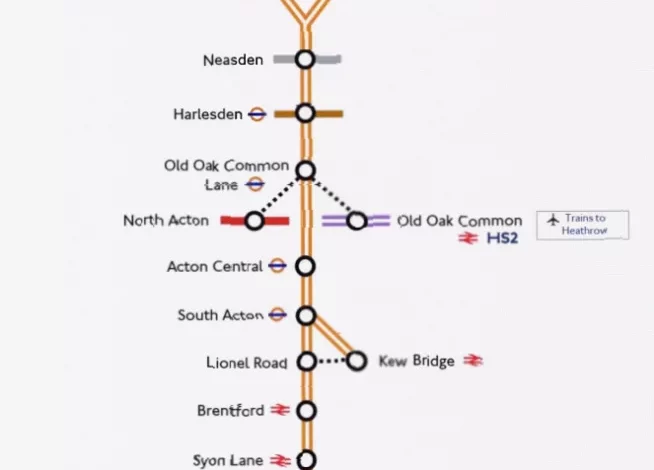
The West London Orbital (WLO) aims to transform connectivity by creating a north-south orbital link across a region with a £70 billion economy. It would utilise existing, underused rail lines—including the freight-only Dudding Hill Line, which has not carried regular passenger services for over a century—to run approximately 11 miles from Hendon to Hounslow, with potential extensions to West Hampstead.
Plans currently feature four new stations at Old Oak Common Lane, Neasden, Harlesden, and Lionel Road, with upgrades to existing stations along the route. The service could operate up to six trains per hour, creating ten new interchanges with other rail and Underground services. A key connection will be to the future Old Oak Common transport hub, linking the WLO with HS2 and the Elizabeth line.
Mayor of London Sadiq Khan, a key proponent, said: “I’m pleased and proud to bring partners together so we can deliver the missing link in public transport for the north and northwest part of the capital. Adding a new line to our fantastic London Overground network will help drive regeneration and economic growth not only along the new route but across our great city.”
Substantial Benefits and Regeneration Drive
Project backers say the railway could support the construction of more than 25,000 homes and create 11,500 jobs, with other assessments suggesting figures of 10,000-plus or 15,800 homes. Wider economic benefits are estimated at £474 million, a revision from earlier projections of £300 million in its first decade.
The line is integral to large-scale regeneration, particularly around Old Oak Common where the OPDC—established in 2015 to oversee the area’s development—anticipates 22,000 new homes and 19,000 jobs. Improved connectivity would enable an estimated 450,000 more people to reach Old Oak Common within an hour, cutting journey times by up to 42 minutes and providing better access to employment, education, and leisure for areas with high deprivation. Unemployment levels in the host boroughs are currently above the London and England averages.
Environmental gains are also central, with the shift from car travel expected to reduce car trips by an estimated 650,000 per year, lowering carbon emissions and improving air quality. Electric or battery-powered trains are being considered for the route.
Funding Path and Operational Hurdles
The newly announced £6.65 million includes £400,000 previously committed from the Mayor of London’s 2026/27 budget, with TfL providing half the total across the 2025/26 to 2027/28 financial years and contributions from Brent Council. However, the overall project cost is substantial, estimated between £430 million and £610 million, requiring future investment from local sources, national government, TfL, and the Greater London Authority.
Significant challenges remain. A primary concern is balancing new passenger services with existing freight operations on shared lines like the Dudding Hill Line, with rail freight operators worried about capacity and potential displacement. Detailed environmental impact assessments are yet to be undertaken, and operating a mixed-traffic railway presents timetable complexities. The route follows a portion of the former Super Outer Circle operated from 1878 to 1880, echoing previous orbital proposals such as Orbirail and the R25.
The Road Ahead
The development funding will allow TfL, the boroughs, OPDC, and Network Rail to refine the scheme. Work will involve finalising preferred options for stations, junctions, signalling, and power supply; modelling how the service integrates with existing rail traffic; assessing environmental impacts; and updating demand forecasts.
Following the 2026 consultation and further design, a decision on seeking statutory approval via a Transport and Works Act Order is expected in late 2027. If approved, construction could potentially begin as early as 2027, with services starting in the early to mid-2030s. The line would eventually be named to reflect the communities and heritage along its route, supported by the West London Alliance of boroughs and the local business community.