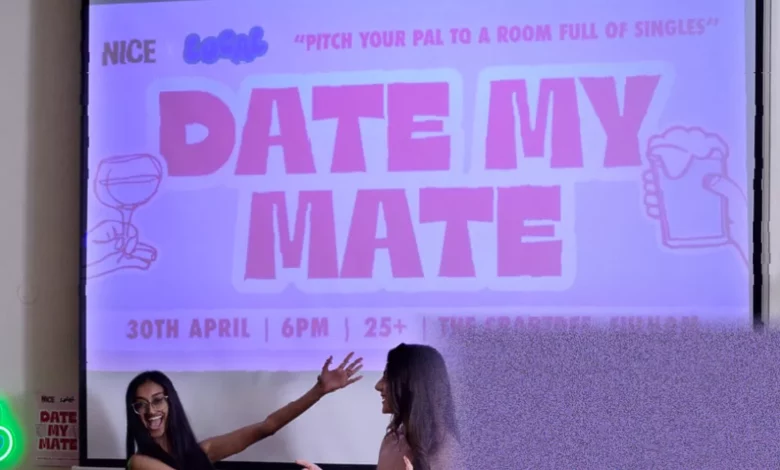
Young singles across England and Wales are taking a punt on a novel matchmaking ritual: standing in front of a room of strangers and letting their friends do the talking. At “Date My Mate” events, participants ditch the dating apps and instead rely on a mate to pitch them to the crowd with a projected slide show, complete with red flags, green flags, and the occasional embarrassing tweet from 2018.
The concept began as a one-off for Valentine’s Day earlier this year and sold out in less than 48 hours. Its host, Emily Churchill, quickly turned it into a recurring series. Now tickets sell out within five minutes. “We’ve hit a cultural nerve,” Churchill said. “Single people are sick of swiping, they want real human connection.”
How the night unfolds
Attendees receive a free drink token and a sticker that brands them as a “date” or a “mate”. The mates are given a loosely enforced three-minute time slot to hype their single friend using a presentation projected on a screen. The presentations resemble online profiles, listing height, profession, and the now-familiar “red flags” and “green flags”.
The format deliberately avoids the intensity of traditional speed dating. “The dating event structure of going to speed dating is just so intense,” said Sophie Lord, who hosts an LGBTQIA+ Date My Mate event in Cardiff. “It’s really fun to go to regardless of whether you meet someone, instead of feeling like you’re in an interview with people.”
At a recent event in Fulham, the gender ratio was evenly split, but Churchill said more single women typically sign up than men. To balance the numbers, tickets are set aside for male applications, and organisers sometimes scout men in person – one pitcher was approached at a pub where he works. James Tyler, who runs the event alongside Churchill, suspects men are more reluctant to come, particularly because the pitch puts the onus on a friend to paint them in a good light. “The men’s ones are more like best man’s speeches, which are basically 90% ripping into them and then 10% ‘but actually he’s a really good man,’” Tyler said.
Why young people are abandoning dating apps
The rise of Date My Mate events comes as the online dating industry faces a significant user exodus. According to a 2024 report by Ofcom, the number of adults using the top ten most popular dating apps declined by 16% between 2023 and 2024. Tinder alone lost more than 500,000 users in the UK over that period, and Bumble and Hinge also recorded notable drops. The decline is most pronounced among Gen Z, who are reportedly finding the novelty of the apps wearing off.
Participants at the Fulham event point to “dating app fatigue” as a driving force. Bruna Dalla-Vecchia, 26, who wore a “date” sticker, said she is fed up. “It’s the saturation of the market,” she explained. “There’s far too many people, there’s the illusion of choice. They get you to go and pay your premium memberships and you don’t really make any meaningful connections.”
Research suggests the problem runs deeper than mere dissatisfaction. Dating apps are designed to be addictive, employing features that trigger dopamine releases in a pattern similar to slot machines. This “intermittent reinforcement” can create a compulsive loop that keeps users swiping for validation. The constant availability of options also leads to what psychologists call the “paradox of choice” — too many potential partners increase decision fatigue, regret, and analysis paralysis, making genuine connection harder rather than easier.
The mental health toll is mounting. A study by the University of Brighton found clear links between ghosting and gaslighting – both common on dating apps – and poor mental health outcomes including depression and paranoia, with young adults particularly at risk. Ghosting, in particular, can lead to confusion, rumination, and a diminished sense of self-worth. Some experts now describe a broader “relationship recession” among young adults, characterised by a decline in dating activity and a struggle to form intimate relationships. Factors include financial insecurity, lack of confidence in dating skills, and a general sense of vulnerability fuelled by mental health challenges and a precarious socio-economic climate.
Dalla-Vecchia said she is usually “far too shy” to approach anyone in person, adding: “You never know if they’re taken or not. This is a good way of being a bit playful about it and taking the stress out of it.”
Participant experiences: humiliation, hope and a few phone numbers
Some presentations veer into what organisers acknowledge can be humiliation rituals. Will Palumbo, 28, came to the Fulham event as a single spectator but was surprised when his mate Will Ainsley, 27, dragged him to the front for a pitch. The slide show included Palumbo’s embarrassing tweets from 2018 and a video from his mother, who described him as “kind, funny and fiercely loyal, much like a human labrador”. Ainsley smiled: “I hope my efforts at presenting have sold Will quite well.”
By the end of the night, wine glasses were empty and phone numbers had been exchanged. Tom Schilling, 26, successfully pitched his friend and met a couple of potential matches himself. “My friend is currently outside chatting to a guy who came up after my presentation asking for her number and he is exactly her type,” he said. “When it comes to their wedding, I will replay the presentation. And I look forward to my two dates in the near future.”
Not everyone left with a match. Dalla-Vecchia said she was still hopeful: “We’re still young. And things like this are popping up all over the place. It’s a fun and natural way of meeting someone rather than looking through a couple of very selected photos through a screen.”
Churchill has already set her sights on expanding the concept to other demographics. “We’ve got plans to do ‘Pitch Your Parent’, where we’re going to get kids of single adults to pitch their parent to a room full of over-45s,” she said.