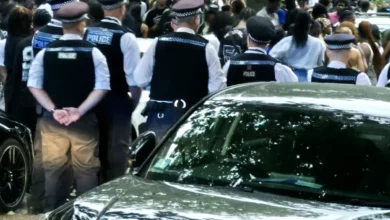
More than a thousand Metropolitan Police officers were deployed across central London on Sunday as a heavily restricted Al-Quds Day demonstration and a counter-protest took place under the shadow of an unprecedented government ban. The event, which saw twelve arrests, was dominated by controversy over chants and the significant police operation to keep rival groups apart.
Home Secretary Shabana Mahmood had granted a police request to ban the traditional march, the first such prohibition in London since 2012. The Metropolitan Police stated the ban was necessary to prevent “serious public disorder,” citing the scale of the protest, planned counter-demonstrations, and the heightened tensions of the ongoing conflict in the Middle East.
While the march itself was outlawed, a “static protest” was permitted under strict conditions. The Islamic Human Rights Commission (IHRC), which organises the annual UK demonstration, proceeded with the event “in defiance of a government ban on the march.” The group condemned the Home Secretary’s decision as a “politically-charged” act, claiming the police had “capitulated to the pressure of the Zionist lobby” and vowing a legal challenge.
Chants and Arrests Spark Investigation
The static protest on Albert Embankment became the focus of a police investigation after musician Bob Vylan led the crowd in chanting “death, death to the IDF.” The Metropolitan Police confirmed they had opened an inquiry into the chants, acknowledging the “concern footage and chanting like this causes, particularly with London’s Jewish communities.”
This was not the first time Vylan, whose real name is Pascal Robinson-Foster, has faced scrutiny for such language; he was investigated for identical chants at the Glastonbury Festival in 2025. On that occasion, Avon and Somerset Police concluded there was insufficient evidence for prosecution. The Met noted that when similar language was used previously, advice from the Crown Prosecution Service (CPS) determined there would be “insufficient evidence to take a case forward.”
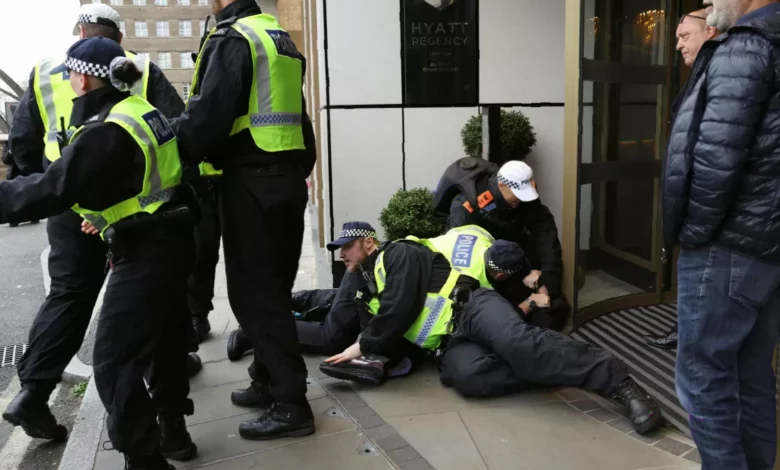
In total, twelve people were arrested across the protest and counter-protest. The arrests included one person for allegedly showing support for a proscribed organisation, another on suspicion of dangerous driving, and others for offences including affray and threatening or abusive behaviour.
Among those detained was a woman seen being led away by officers while holding a sign that read: “I still oppose genocide. I still support Palestine Action.” The police had previously warned that supporters of Palestine Action would face arrest; the group was proscribed as a terrorist organisation by the Labour government in 2025.
A Day of Divided Protest
Police used the River Thames as a physical barrier to separate the opposing groups. The Al-Quds Day protest was confined to Albert Embankment on the south bank, while a counter-protest, co-organised by the Jewish-led group Stop The Hate and The Lion Guard of Iran, assembled on Millbank to the north. Iranian dissidents were among those expected at the counter-demonstration.
Assistant Commissioner Ade Adelekan later noted that the stringent restrictions likely reduced the overall turnout, with some potential participants having “chosen” to stay away.
At the Al-Quds Day assembly, demonstrators held Palestine flags and banners reading “Free Palestine” and “No to Israeli occupation.” The crowd was also heard chanting “from the river to the sea” and displayed pictures of Iran’s late leader Ayatollah Ali Khamenei, accompanied by the message “Choose the right side of history.”
Speaking to the assembled crowd, Hussain Shafiei of the Workers Party of Britain told attendees: “The al-Quds march has happened 40 years peacefully; this is the first time it has been banned. They are so worried, they are so scared that the whole world has turned on Zionism.”
Historical Context and Lasting Controversy
The London event is part of the international Al-Quds Day, established in 1979 by Iran’s first supreme leader, Ruhollah Khomeini, to express support for Palestinians and oppose Israeli control of Jerusalem. The IHRC, which runs the UK demonstration, has openly praised Iran’s former leadership. The organisation also condemned the killing of Ayatollah Khamenei, referring to it as a “cowardly, treacherous, and illegal assassination.”
The day has long been a flashpoint. Previous London marches have seen participants waving flags of Hezbollah, a group proscribed as a terrorist organisation in the UK. Critics consistently accuse the rallies of antisemitism, a charge the IHRC rejects.
In a statement recalling a past tragic incident, the IHRC itself noted that in 2017, a terrorist inspired by anti-Muslim material failed to reach the Al-Quds Day rally due to police cordons and instead attacked worshippers outside Finsbury Park Mosque.
With the event this year occurring against the backdrop of what organisers termed the “US-Israeli war on Iran,” the Metropolitan Police had briefed officers to identify chanting and placards that could cross the line into hate crime or express support for proscribed groups. The force stated it was prepared for a “difficult public order” environment, a challenge met by deploying what a spokesperson described as a “significant” number of officers to ensure the demonstrations concluded peacefully by their 3pm deadline.