Government land, including prison estates and military training ranges, is to be repurposed as nature havens under a programme the Environment Secretary has said demonstrates the Government’s commitment to restoring natural habitats. Tree nurseries will be established inside prisons, military ranges could become heathland or peat bogs, and more “green bridges” will be built over roads and railways to help wildlife move safely. The scheme is expected to be confirmed in the coming weeks.
How government land will be transformed
The plans cover land owned by several departments. On Ministry of Justice land, tree nurseries are intended to serve a dual purpose: contributing to ecological restoration while also supporting prisoners’ welfare. Similar initiatives already exist, such as at Magilligan Prison in Northern Ireland, where a tree nursery produces up to 70,000 native trees annually, involving prisoners in growing trees for woodland creation and connecting people with nature. HMP Haverigg in South Cumbria also hosts a tree nursery as part of a project to restore endangered species.
Ministry of Defence land will see peatland restoration on military training ranges, alongside the construction of new stone dams. These measures aim to revive natural habitats while also limiting flooding, thereby allowing more consistent training conditions for the armed forces. The UK holds a substantial portion of the world’s blanket bog, and peatlands are significant carbon sinks. Restoration on the MOD estate is already underway in some locations; for example, peatland restoration has been completed on the Warcop Training Range in Cumbria.
The Department for Transport will create more “green bridges” on land it owns around roads and rail lines to facilitate wildlife movement. Another possibility being considered is a greater use of solar panels on government buildings.
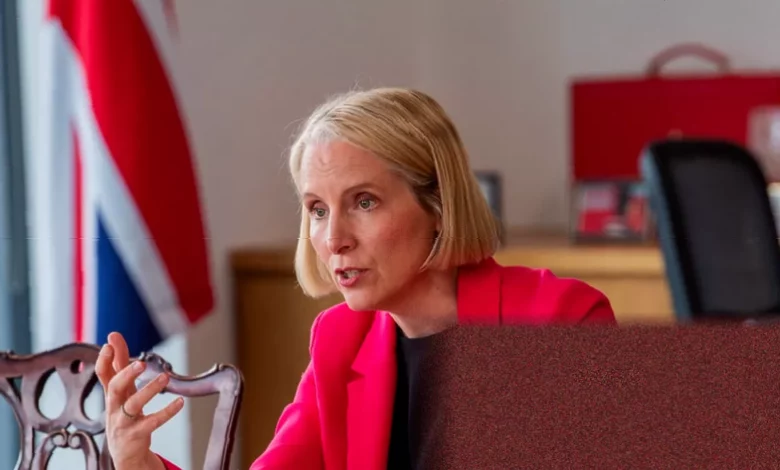
Emma Reynolds said the projects were “just one example of how the government is delivering better outcomes for nature and the environment for future generations”. She added: “These are decisions that we are making, that I am making now, that will have an impact for generations and generations to come. So that’s really important.”
The wider government commitment includes a manifesto pledge to restore natural landscapes through reforestation and biodiversity initiatives. Labour has promised to halt the decline of species by 2030 and protect 30% of land and sea by the same date – the “30 by 30” target. Plans to expand nature-rich habitats such as wetlands, peat bogs and forests are also part of the strategy.
Political context and criticism
Reynolds, who replaced Steve Reed as Environment Secretary in September 2025, returned to Parliament in 2024 after losing her seat in 2019. She was first elected as MP for Wolverhampton North East in 2010, and was re-elected in 2024 as the MP for Wycombe. Before her current role, she served as Economic Secretary to the Treasury from January to September 2025 and as Parliamentary Secretary at HM Treasury and the Department for Work and Pensions from July 2024 to January 2025. She studied Politics, Philosophy and Economics at Wadham College, Oxford, and has a background in the financial sector and foreign policy, as well as experience working with rural communities.
The Labour government under Sir Keir Starmer has faced criticism from some opponents, especially the Green party, for allegedly prioritising economic growth over the environment. Reynolds rejected this, pointing to policies including the government estate plans, the reintroduction of species such as beavers and the golden eagle, and the wider 30 by 30 target as evidence of a strong commitment to restoring nature.
The Environment Secretary was scathing about the Green party’s environmental stance, claiming it had become less wholehearted under Zack Polanski’s leadership, with an increased policy focus on areas such as economic inequality. “I would dispute the kind of priority they seem to be giving at a national level to environmental issues,” she said. “I also think they’ve got a terrible record in local government on these things.” She cited objections from some local Green parties to solar farms and pylons intended to carry electricity from offshore wind generation. “They are not prepared to take any of the sometimes difficult decisions that we need to take as a country to put in place green infrastructure,” she said. “I will not take lessons from a Green party that rarely talks about nature; that, frankly, is a party of protest.”
Reynolds was even more critical of Reform UK, saying she would be “very worried” about what a Nigel Farage-led government would do to the environment. Reform advocates lifting the ban on fracking, a policy strongly opposed by environmental groups due to risks to water and air quality, potential earthquakes, and contribution to climate breakdown. The current Labour government is staunchly opposed to fracking, with Energy Secretary Ed Miliband vowing to permanently ban new onshore oil and gas licensing. Reynolds noted that the former Conservative minister and keen fracking advocate Steve Baker lost his Wycombe constituency to her in 2024. “Fracking is never very popular, as my predecessor in Wycombe found out,” she said.
Prime Minister Sir Keir Starmer has pledged to cut UK emissions by 81% by 2035. Labour’s manifesto also includes plans to make the UK a clean energy superpower, with commitments to scrap rules hindering wind turbine construction and favouring renewables in planning. Great British Energy, a new publicly-owned company, has been launched with £8.3 billion to invest in clean energy projects.
The EU deal and trade-offs
The government is likely to drop plans to stop imports of foie gras or fur, the former of which was a pre-election promise. Production of foie gras has been illegal in the UK since 2006 due to welfare concerns, but imports have continued. The decision to abandon the ban, reported to be due to EU red lines in trade negotiations, has led to disappointment among animal welfare charities.
Reynolds defended such compromises, saying the benefits of a revamped deal with the European Union to remove much red tape on agriculture and food were very significant. “The prize is big,” she said. “We can talk about the detail, but the overall prize here is to bring down the barriers at the border, and the friction and the cost and the administrative burden that the previous Tory government’s botched Brexit deal has left us with.” She added: “We know that there are many small businesses that gave up exporting altogether to the European Union, and many big businesses just face terrible delays, or just uncertainty.”
The new agri-food deal aims to simplify border checks, reduce costs, and remove barriers for British food and farming businesses. A new Sanitary and Phytosanitary (SPS) agreement is expected to be fully implemented by mid-2027. This could eliminate costs associated with export health certificates, phytosanitary certificates, and other checks, potentially saving businesses significant sums.