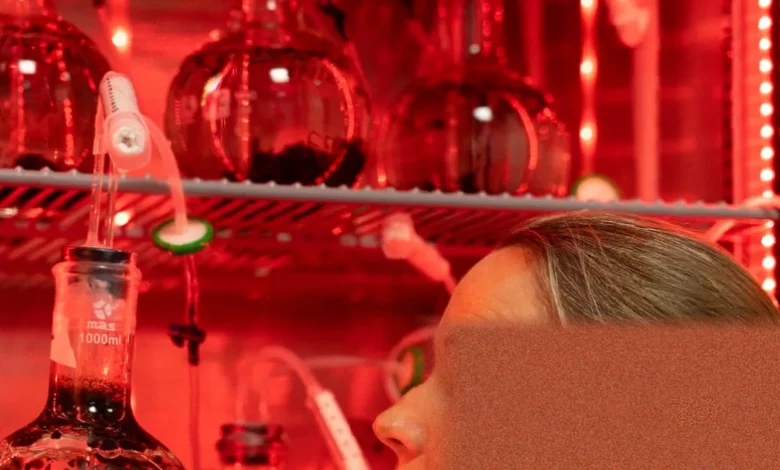
In the mudflats of Swan Bay, Victoria, royal spoonbills sweep their paddle-shaped bills through shallow water, but it is a short walk away — inside a fridge bathed in red light at Deakin University’s Queenscliff Marine Science Centre — where scientists are quietly building a “living library” of at-risk marine life, aiming to stave off extinction. The fridge, equipped with sensors, alarms and a backup generator, holds beakers of bubbling golden kelp kept perpetually in an early algal life stage. “They won’t produce the next stage. They’ll just keep growing like grass,” says Associate Professor Prue Francis, the senior lecturer leading the cultivation work. A second, colder fridge contains trays of tiny vials of the same species, dormant. These fridges form the core of what Deakin calls its living library: a biobank designed as long-term storage for threatened marine organisms, acting as an insurance policy against species loss and a research hub for understanding genetics, growth and resilience in an era of environmental crisis.
The Queenscliff centre, which recently underwent a $3.5 million upgrade to expand its aquarium rooms, tank areas and computing capacity, is now a key site for Deakin’s Centre for Marine Science and delivers Victoria’s only dedicated undergraduate Bachelor of Marine Science degree. The living library is part of a broader network of biobanks across Australia. The Australian National Botanic Gardens in Canberra collects and stores seeds from the ACT region, the Australian Alps, Uluru, Kakadu and Norfolk, Christmas and Cocos islands, holding approximately 4,000 different plant taxa — many nationally threatened — in a walk-in -20C vault. The facility itself underwent a $5.7 million upgrade to increase storage capacity and research capabilities, and is part of the Australian Seed Bank Partnership, an alliance of ten conservation seed banks nationwide.
More unusual is the collection at Melbourne Museum’s Ian Potter Australian Wildlife BioBank, which holds millions of cryogenically frozen living cells from roughly 50,000 samples of blood, feathers, tail tips and ear snips from Australian wildlife. The samples are kept in 2ml tubes at -196C — a temperature at which all biological activity stops — and there is even potential to store embryos from threatened species. A separate “living biobank” is being developed by the University of Melbourne and Museums Victoria Research Institute, the first of its kind in an Australian museum, collecting live cells including skin, sperm and egg cells from Australia’s unique wildlife. The project aims to gather cells from up to 100 species over three years, with a focus on mammals, reptiles and birds, including endangered species such as the Smoky Mouse and Grassland Earless Dragon. Researchers describe it as a “frozen zoo” and an insurance policy against catastrophic events like bushfires and floods. Australia’s high rate of mammal extinctions makes such biobanking particularly critical.
It was a crisis that spurred the establishment of biobanks for golden kelp (Ecklonia radiata), a foundation species of the 8,000km stretch of interconnected ecosystems that make up Australia’s Great Southern Reef. The kelp provides critical habitat and food for lobsters, abalone and numerous fish species, many found nowhere else on Earth. But golden kelp thrives in cold water and is the first thing to die off when waters warm. “There was a really intense marine heatwave off the coast of Western Australia a few years back and it wiped out a lot of the golden kelp,” Francis says. “And that was scientists’ call to action, seeing that huge decline, to start establishing biobanks around the different areas where this golden kelp is found.” Marine heatwaves are increasing in frequency and intensity due to climate change; the 2011 Western Australia event led to significant losses in fisheries and abalone stocks, and the 2015/16 Tasman Sea marine heatwave negatively impacted aquaculture industries and sessile marine life.
Warming waters have also contributed to a boom in purple sea urchin populations, as their predators have been overfished, leading to the creation of “urchin barrens” — areas of bare reef devoid of kelp. Francis was involved in a recent kelp restoration project in two marine sanctuaries in Port Phillip Bay — Jawbone and Ricketts Point — where golden kelp had been overgrazed. “The first thing we did was to reduce the urchins in those areas to a density that we know that they can coexist with the kelp,” Francis says. “Then part of our work was to grow the kelp.” In the laboratory, her team experimented with substrates such as cotton twine and pieces of green gravel — “Gardening at its best!” Francis says — to grow juvenile kelp, which they call “kelplings”. After six weeks of growth, the kelp was sent off with scuba divers to be “planted” in place back in 2022. Just a couple of weeks ago, a project partner at the Nature Conservancy sent Francis photos of the restoration sites. “They just look absolutely fantastic,” she says. “Some of those kelp have gone beyond 30cm in length and are showing reproductive signs as well.” A handbook on golden kelp cultivation has been produced, offering practical guidance for restoration and aquaculture, and Victoria’s first Golden Kelp seedbank — now being established at Deakin’s Queenscliff centre — is being expanded to include sites along the state’s coastline.
Oysters and seagrass: restoration under the same roof
A distinctive briny smell lingers in the halls of the Queenscliff centre, a product of up to 800,000 litres of seawater pumped through the facility every day and split between the university’s labs and the Victorian Fisheries Authority and Shellfish Hatchery also on site. The smell is particularly pronounced in a room full of open-topped bubbling tanks, where Dr Kathy Overton manages a small community of native flat oysters. These oysters once formed vast and complex reefs throughout temperate Australia, until destructive fishing practices all but wiped them out. “Less than 1% of historical reefs remain,” Overton says. “They’re definitely one of the most imperilled marine ecosystems that we have here in Australia.” Last year, Overton collected samples from remnant reefs in different parts of Victoria to understand their genetic diversity and to see if she could get different genetic populations to reproduce — three out of four populations in the trial were successful. “Having these oysters here means that we can look for different experiments to better understand how we can restore them,” Overton says. “In the long term, it’d be really fantastic to be able to build on this.” The Victorian Shellfish Hatchery at the same site produces spat for aquaculture and restoration, and projects elsewhere — using limestone rubble and recycled shells seeded with hatchery-reared oysters and mussels — are rebuilding reefs in Port Phillip Bay, Kangaroo Island and Noosa, providing habitat, improving water quality and reducing coastal erosion.
On the other side of the lab, marine ecologist Laney Callahan, a PhD candidate at Deakin University, is running an experiment on seeds harvested from seagrass — the only flowering marine plant. Seagrass meadows are favoured habitat for fish, crustaceans and other marine life, while processing carbon and nitrogen, trapping sediment and keeping water clear. But because seagrass often occurs in estuaries and intertidal zones, it is heavily affected by coastal development, agricultural runoff, dredging and climate change. “Any time the ocean’s changing because of something that we’re doing, they’re vulnerable to that,” Callahan says. Seagrass meadows declined substantially in Port Phillip Bay during the millennium drought and in Western Port Bay during large-scale industrialisation in the 1970s and 1980s. In the most degraded areas of Western Port, the water is full of sediment and the mud is waist-deep. “That’s one of my dream sites to restore but it’s definitely the most difficult,” Callahan says. Six months ago, she planted 300 square metres of seagrass in Coronet Bay — a project showing early positive results — but “the goal is to grow bigger. We really want to achieve larger scale restoration this year, hopefully,” she says. Callahan’s research uses unmanned aerial vehicles (drones) to map seagrass extent and characteristics. Recent work published in May 2025 focuses on matching seed planting methods to species and site conditions for intertidal seagrass restoration, and further studies are improving nursery propagation techniques and trialling seedling and direct seeding methods. “It’s a global challenge at the moment, seagrass restoration,” Callahan says. “There’s a handful of successful projects that have achieved restoration at a scale that’s ecologically relevant, but very few. And that’s something that we’re all working towards together.”