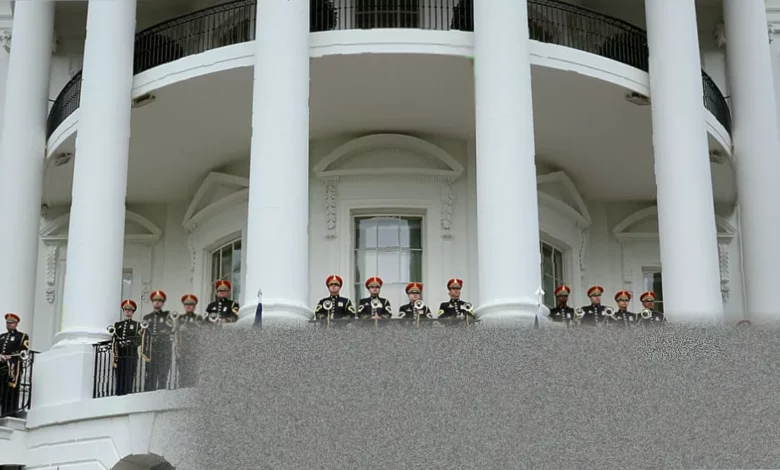
There is a peculiar quality to certain moments in the present: they already feel as though they belong in a school textbook, a museum exhibit, or a documentary narrated decades hence. King Charles III’s four-day state visit to the United States in late April 2026 is one such moment — a historical artefact suspended between the chapters documenting the war on Iran and the global energy crisis. Here, captured in a single frame, is the entire constellation of Trumpland: gold plates on the White House dinner table, a monarch offering polite but pointed remarks, and a gathering of the money men, media loyalists, and tech billionaires whose presence seemed to underline the forces shaping an era of institutional decay.
A dinner party on the edge of history
The state dinner held at the White House on 28 April 2026 was, by design, a showcase of power. Among the guests were seven members of the Trump family, seven figures from Fox News — including Bret Baier, Maria Bartiromo, Ainsley Earhardt, Greg Gutfeld, Laura Ingraham, Jesse Watters and Fox News Media CEO Suzanne Scott — and the chief executives of America’s most valuable corporations: Jeff Bezos of Amazon, Tim Cook of Apple, Jensen Huang of NVIDIA, Marc Benioff of Salesforce, and David Ellison of Paramount Skydance. The president’s toast singled out the Masters champion Rory McIlroy, who was asked to stand and be acknowledged for his recent victory. McIlroy, who was skipping a PGA Tour event at Trump National Doral that week, attended with his wife, Erica Stoll. The menu, which included spring-herbed ravioli and Dover sole, was served on gold plates — a detail that one observer described as “the universal sign of a regime at the peak of excess”.
The guest list read as a snapshot of the forces underpinning the Trump administration: billionaire-funded corporate media, big tech, private equity, and sports stars content to bask in proximity to power. According to Nesrine Malik, a Guardian columnist who covered the visit, the dinner concentrated in one room the “Lord Haw-Haws, the nepo babies, the quislings” who have enabled the presidency’s “colossal violations”. The event was hosted by President Donald Trump, whose second term has seen his approval rating sink to 34% in early May 2026 — the lowest mark of his current presidency, according to a Washington Post-ABC News-Ipsos poll conducted from 24 to 28 April. His disapproval rating reached a new high of 62%, driven largely by public dissatisfaction with his handling of the war on Iran, rising living costs, and inflation.
Two institutions at a nadir
The visit was also an exercise in mutual rehabilitation — a moment when two nations, each grappling with the erosion of their foundational institutions, clung to past glories. Support for the British monarchy has fallen to 45% by February 2026, with a third of the public preferring an elected head of state, according to polling data. Among younger demographics the decline is steeper, though a YouGov poll in April 2026 found that 64% of Britons still want to keep the monarchy, and 59% believe it is good for the country. King Charles himself enjoys a 60% favourability rating, with 34% holding a negative view — a figure that places him well below his mother, the late Queen Elizabeth II (81% positive), and his son Prince William (76% positive). Prince Andrew, meanwhile, languishes at the very bottom of the popularity rankings with just 3% positive ratings, a legacy of his association with the Jeffrey Epstein scandal.
That scandal, which continues to lap at the front doors of the presidency and has already claimed a prince and the UK ambassador to the US, was an inescapable undercurrent of the visit. King Charles addressed victims of abuse during his address to Congress — the second time a British monarch has done so, following the Queen’s speech in 1991 — but the context was unavoidable. Malik noted that “a whole class of people tarred by associations with Jeffrey Epstein” now populate the highest echelons of both US and UK public life. In the UK, Prime Minister Keir Starmer’s Labour government is described as being “on the ropes”, while in the US no serious opposition to Trump is in sight. “The two countries,” she wrote, “squat on the legacies and reputations and treasures of the past.”
Geopolitical backdrop: war, energy and NATO
The state visit took place against a landscape of profound crisis. The US and Israeli war on Iran, which began in February 2026, has triggered what analysts describe as the largest supply disruption in the history of the global oil market, with the closure of the Strait of Hormuz cutting off 20% of global supplies. Brent crude has surged past $100 per barrel, gas prices have spiked, and economies worldwide face the threat of stagflation and recession. The energy crisis was a central factor in the disapproval of Trump’s handling of the economy. The war itself has been met with significant disapproval: 66% of respondents in one poll opposed the president’s approach.
Transatlantic relations were described as strained, with the visit intended to reaffirm ties. King Charles’s address to Congress subtly reminded lawmakers of the importance of “checks and balances” and the historical significance of the US-UK alliance — remarks that were interpreted by some as a gentle counterweight to Trump’s ongoing battle with the judiciary and his willingness to launch wars without congressional approval. The European press took note: Le Monde declared that Charles had given Trump a “lesson in democracy”, a visit that “carries symbolic weight for all Europeans committed to the rule of law”. The next NATO summit, scheduled for Ankara on 7–8 July 2026, looms as a potential flashpoint, with fears that Trump will attempt to sideline European allies.
Media and the mirage of normality
The media reaction to the visit was telling. The New York Times devoted almost its entire front section the following day to the king’s jokes, his decorum, the menu, the guest list and his itinerary. In the UK, newspapers hailed Charles’s performance as a “masterclass in diplomacy” and declared that he had “re-forged the special relationship”. Malik observed that the visit offered a precious fiction: that “the White House had not been driven into the gutter”, and that bipartisanship could be resuscitated for a single evening, like a warring couple putting on a united front for guests. Yet beneath the surface, the reality was starker. The king’s “subtle rebuttals”, as some commentators called them, were little more than naive theatre, she argued — an emissary from a civilisation unable to recognise how much its own failings and unchallenged US hegemony had already called time on the rules-based order.
The Fox News presence at the dinner — seven of the network’s most prominent personalities — contrasted with a broader trend among other MAGA media figures who had broken with Trump over the Iran war. But for that evening, the alignment was clear. The state dinner was a snapshot of the forces that remain indifferent to the president’s violations: billionaire-funded corporate media, big tech, private equity, and celebrities happy to be close to power.
What remains
The trajectory, as Malik put it, is towards “more trouble, rather than tranquility”. The possibility of an extended war on Iran and further Middle East destabilisation, global energy shocks, perhaps even the unravelling of NATO and the breakdown of American democracy itself, are all on the horizon. King Charles’s visit to the US — which also included a ceremonial welcome at the White House on 27 April, a wreath-laying at the National September 11 Memorial in New York on 29 April, a stop in Front Royal, Virginia on 30 April, and a subsequent visit to Bermuda from 1–2 May — already feels like a beat in a narrative, a cliffhanger that observers in the future will recognise as the moment when something was ending and no one knew it. The last state visit by a British monarch to the US was in May 2007, when Queen Elizabeth II visited President George W. Bush. This time, the visit coincided with America’s Semiquincentennial — the 250th anniversary of the Declaration of Independence — yet the celebrations were overshadowed by a war, an energy crisis, and the steady hollowing out of the institutions that once defined both nations.