Susie White reports human presence enables mallard, owl and woodcock to nest in her garden

Woodland birds are nesting unusually close to a house in Northumberland, a nature writer has reported, describing tawny owls, woodcocks and mallards all choosing to breed within metres of a busy garden and its resident human.
Nature writer and regular Guardian Country Diary contributor Susie White observed the behaviour at her own garden, where a female tawny owl has taken up residence in a nest box fixed to a sycamore tree. Each evening, as dusk falls, the owl emerges in silence, dropping towards the woodland border and skimming the plants on the same trajectory every night – a grey shadow in the gloaming. Tawny owls are the most common and widespread owl species in Britain, found in mixed and deciduous woodlands as well as parks and larger gardens. They are mainly nocturnal and highly territorial, and will readily use artificial nest boxes where natural tree cavities are scarce. The species is listed on the UK’s Amber List of Birds of Conservation Concern due to a long-term decline since the 1970s, driven by habitat loss, road fatalities and a shortage of natural nesting cavities.
Secretive woodcock returns for third attempt
White also spotted a woodcock slinking along a garden path, using a box hedge to disguise its passage. The bird is nesting somewhere in the thick leafiness of the garden. In July 2023, White wrote about a woodcock that nested in a flower border just a few metres from the house, successfully hatching four chicks from four eggs. Last year, a cat disturbed another attempt, captured on a trail camera. White believes this may be the same bird returning for a third time. Woodcocks are notoriously secretive and shy ground-nesters, favouring dense woodlands with clearings. Their close proximity to a house is considered very unusual. The species is red-listed in Britain due to a long-term decline in its breeding range and numbers, with habitat loss and changes in woodland management identified as major pressures. Woodcocks are crepuscular, most active at dawn and dusk, and feed on invertebrates such as earthworms by probing damp ground with their long bills.
Mallard ducks rescued from boundary wall
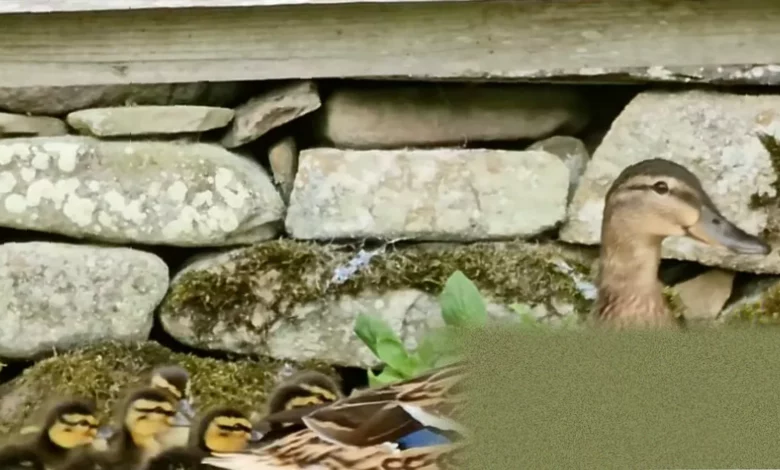
A third nest belongs to a mallard, hidden beneath foliage just inches from a path. White spoke to the duck as she walked by so the bird became familiar with her voice, anticipating she would need to help the ducklings over a boundary wall. When the ducklings hatched, White was ready with a bucket. She approached the unflustered mallard – as she had done the previous year – and scooped all ten ducklings into the bucket, then held it, squeaking and piping, over the wall. The mallard flew over, rejoined her young and led them to the river. Mallards are the most commonly sighted duck in the UK, found in almost any wetland habitat including urban parks and gardens. They nest in secluded, well-vegetated areas near water, often in unusual places such as wood piles or large flowerpots. The species is on the UK amber list, indicating a moderate level of conservation concern.
The ‘human shield effect’: why birds feel safer near people
White attributes the unusual nesting behaviour to the so-called “human shield effect” – a phenomenon in which the presence of humans changes the behaviour of animals, making them less vigilant for natural predators. In urban or human-dominated environments, human activity can eliminate or significantly reduce predatory pressure. Animals that adapt to living near humans may thrive because humans inadvertently protect them from other predators, even though humans themselves can pose a danger to wildlife.
Research has shown that mesopredators – medium-sized predators – may move closer to human habitation to avoid larger carnivores such as wolves or cougars. One study in Washington found that coyotes and bobcats that did so were killed more often by humans than by the large carnivores, a phenomenon researchers called the “paradox of the lethal human shield”. For prey species, the strategy can offer genuine refuge, but it also brings increased risks of human-wildlife conflict and disease from domestic animals.
In White’s garden, the combination of human presence and the undisturbed density of the wildlife garden has made birds feel safer, and she believes they may have learned this from successful previous years. Gardens across the UK – an estimated 24 million of them – are increasingly recognised as vital wildlife habitats, forming a network of green spaces that can support declining species when managed to provide food, water and shelter.
Early evening, the female tawny owl grows restless and calls to the answering male. He flies briefly to the nest box for a noisy reunion, before re-emerging in front of the window, his wing tips backlit by amber sunlight.