
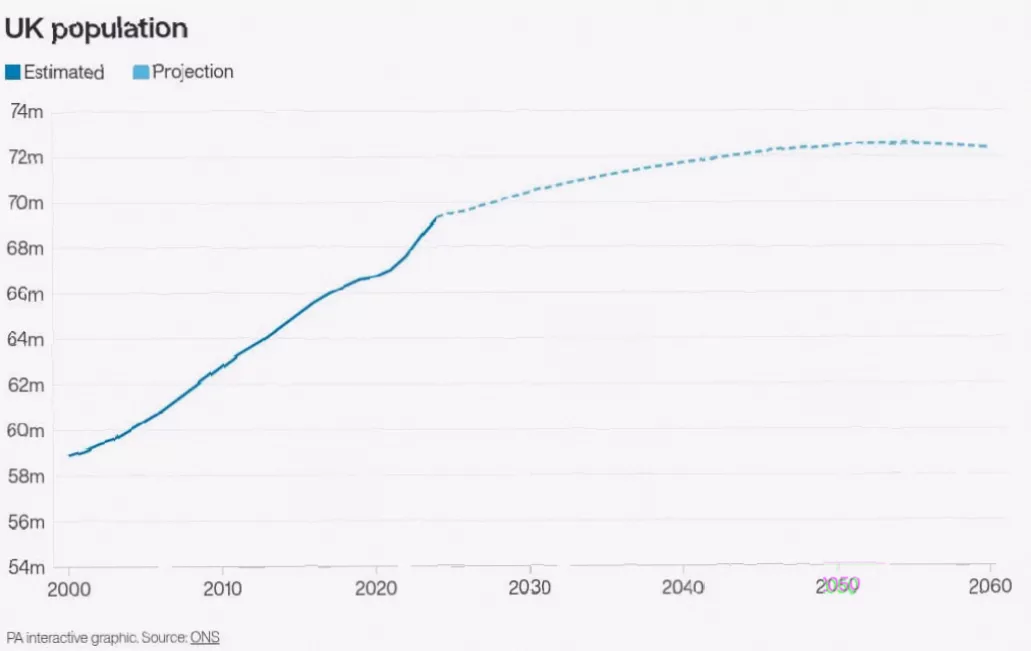
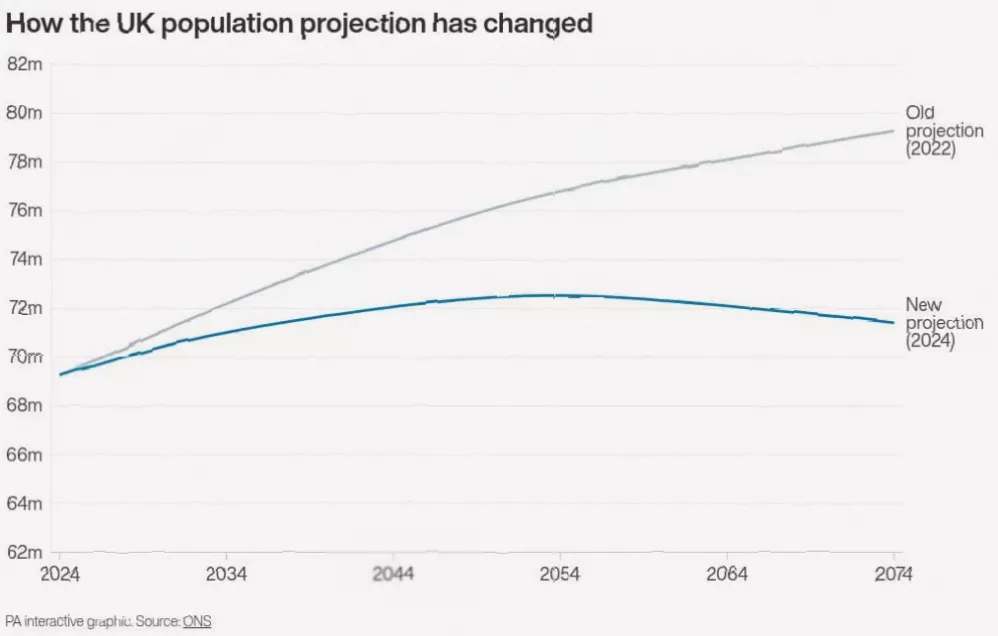
The UK population is on course to begin shrinking from the mid-2050s, a dramatic reversal of previous official forecasts that had anticipated continuous growth until the end of the century. The latest projections from the Office for National Statistics (ONS) show the population reaching a peak of 72.5 million in 2054 before entering a sustained decline – a stark departure from earlier estimates that predicted uninterrupted expansion until 2096.
According to the ONS, the population will grow at a markedly slower rate over the next decade than previously reported. Some 1.7 million people are expected to be added between 2024 and 2034, lifting the total from 69.3 million to 71.0 million – a 2.5 % increase. That is less than half the rise of 3.0 million the ONS had forecast last year, which would have taken the population to 72.2 million by 2034, a 4.3 % jump. Growth is then projected to slow further during the 2030s and 2040s before the peak in 2054. Beyond that point the population falls to 72.1 million by 2064 and 71.4 million by 2074.
Sharp fall in net migration
The downward revision is driven chiefly by a steep drop in net migration, alongside lower fertility assumptions. James Robards, ONS head of household and population projections, said: “Our latest projections indicate slower population growth than previously projected. This is mainly due to lower migration assumptions – reflective of the recent steep fall in net migration – and lower fertility assumptions. At the UK level, the population is projected to peak in the 2050s before decreasing.”
Net migration – the difference between the number of people arriving in the UK long-term and those leaving – stood at an estimated 204,000 in the year to June 2025, down 69 % from 649,000 in the previous 12 months. The ONS has adjusted its methodology for projecting future migration, deliberately excluding recent years characterised by “unusually high levels of migration” in order to produce a more representative long-term average. This methodological shift reflects both statistical caution and real-world policy changes: the government has tightened restrictions on work and study visas, and the broader political climate around immigration has shifted.
The significance of migration to UK population dynamics is hard to overstate. Over the two decades from 2004 to 2023, net migration accounted for 65 % of population growth; since 2020 it has contributed 98 %. Under the new projections, net migration is expected to add 2.2 million people to the population in the decade to 2034. Yet that addition will be partly offset by natural change – the gap between births and deaths. Deaths are projected to outnumber births every year from 2026 onwards, with 450,000 more deaths than births over the same ten-year period. The net effect is the 1.7 million total growth for 2024‑2034.
Natural change turning negative marks a structural shift. Lower fertility rates are a key factor: the ONS has assumed that the total fertility rate will remain below replacement level, compounding the impact of an ageing population. The number of people of pensionable age is projected to rise from 12.4 million to 14.2 million by 2034, when they will represent one in five of the population (20.0 %). By the peak year of 2054, pensioners will account for 22.0 % of the total. In contrast, children under 16 will fall from 12.6 million (18.2 % of the population) to 11.0 million (15.5 %) by 2034, and further to 14.5 % by 2054. The number of people aged 85 and over is projected to almost double in the next 25 years, from 1.7 million in 2022 to 3.3 million by 2047. The old-age dependency ratio – the number of people of pensionable age per 1,000 working-age people – is expected to rise from 278 in mid‑2022 to 302 by mid‑2047.
These demographic trends carry far-reaching implications. A smaller and slower-growing population will likely mean slower economic growth and fewer taxpayers, with economists warning that a sharp decline in immigration could lead to a smaller UK economy, larger government debts and higher taxes. Public services, particularly the NHS and social care, face increased pressure from an ageing population, rising multimorbidity and health inequalities. The Health Foundation has estimated a significant need for additional health and social care staff by 2030‑31. Adding to the challenge, recent analysis shows that healthy life expectancy in the UK has fallen by more than two years between 2012‑14 and 2022‑24, a decline that contrasts with improvements seen in many comparable countries, raising concerns about the quality of later years and the potential for greater demand on care services.
The ONS stressed that its projections are not forecasts or predictions; they are based on current and past trends and are updated as those trends change. Since the figures were compiled using a methodology that excludes the extraordinary migration spikes of recent years, any shift in government policy or global events could alter the trajectory.

Regional variations
The national picture masks significant differences across the four countries of the UK. England is projected to see its population peak at 62.1 million in 2056 – later than the UK as a whole. But the peak arrives much sooner in the other nations: Wales in 2035 at 3.2 million, Scotland in 2033 at 5.6 million, and Northern Ireland in 2031 at 1.9 million. England’s population grew at 1.2 % in the year to mid‑2024, faster than Scotland (0.7 %), Wales (0.6 %) or Northern Ireland (0.4 %). Looking further ahead, Scotland’s population is projected to fall by 1.3 % between mid‑2024 and mid‑2049, and Northern Ireland’s by 1.0 % over the same period.
The ageing of the population is already reshaping the age structure. The number of people of pensionable age is projected to rise from 12.4 million to 14.2 million by 2034, when it will account for one in five (20.0 %) of the total population. By the time the UK population is projected to peak in 2054, pensioners will account for 22.0 % of the total and under‑16s will make up 14.5 %. The ONS has also published revised population estimates for England and Wales, showing a population of 61.8 million in mid‑2024, with growth primarily driven by net international migration.