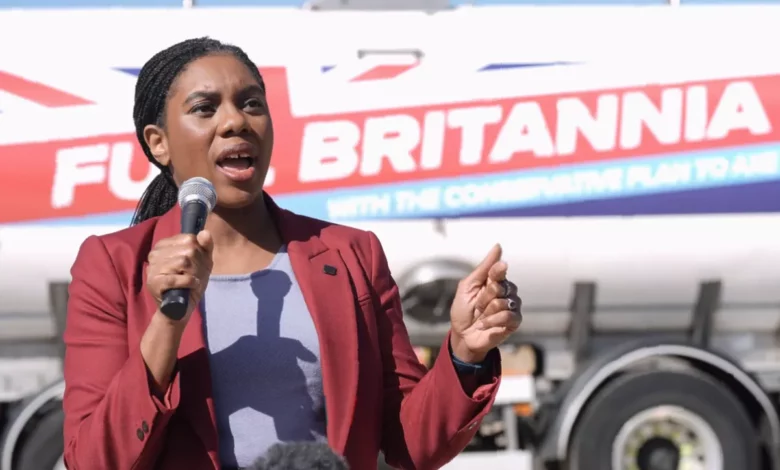
The Conservative Party has launched a “Get Britain Drilling” campaign, positioning a push for maximising domestic oil and gas reserves as the centrepiece of its response to energy price hikes triggered by conflict in the Middle East.
Leader of the Opposition Kemi Badenoch will formally kick off the initiative on Monday with a visit to an oil rig off Aberdeen, arguing that new drilling is essential for the UK’s energy, financial and national security. The campaign comes amid a spike in global oil prices following Iran’s blockade of the strategically vital Strait of Hormuz.
The Three-Point Plan
At the heart of the campaign is a three-point plan. The Conservatives propose an immediate end to the moratorium on new oil and gas licences imposed by the Labour government. They also pledge to abolish the Energy Profits Levy (EPL) – the windfall tax on oil and gas profits – and to increase financial support for the fossil fuels industry.
Mrs Badenoch has accused Labour of economic illiteracy, stating its ban on new licences was “stupid” in its manifesto and “completely crazy” during an energy crisis. “Drilling our own oil and gas is about energy security, it’s about financial security, it’s about national security,” she said. “It’s more jobs, good for business and provides tax revenues that could be used to bring down bills.”
The party plans to announce further measures aimed at reducing living costs and business energy bills in the coming week. The campaign directly targets two major North Sea projects: the Rosebank and Jackdaw fields.
The Case For and Against Domestic Reserves
The argument for accelerating North Sea production hinges on the concept of energy sovereignty. Proponents like Mrs Badenoch contend that domestic resources shield the UK from volatile global markets and geopolitical shocks, such as the current Middle East conflict. They point to the economic benefits of investment, jobs, and tax revenues.
However, critics from across the political and environmental spectrum argue this is a flawed and misleading narrative. They point to the fundamental nature of the North Sea as a “mature basin”, where output has declined by 75% since its peak and an estimated 90% of its reserves are already depleted.
Tessa Khan, executive director of the campaign group Uplift, labelled the Conservative plan a “dangerous fantasy”. Her organisation’s research suggests that hundreds of North Sea licences granted under previous governments yielded only 36 days’ worth of gas. “Politicians who refuse to acknowledge the reality of the declining North Sea are endangering our security and economy,” she said, arguing long-term job security lies in renewables, not a “pipdream”.
The government and independent experts also challenge the idea that new drilling would lower bills. Energy minister Michael Shanks MP stated that the Conservative shadow energy secretary had himself admitted new licences would not “take a penny off bills”. Analysis from the Energy and Climate Intelligence Unit supports this, noting the windfall tax is an “upstream tax” on profits, not output, and cannot be passed on to consumers. Energy Secretary Ed Miliband has been unequivocal: “anyone who tells you that new licenses in the North Sea will make any difference to price is not telling you the truth.”
The Labour government’s strategy, as outlined in its Energy Security Strategy, focuses on diversifying sources and investing in offshore wind, nuclear, and other renewables to decarbonise the power sector by 2035. Ministers argue true security comes from “homegrown power that the UK controls”, learning from the current crisis to avoid future exposure to volatile fossil fuel markets.
Projects in the Balance
The political debate is crystallised around specific fields. Rosebank, the UK’s largest undeveloped oil and gas field located north-west of Shetland, holds nearly 500 million barrels of oil equivalent. Operator Equinor plans a $3.8 billion first phase, targeting first oil in late 2026. However, a legal challenge in January 2025 ruled its approval unlawful for not accounting for emissions from burning its fuel.
The Jackdaw gas field, east of Aberdeen and operated by a Shell affiliate, is slated for production in 2025 and could meet 6% of UK North Sea gas output, heating around 1.4 million homes. Its consents were also ruled invalid by a Scottish court in early 2025, with work continuing pending a government consultation.
These legal hurdles underscore the complex landscape. Furthermore, the scale of existing government support for fossil fuels is significant. Research from Global Justice Now estimates the UK provides £17.5 billion annually in fossil fuel subsidies and support, a figure projected to reach £87.5 billion over the current parliament – taxpayer funding that some argue contradicts climate goals.
At Prime Minister’s Questions, Mrs Badenoch pressed Sir Keir Starmer on the licences, claiming his referral to the Energy Secretary revealed that “Ed Miliband is now running the Government.” The Prime Minister reiterated that the legal powers reside with the Energy Secretary.
The “Get Britain Drilling” campaign sets a clear political dividing line, framing energy security as a choice between exploiting dwindling domestic hydrocarbons and accelerating a renewable transition. With global markets in flux and the North Sea in decline, the debate over which path genuinely insulates the UK from future shocks is only intensifying.