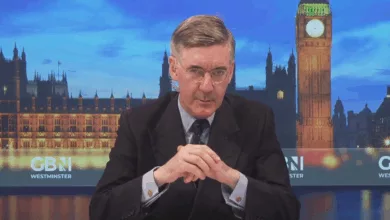
Labour is braced for a net loss of 1,850 council seats in England when voters go to the polls on 7 May, according to a forecast from the Conservative peer and elections specialist Lord Robert Hayward. The projection, which signals a nationwide collapse in support for Sir Keir Starmer’s party, was revealed on ITV’s Peston programme and is being taken seriously across Westminster because of Hayward’s reputation for politically neutral, well-informed analysis. The scale of the expected losses is even larger than the 1,500 figure that prompted a recent Sunday Times report to warn of a potential “nervous breakdown” inside Labour if such a result materialises.
Hayward’s English local election forecast in detail
Hayward, a former Conservative MP and now a member of the House of Lords, is one of the few psephologists whose forecasts are closely watched by the main parties. His latest breakdown predicts that Reform UK will be the biggest beneficiary, gaining 1,550 seats overwhelmingly outside London. He believes the party’s national equivalent vote share will be lower than last year, but the net gain in seats will come from both Labour and the Conservatives. Independents are forecast to pick up 250 seats, with significant gains expected in east London, Birmingham and Lancashire.
The Conservatives are projected to lose around 600 seats, many of them in councils deferred from previous elections. Hayward notes that these seats were last contested in 2021, a year that saw a “vaccine bounce” for the Tories. Despite the losses, he expects the party to hold onto some notable councils and to prevent Reform UK from taking control of target councils. The Conservative national equivalent vote share is forecast to be about static compared with last year.
The Green Party is expected to gain 500 seats, concentrated in London and middle-class urban areas elsewhere. Hayward says they “definitely” have the potential to win a mayoralty and possibly one or two councils. The Liberal Democrats are predicted to gain 150 seats, but Hayward cautions they will need to win control of councils to be considered significant players. Their national equivalent vote share is expected to reflect their decline in opinion polls, and he suggests they have “up to a point” lost their position as a protest party.
Other forecasters have produced broadly similar numbers. Stephen Fisher, an Oxford politics professor who works with John Curtice on BBC general election exit polls, published projections on his Elections Etc blog last month. Political commentator Sam Freedman has also shared his own projections on his Substack blog, Comment is Freed. The Guardian’s data experts, meanwhile, have analysed recent polling and conclude that Labour’s vote share could fall to historic lows across councils in England and the devolved parliaments in Wales and Scotland, with Reform UK, the Greens and nationalist parties making substantial gains.
Send report: Schools penalised for inclusion
Separately, the NAHT headteachers’ union has warned that Ofsted’s new report card system is “actively penalising” schools that are more inclusive of pupils with special educational needs and disabilities (Send). The union’s analysis of inspections found that one in five (20%) schools with above-average numbers of Send pupils were judged “needs attention” – the second-lowest grade – for attendance and behaviour. This compares with one in ten (9%) of schools with below-average Send numbers. The findings come as the government presses ahead with sweeping reforms intended to make the Send system and schools more inclusive. Paul Whiteman, general secretary of the NAHT, said the results should “ring serious alarm bells” for ministers’ ambitions to educate more Send children in mainstream settings.
Forecasts for Scotland and Wales
Hayward has also given predictions for the Scottish Parliament and Welsh Senedd elections on the same day. He expects the SNP to fall just short of an overall majority in Holyrood. In Wales, he forecasts that Plaid Cymru will become the largest party in terms of both votes and seats. These projections are less reliant on Hayward’s specialist modelling because more polling is available for the devolved contests. Another source, Nowcast UK, produces seat projections based on that polling data. By contrast, English local elections are harder to poll accurately, which is why Hayward’s assessment carries particular weight among political strategists.