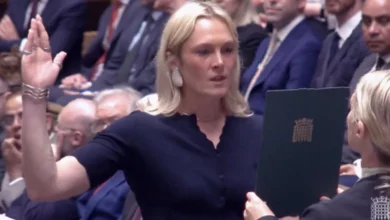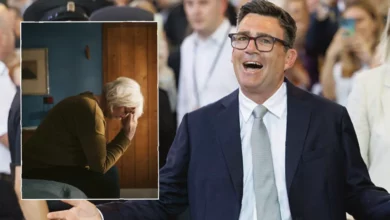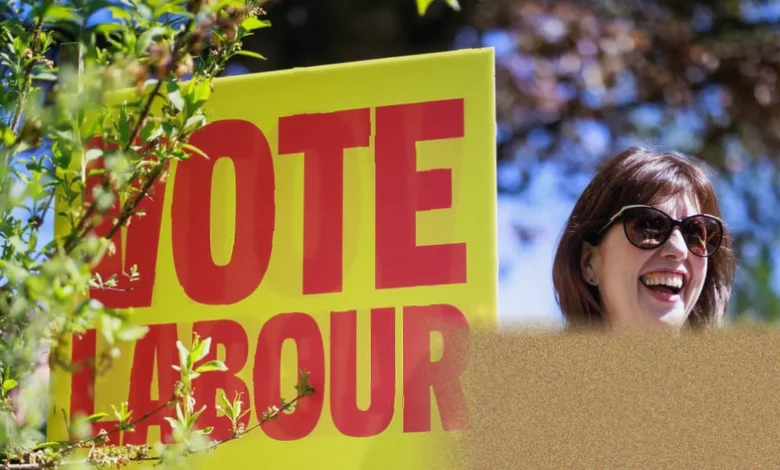
Labour faces a challenge from the Green party in affluent Leeds wards, where canvassers for the party once secure in its dominance are now working harder to hold on to ground.
On the wide streets around Roundhay Park, Lucy Powell, Labour’s deputy leader, joined activists walking between stone-built mansions with manicured lawns and window-box pansies. The suburb is one of the safest Labour wards in Leeds, home to graduates, doctors, lecturers and small business owners. In years past, many of these houses with sweeping driveways and climbing roses would have been natural Conservative territory – a short walk away is Roundhay School, alma mater of Liz Truss, who amusingly tried to paint it as the wrong side of the tracks.
But Labour councillors in the ward now face a different adversary: the Green party. It is in these wealthy areas, as well as in more diverse suburbs and among the student population, that the Greens are making gains. “There’s no question these are going to be difficult elections,” Powell said, stopping at the church’s community cafe. “Look at where we are in the polls. We haven’t given a strong enough account of ourselves and what we’re doing in government nationally, how we are reshaping the country. People are wanting change and they’re looking elsewhere to vote for change.”
How the Greens are winning ground in traditional Conservative territory
The Green party’s advance in Leeds is not confined to student areas. Zack Polanski, the party’s leader, has made the city a key target, especially younger, mixed areas such as Hyde Park and Armley. Students hosted a fundraising rave for the Greens, attended by Polanski, which raised more than £16,000 for the local campaign. Locally, the Green candidate is Brannoc Stevenson, another former pupil of Roundhay School. Several residents mentioned they fondly know his family, and a mix of Green and Labour boards now sit on top of manicured hedges.
The political divides are unpredictable. Jill, a local homeowner chatting to Powell in the sunshine, said she would consider voting Labour, having previously been a Conservative, and was unconvinced by the Greens. But inside the Clocktower Community Cafe, where Powell did the rounds of the tables over tea and cake, many said they were considering voting Green. “We’re very proud of the green space around here, I think we could do with someone who will protect it,” one said.
The Green and Labour leaflets bear a striking similarity, both featuring independent local bus networks – which Labour has legislated to allow – and approval for a Leeds tram, promised during the last budget. It is frustrating, Powell said, to see a party claim credit for policies delivered by a Labour government. “I think it’s about being a lot clearer that we are prepared to take on these things more strongly, and not cede the progressive ground either,” she said. “I saw the Greens are trying to take credit for votes at 16. That’s a Labour manifesto commitment, a Labour bill. It’s been a long-standing Labour cause … We weren’t shouting about it. And if you cede the ground, then others come and play and claim credit for your progressive agenda and what you’re actually delivering. I feel like we’ve let them come on to our ground, rather than they’ve won it over.”
Labour’s strategy to win back disillusioned voters
Labour’s local councillor Jordan Bowden has been talking up the council’s own green credentials – it was named green council of the year. He speaks to residents about solar panels and heat pumps for schools, sewage problems in the waterways around Roundhay Park, bike lanes and electric bikes, one of which Tracy Brabin, the mayor of West Yorkshire, used to cycle into town. Activists briefly considered calling them “Brabin bikes” – they joked – but unlike Boris Johnson, who took ownership of a cycle scheme his Labour predecessor had introduced, the party is still squeamish about taking credit for its own achievements.
Kathleen Johnstone, a former foster carer and longtime community activist, is standing for Labour in the ward for the first time. The ward extends down to the border of Harehills, one of the poorest pockets of the city, and Oakwood, popular with young city workers. “I think they see the Greens as a breath of fresh air,” she said. “But I’m not the same-old Labour, I’m me. I want to show what the city council has done, under really hard circumstances. We are finally getting more money from local government, we don’t want the rug pulled from under us.”
Powell said she remains convinced that many voters frustrated with Labour – and looking to other parties – can be won back. “On Gorton and Denton, people were making their minds up right until the last minute. And I think that is true here. There’s people who have made their decision. They’re voting Reform, they’re voting Green, or they’re voting Labour. But there’s a lot of soft voters in the middle, to be honest, and it doesn’t ever come through in polls. And there is absolutely an anti-Reform coalition. That is not just the demographic you might imagine. It’s not just Guardian readers. It’s white, working-class people who traditionally vote Conservative or traditionally vote Liberal Democrats. They know the stakes are very high.”
In East Leeds, a strong Reform UK presence is also targeting gains, adding another dimension to Labour’s challenge. Powell argued that the party must be clearer about whom it is prepared to take on. “It’s being clearer about who we’re not for and who we are prepared to take on, whether that is the social media companies, whether that is the water companies, whether that’s the energy companies who are perhaps profiteering, when everybody else is seeing their bills going up.”