Business Secretary Peter Kyle has firmly rejected calls for the UK to rejoin the European Union, stating the government’s current policy is the right one “for the moment we’re in”. He made the remarks on LBC Radio, directly addressing the campaign for renewed membership championed by London Mayor Sadiq Khan.
Labour’s internal divide on Europe
The minister’s comments highlight a clear division within the Labour Party. Mayor Khan has argued that rejoining the EU is “inevitable” and should be a manifesto commitment, citing Brexit’s economic and cultural damage. This stance is at odds with the government’s official position, as reiterated by Downing Street and senior figures, which rules out a return to the EU, the single market, or the customs union.
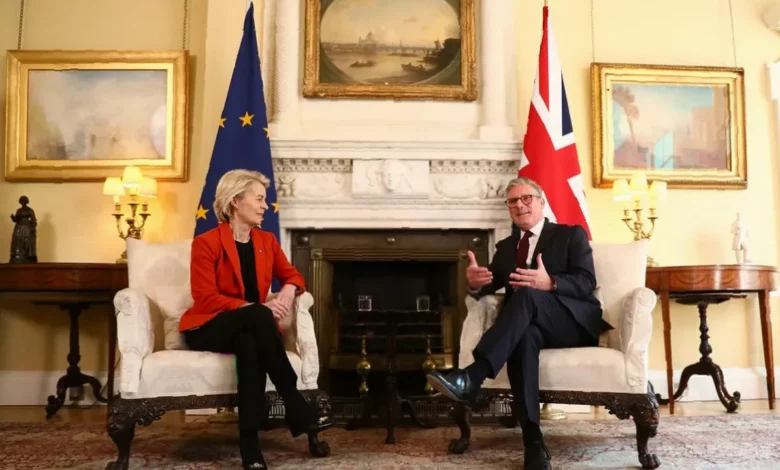
Instead, Mr Kyle emphasised the administration’s focus on a “reset” of relations with Brussels. He said the government is “rebuilding the relationship, and we’re very open-minded about the alignment that will bring benefits to both EU countries and the UK”. This reset, as outlined in the Labour manifesto, aims to reduce trade barriers by seeking a veterinary agreement to cut border checks and a deal for mutual recognition of professional qualifications, while explicitly maintaining the “red lines” on freedom of movement and full reintegration.
The economic backdrop to the ‘reset’
This policy unfolds against a stark economic backdrop. Multiple studies estimate that Brexit has reduced UK GDP by 6% to 8% compared to remaining in the EU, with business investment 12% to 18% lower. Trade in goods has fallen by approximately 13%, hampered by the non-tariff barriers and “red tape” introduced by the post-Brexit Trade and Cooperation Agreement (TCA). The government’s reset agenda, including the earlier Windsor Framework which eased Northern Ireland trade tensions, is an attempt to mitigate this damage within its political constraints.
While some Labour figures like Health Secretary Wes Streeting have shown openness to a customs union, Mr Kyle’s interview reinforced the leadership’s consistent message. He dismissed engaging in a “long, protracted debate about rejoining,” arguing it would distract from exploiting existing opportunities.
Focus shifts to global trade deals
The Business Secretary pivoted the focus towards global trade, beyond Europe. He pointed to “the additional trade deals we’ve got around the world” and specifically highlighted the value of a UK-US tech deal. This aligns with the government’s broader pursuit of agreements with countries like India, though such deals have faced complexities, including ongoing negotiations over US steel tariffs.
Mr Kyle’s framing suggests a strategic choice to deepen partnerships where feasible, rather than re-open the constitutional question of EU membership—a move some reports suggest the EU itself would be hesitant to entertain so soon after the Windsor Framework. His conclusion was a clear statement of prioritisation: the immediate task is to “explore all the opportunities we have with the EU, with the US,” using the current reset as the foundation.