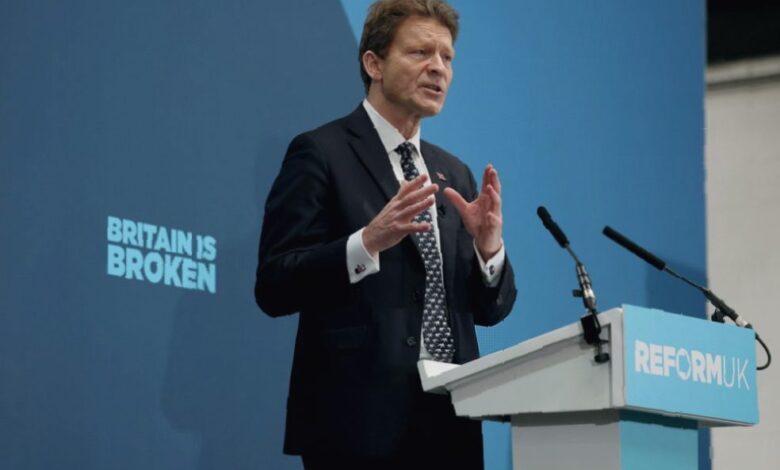
Reform UK has positioned the controversial revival of fracking as a central pillar of its plan to “reindustrialise Britain”, with party chairman Richard Tice declaring the pursuit of domestic shale gas a “patriotic duty” that would deliver cheap energy and local jobs.
The party’s business, trade and energy spokesman made the case during an appearance on GB News, hours after setting out the policy at a steel stockholding business in Dudley. He argued that embracing the extraction technique was essential for national prosperity. “We want cheap energy. That’s what makes a rich nation,” Tice stated, according to GB News. He claimed the public had been “deeply misled by misinformation” about the process, contrasting it with the United States where he said shale gas had driven low prices and high growth.
Promising to ditch what he termed Net Zero “madness”, Tice framed the policy in starkly local terms. “I want Lincolnshire gas for Lincolnshire, jobs for Lincolnshire growth. I want Yorkshire Gas for Yorkshire jobs and Yorkshire growth,” he told presenter Jacob Rees-Mogg, a former business secretary who has previously expressed personal support for fracking. Tice said he would use “energy treasure from under our feet” to cut bills and address the cost of living.
Swift condemnation from environmental campaigners
The proposal was immediately condemned by environmental groups and Conservative environmentalists. John Flesher, director of the Conservative Environment Network, dismissed Tice’s “patriotic duty” argument as “farcical”. In a statement reported by GB News, Flesher said significant obstacles remained, including “massive community opposition and a lack of investor confidence”. He added that even if fracking commenced, “it would do nothing to cut Britain’s scandalously high energy bills” and called it a “distraction from the real problems our country faces.”
Mike Childs, head of policy at Friends of the Earth, urged a focus on renewables instead. “Solar and onshore wind are now far cheaper than new gas or nuclear, cutting bills as well as emissions,” he said, advocating for “vast homegrown renewable power – alongside a nationwide programme of home insulation, which would deliver real energy security”. He argued that rolling back climate action only benefits “polluters, billionaires and the vested interests cashing in on fossil fuels”.
A history of bans and public scepticism
The push comes against a backdrop of intense political and public debate over fracking in the UK. A moratorium on fracking in England has been in place for significant periods, first imposed in November 2019 due to concerns about earthquakes. It was briefly lifted in September 2022 under Prime Minister Liz Truss, only to be reinstated by her successor, Rishi Sunak. The Labour Party has pledged a permanent ban, while Reform UK has vowed to lift the moratorium if it gains power.
Public opinion on the issue is nuanced. A Survation poll from September 2022 indicated just 34% support for fracking, compared to 74% for onshore wind and 81% for solar. More recent polling in June 2023 suggested 48% in favour of fracking resuming, with 28% against. However, local support is typically much lower, with one survey finding only 22% would support fracking in their local area, while 45% were opposed.
Substantial doubts persist about the economic and practical viability of a UK shale gas industry. Experts point to the nation’s more complex geology compared to the United States, leading to higher drilling costs. Analyses suggest thousands of wells would be needed to make a meaningful contribution to domestic supply, and that any gas extracted would be sold at international market prices, making it unlikely to significantly reduce UK energy bills. The process, which involves injecting high-pressure fluid into rock to release gas, is also associated with environmental risks including potential water contamination and the triggering of seismic activity—a concern that halted UK operations in 2019.
Reform UK’s energy platform, which is critical of the Net Zero trajectory, advocates maximising domestic oil and gas production for energy sovereignty. The party has reportedly received significant donations from fossil fuel interests. Its mayor for Greater Lincolnshire, Andrea Jenkyns, has reportedly approached a US oil and gas company about reviving fracking in the county, where licences have previously been issued alongside areas of Surrey, Sussex, Somerset, Derbyshire, Nottinghamshire, Lancashire, and Yorkshire.