Keir Starmer faces a destabilising test of authority and survival, as a scandal over the botched appointment of Peter Mandelson as Washington ambassador escalates into a full-blown crisis of judgment and trust at the heart of his government.
Starmer’s Troubles: A Crisis of Judgment
The prime minister’s troubles stem directly from his decision to appoint the veteran Labour figure, Lord Mandelson, to the prestigious diplomatic post in February 2025. The appointment unravelled months later when Mandelson was sacked in September 2025, after emails emerged suggesting he had shared sensitive government information with the convicted sex offender Jeffrey Epstein in 2009. A further release of Epstein files in January 2026 intensified the scrutiny.
The core of the crisis, however, lies in the security vetting. It has been revealed that in January 2025, the UK Security Vetting (UKSV) agency recommended Mandelson’s security clearance be denied. Despite this, Foreign Office officials granted him clearance the following day. The prime minister has stated he was unaware of this failed vetting, claiming critical information was withheld from him, and that he would not have proceeded had he known.
The Prime Minister’s ‘Lawyerly’ Defence and its Implications
Sir Keir Starmer has sought to bat away the controversy with a defence that leans heavily on process and the precise chain of information. He has apologised for a “wrong judgment” but insists he did not mislead Parliament, blaming top civil servant Sir Olly Robbins for not informing him of the UKSV’s negative recommendation. This focus on procedural detail, however, has opened him to the charge that he is arguing like a lawyer while the political case against him grows.
That political case has been powerfully bolstered by the testimony of Sir Olly Robbins himself, who was sacked as Permanent Secretary at the Foreign Office over the scandal. Giving evidence to MPs, Robbins painted a picture of intense pressure from the centre of government. He stated there was “constant chasing” from Downing Street and an “atmosphere of pressure” to approve the appointment, suggesting a “dismissive” attitude from Number 10 towards the vetting timeline. While Robbins said he was briefed that Mandelson was a “borderline” case leaning towards denial, he claimed he did not see the actual vetting file and indicated officials debated withholding the documents from Parliament.
The stark conflict between the prime minister’s claim of being kept in the dark and his former top official’s account of pressure from the centre creates a damaging credibility gap. It allows critics to question not only Starmer’s judgment in selecting Mandelson—given the peer’s long and controversial career and known association with Epstein—but also his curiosity and command over his own government’s operations.
Mounting Pressure Within Labour
Questions are growing louder within the Labour Party itself. The resignation in February 2026 of the prime minister’s chief of staff, Morgan McSweeney—who took “full responsibility” for the appointment—removed a key pillar of support and underscored the severity of the self-inflicted damage. McSweeney is yet to give his own evidence to MPs.
While senior figures like Angela Rayner and Wes Streeting have offered public support, the briefing’s description of “restless backbenchers” and a “fracturing cabinet” points to significant internal unease. Some, like Labour MP Jonathan Brash, have expressed frustration with the “psychodrama” distracting from government work. More starkly, senior Labour peer Lord Glasman has called for Starmer to resign. This internal pressure is compounded by an external threat, with the Green Party’s recent by-election win and poll lead signalling a challenge to Labour’s base.
The political markets reflect this peril, showing a significant conviction that Sir Keir will be out of office by the end of 2026. Speculation about successors, with names like Andy Burnham and Angela Rayner frequently mentioned, persists in the background, though the lack of an obvious, unifying alternative currently remains a factor in his survival.
Badenoch’s Forensic Strategy
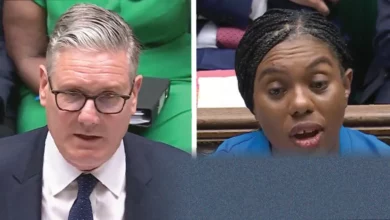
Across the Commons, Conservative leader Kemi Badenoch has adopted a forensic approach to the scandal, probing the detail to build a case against the prime minister. She has been a vocal critic, accusing Starmer of misleading Parliament and hammering the theme of flawed judgment. Her strategy appears to be playing a longer game, using the crisis to shape a political narrative of a Labour government mired in incompetence and secrecy so soon after taking office.
This attack forms part of a broader political strategy from Badenoch, who is seen as positioning the Conservatives further to the right, downplaying centrist ideas to focus on issues like immigration and economic prudence—a tack that has drawn criticism for potentially alienating moderate voters. For her, Labour’s turmoil is an opportunity to consolidate her own standing as opposition leader and define the post-Starmer political battlefield, should the prime minister’s position become untenable.