The fabric of local government in small-town America is being stretched to breaking point by a surge in data centre developments, sparking unprecedented civil discord, a wave of resignations, and a deepening crisis of trust between residents and their elected representatives.
In Ashville, Ohio, a village of fewer than 5,000 people south of Columbus, the mayor and a council member resigned abruptly late last year after public recoil over a proposed facility by Virginia-based EdgeConneX. The departures stripped the community of valuable administrative experience. More recently, the Ashville Village Council voted 4-2 to reject the annexation of approximately 400 acres tied to that project, though the company still plans to build on a separate 200-acre site already within village limits. EdgeConneX has reportedly agreed to fund a $35 million infrastructure project for sewer repairs and contribute $105 million to schools over 15 years, alongside funding for local emergency services.
Wilmington, Ohio: A $4 Billion Bargain and Rising Distrust
The tension is palpable in Wilmington, Ohio, where Amazon Web Services (AWS) plans a $4 billion data centre on 500 acres. The company is seeking a 30-year tax abatement, a deal that would see it exempt from property taxes for three decades in exchange for funding local schools and infrastructure. Critics note this amounts to a 70% tax reduction, with Amazon paying only 30% through a Payment in Lieu of Taxes (PILOT) agreement. They argue the concession is excessive, given that Ohio has repealed its corporate income tax, no longer taxes corporate personal property, and has a data centre incentive law exempting equipment from sales and use taxes.
Resident Quintin Koger Kidd, who last year filed a court complaint seeking the removal of the mayor and council over alleged open meeting violations, is aghast. “The people up on city council are, for the most part, good people. They care about the community, [but] they have been taken advantage of by these companies,” he says. “It’s the digital colonization of flyover states.”
The rezoning process has been criticized for a lack of transparency. Some residents say the first they heard of a critical compensation agreement was during a 7.15am school board meeting last November. The city council also wants to rezone an additional 545 acres from “rural residential” to allow data storage facilities. Meanwhile, the value of agricultural land near the proposed site reportedly soared from under $10 million in 2021 to $21 million by August of the following year. Property records from the Clinton County auditor’s office show a tract of over 280 acres is part-owned by a city council member.
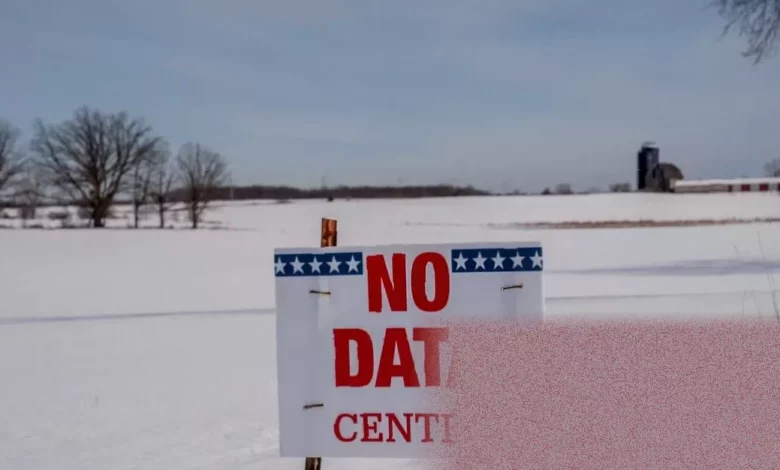
AWS states the project will create 100 permanent jobs with an $8 million payroll, a figure viewed skeptically in a community still scarred by the 2009 closure of a DHL Express facility that eliminated over 8,000 jobs. Lawn signs opposing the development are multiplying, and Koger Kidd, standing in a new housing development abutting the site, warns of noise from backup generators. Neither AWS nor Wilmington’s city council responded to requests for comment.
Legal Battles and “Exclusionary Zoning” in Saline Township
In Saline Township, Michigan, a rural community of 2,270 people, officials initially voted against rezoning agricultural land for a $7 billion, 1.4-gigawatt data centre proposed by a developer representing tech giants Oracle and OpenAI. Their resistance was short-lived. Within weeks, lawyers for the developer, Related Digital, and landowners sued, alleging the township was guilty of “exclusionary zoning”—a practice illegal in Michigan. The township quickly settled, setting the massive project in motion.
“In the 50 years I’ve spent practicing municipal law, this is one of the most divisive things I’ve seen,” says Fred Lucas, attorney for the township. “It’s been a nightmare. Every [public] meeting is filled with people calling for everybody to resign.” Some locals, livid, have sued township leaders for allegedly violating Michigan’s Open Meetings Act by making decisions in secret.
Related Digital claims the project will create 2,500 union construction jobs and thousands more in the wider community. A spokesperson, Natalie Ravitz, said, “We are developing on just 250 acres of the more than 1,000 acres we own – so 75% of the site is being preserved as open space, farmlands and wetlands.” The settlement includes conditions to protect farmland, preserve wetlands, and limit water use and noise.
Public Unrest and Environmental Fears
Community meetings have turned volatile elsewhere. In Port Washington, Wisconsin, three people were arrested at a city council meeting in December after a brawl erupted over a proposed data centre. A month earlier in DeKalb County, Georgia, police escorts were required at a council meeting discussing such developments. There, residents express concern about environmental impact, health effects, and the targeting of predominantly Black neighborhoods as “sacrifice zones.” The county has proposed a zoning amendment with stricter requirements on noise, water use, and distance from homes, but many feel these are insufficient. A temporary moratorium on new data centre approvals is in place until December 2025.
The Stark Economics and Heavy Toll
Experts point to a fundamental communication gap. “Both parties are talking past each other when it comes to the benefits and the costs that are associated with the data centres,” says Nicol Turner Lee, director of the Center for Technology Innovation at the Brookings Institution. “These are private corporations that, in many respects, have been given a lot of political deference to engage in this very accelerated behaviour.”
While developers tout job creation, research suggests operational roles are often few. A 2017 report estimated a typical large data centre employs around 1,700 during construction but only about 150 in ongoing operations. Tax breaks are frequently offered, though some studies indicate factors like construction costs and electricity access are more critical to siting decisions than subsidies.
The environmental and resource strains are substantial. Data centres require vast amounts of water for cooling; large facilities can consume up to 5 million gallons daily, comparable to a small town. By 2028, AI-related data centres in the U.S. could require up to 32 billion gallons annually. Energy consumption is equally daunting: modern AI facilities can use as much power as 100,000 homes, with data centres projected to account for up to 12% of all U.S. electricity consumption by 2028. This demand strains local grids and can raise prices for residents. Additionally, backup diesel generators release pollutants like nitrous oxides, worsening air quality.
Governance challenges are acute. Local authorities often have limited power over impacts, and negotiations with deep-pocketed developers are asymmetrical. The term “digital colonialism” is invoked to describe how Big Tech can dominate regional digital ecosystems, extracting value without equitable benefit sharing. Land use is transforming rapidly: the average data centre site now covers around 224 acres, a 144% increase since 2022, with hyperscale facilities exceeding 1,000 acres, often swallowing agricultural land.
As landowners assert their right to sell, and companies promise investment, the grassroots backlash underscores a profound dislocation. The administration of small towns, once centred on zoning amendments and road repairs, is now on the frontline of a national debate over technology, community autonomy, and who bears the cost of the digital age.