In the three years since a white van pulled up to a bus stop in Cuautla and snatched her son, Patricia García has learned to search for the dead. She probes the earth with metal rods alongside a collective of mothers, looking for the hidden graves that have become a grotesque feature of the Mexican landscape. They have found bodies, but not the one she seeks: her 31-year-old son, Ángel Montenegro, a construction worker who vanished after a night out with friends in August 2022.
Montenegro’s cap and a single tennis shoe were all that remained at the scene after he and a co-worker were dragged into the vehicle. The co-worker was released moments later; Montenegro was driven away, becoming one entry in a national registry of loss that now exceeds 130,000 people.
A Crisis Spinning Out of Control
According to a damning analysis by the public policy firm México Evalúa, reported disappearances in Mexico have skyrocketed by 213% in the last decade, rising from around 4,100 cases in 2015 to nearly 12,900 in 2025—a record high for new cases. Security analyst Armando Vargas described the situation as a problem that has become “uncontrollable at the national level,” one that “captures the lethal violence” engulfing the country.
The surge is inextricably linked to the expanding power and diversification of the country’s cartels. As these groups seize territory and move beyond drug smuggling into trades like organ trafficking, sex trafficking, and migrant smuggling, the abduction of people has become a routine tool. Forced recruitment, often targeting the young, fuels their ranks. “Expanding their ranks often involves forced recruitment, while taking over new territory requires the ‘annihilation of rival groups’,” Vargas said.
This territorial warfare is increasingly invisible. To avoid drawing official attention, cartels meticulously dispose of their victims, burying them in unmarked graves, burning them, or dissolving them in vats of acid. By making bodies disappear, criminal groups “invisibilize the violence, because that puts them under the radar,” Vargas explained. Some analysts suggest murders are being hidden within disappearance statistics, distorting the true picture of the carnage.
Geographies of Loss and a Tactic of Deception
The violence is not evenly distributed. States like Sinaloa, Sonora, and Baja California Sur record some of the highest rates, reflecting fierce cartel rivalries. Jalisco leads the nation in documented disappearances, with over 15,000 cases. There, groups like the Jalisco New Generation Cartel (CJNG) are known to use deceptive social media ads for fake jobs to lure recruits, some as young as 13. A third of the missing in Jalisco are aged between 15 and 29.
Women are disproportionately affected, accounting for nearly 23% of the 124,987 disappearances registered in the National Registry of Missing and Unlocated Persons (RNPDNL) as of March 2025. The State of Mexico presents a particularly alarming picture, accounting for almost half of the disappearances of women and girls in the region between 2018 and 2024.
The human cost is documented in clandestine gravesites across the country. Since 2006, nearly 5,000 bodies have been recovered from over 3,000 unmarked graves. In a single grisly discovery in January 2025, at least 56 bodies were found in mass graves in Chihuahua state. A ranch in Jalisco, linked to the CJNG, was revealed to be an extermination camp where victims were tortured and killed.
Institutional Neglect and a Rejection of Scrutiny
Analysts argue this criminal expansion advances in lockstep with state failure. “Criminal power advances in parallel with institutional neglect,” said Vargas. The government’s primary response, the National Search Commission launched in 2018, has been poorly funded and politicised. Its public platform became a liability, prompting then-President Andrés Manuel López Obrador to launch an opaque “review” that slashed the official number of disappeared to just 12,377 ahead of the 2024 elections.
The current president, Claudia Sheinbaum, has been dismissive of critical reports, stating that existing platforms have “a lot of problems” and promising more accurate data. Her first year in office, however, saw the crisis deepen, with over 14,800 people disappearing between October 2024 and October 2025—an average of 40 per day and a 20% increase on the previous year.
When investigations do occur, they are crippled by impunity. In 2022, over 96% of crimes in Mexico went unsolved, according to United Nations data. The rate is even worse for disappearances: nationally in 2021, only between 2% and 6% of cases were prosecuted, resulting in a mere 36 sentences. The government has also rejected claims by the UN Committee on Enforced Disappearances that the state systematically carries out enforced disappearances, calling the allegations unfounded.
President Sheinbaum has proposed reforms, including strengthening the Search Commission and scrapping the 72-hour waiting period to report a missing person. Yet families of the missing fear these measures are insufficient to tackle the entrenched corruption and incompetence that allow cartels to operate with such brazenness.
The Searchers Who Do the State’s Work
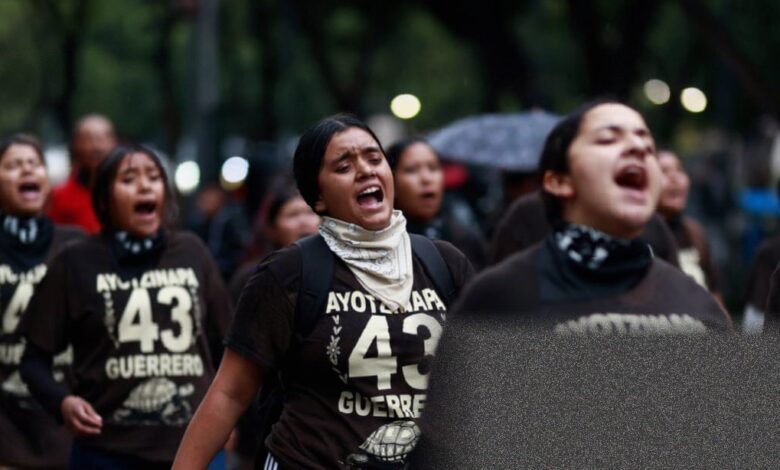
With the state’s response deemed inadequate, the desperate labour of finding the disappeared has fallen to families. Collectives of *buscadores*, or searchers, mostly women like Patricia García, weekly risk their lives to comb fields and scrubland. They are instrumental in discovering graves, yet they themselves face violence and threats; human rights defenders within these groups have been murdered or disappeared.
For García, the search for her son has been a gruelling odyssey. In November 2022, she and her collective searched a field on Cuautla’s outskirts where Montenegro’s phone last pinged. They found six bodies. They returned four months later and found five more. None were Ángel.
The work fractures a life. “You’re left in broken pieces,” García said. “It’s like when a vase shatters: you can glue it back together but the cracks are always there.” She continues, divided between caring for her family and probing the earth for answers, one of countless Mexicans living in the long, silent wake of a disappearance.