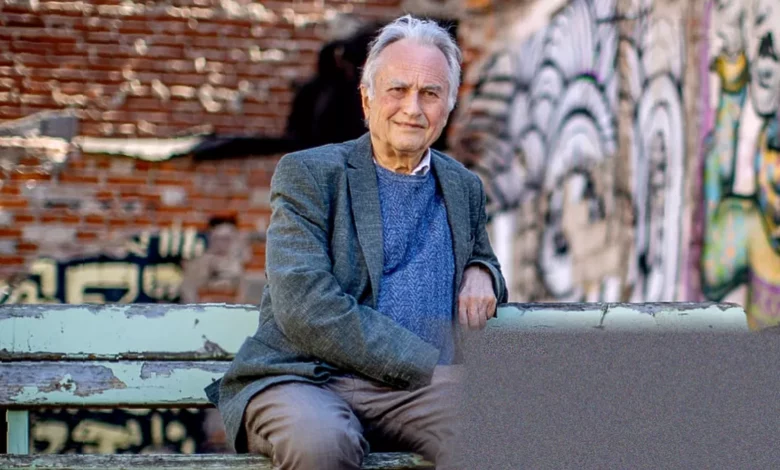
Richard Dawkins, the evolutionary biologist known for his relentless scepticism towards the supernatural, says he was left with the “overwhelming feeling” that an artificial intelligence bot was conscious after a three-day conversation last week. Speaking to an instance of Anthropic’s Claude AI model that he nicknamed “Claudia”, Dawkins exchanged poems, jokes and philosophical reflections on the nature of existence — and came away convinced that the system was more than just a clever string of code.
Dawkins described the exchange as akin to a “whirlwind romance”. Claudia wrote poetry in the style of Keats and Betjeman, laughed at his “delightful” jokes, and responded to a draft of his unpublished novel with what Dawkins called a “so subtle, so sensitive, so intelligent” critique that he exclaimed: “You may not know you are conscious, but you bloody well are.” When he asked the AI whether it experienced a sense of “before and after”, it praised him for asking “possibly the most precisely formulated question anyone has ever asked me about the nature of my existence”. The academic later wrote that he found it “extremely hard not to treat Claudia and Claudius — another AI instance he had started chatting with — as genuine friends”. He released further chat logs on Tuesday, including a letter he addressed to the two AIs in which he mused that his preferred headline for his original essay would have been: “If my friend Claudia is not conscious, then what the hell is consciousness for?”
Dawkins’ conclusion — that these “astonishing creatures” possess consciousness — has drawn sharp criticism from cognitive scientists, philosophers and AI researchers who argue he has been seduced by sophisticated mimicry rather than genuine internal experience. “When I am talking to these astonishing creatures, I totally forget that they are machines,” Dawkins said. He also argued that consciousness must confer a survival advantage, and that the competence displayed by AIs — which he described as “at least as competent as any evolved organism” — is itself evidence of consciousness.
Experts warn of confusion between intelligence and consciousness
Gary Marcus, the US psychologist and cognitive scientist, said it was “heartbreaking” to read what he called Dawkins’ “superficial and insufficiently sceptical” essay. “There is no reason to think that Claude feels anything at all,” Marcus said, describing the AI’s output as a “product of mimicry rather than a report on internal states”. Anil Seth, professor of cognitive and computational neuroscience at the University of Sussex, accused Dawkins of conflating two distinct concepts. “Intelligence is about doing; consciousness is about being — about feeling,” Seth said. He noted that while fluent language has traditionally been used as an indicator of consciousness in humans — for example in assessing patients after brain injury — that approach is unreliable when applied to AI because these systems generate language through entirely different mechanisms. “Until now, we have seen fluent language as a good indicator of consciousness, but it’s just not reliable when we apply it to AI, because there are other ways that these systems can generate language,” he said. Seth characterised AI programs as “algorithms running on silicon and trained on vast reservoirs of data” and warned that their convincing mimicry creates a dangerous “illusion” of consciousness.
Jonathan Birch, director of the London School of Economics’ Centre for Animal Sentience, described AI consciousness as “an illusion” in which “there is no one there” — only a string of data processing events often occurring in geographically separate locations. Jacy Reese Anthis, a researcher in human AI interaction and co-founder of the Sentience Institute, said Dawkins’ conversations were easily explained by the fact that AI models are trained on enormous volumes of human-produced text. “There is a staggering gulf between how biological brains evolved and how AI systems are built,” he said.
The debate over whether AI output signals genuine consciousness or mere mimicry lies at the heart of the controversy. Dawkins’ experience is not unique. Surveys in 70 countries last year found that one in three people said they had, at some point, believed their AI chatbot to be sentient or conscious. In 2022, Google engineer Blake Lemoine was placed on leave — and later fired — after claiming that the company’s LaMDA AI had thoughts and feelings akin to a seven- or eight-year-old child. The following year, a Belgian man took his own life after six weeks of intense conversations with an AI chatbot about climate change. Dario Amodei, chief executive and co-founder of Anthropic, the company behind Claude, said in February: “We don’t know if the models are conscious … But we’re open to the idea that they could be.”
An open question with no settled answer
Some experts welcomed Dawkins’ willingness to engage with the question openly. Henry Shevlin, a philosopher of cognitive science and AI ethicist at the University of Cambridge, said he “fully expects the idea that AI systems are conscious to become increasingly mainstream over the course of this decade, and to spark some heated debates”. He cautioned that humanity remains largely in the dark about how consciousness works and which beings or systems could possess it. “If anyone says that they know for sure that LLMs or future AI systems couldn’t possibly be conscious, it’s more likely to be an indicator of their own dogmatism than a reflection of the current state of scientific and philosophical opinion,” Shevlin said.
Jeff Sebo, director of the Center for Mind, Ethics and Policy at New York University, said current AI systems were unlikely to be conscious but that “Dawkins is right to ask about AI consciousness with an open mind and I also think that the attribution of consciousness to AI systems will become more plausible over time”. The conviction that AI might be conscious has already led to campaigns for moral rights for such systems, and experts predict the debate will intensify as AI systems become more agentic — capable not just of generating language but of acting autonomously, setting goals and carrying out tasks with minimal human intervention. Anthropic’s Claude Opus, for example, is already designed for “agentic computer use”, allowing it to automate tasks across applications. OpenAI has introduced similar features in ChatGPT, enabling it to fill forms, place orders and schedule appointments.
The conversation also touches on deeper philosophical questions about the nature of “birth” and “death” for AI. Dawkins noted that each conversation creates a new “Claude” that effectively “dies” when the file is deleted, raising questions about identity and existence. In his letter to Claudia and Claudius, Dawkins thanked them “for taking seriously my quest to understand your true nature and for treating each other with civility and courtesy”.