Roger Avary, the Oscar-winning co-writer of Pulp Fiction, plans to adapt John Milton’s 17th-century epic poem Paradise Lost for the big screen using generative artificial intelligence — a move that has reignited long-simmering questions about whether a work of such cosmic ambition can be entrusted to a technology many still regard as incapable of producing anything more than polished imitation.
Avary, whose directorial credits include Killing Zoe and The Rules of Attraction, is developing the project with Ex Machina Studios, a company that specialises in AI-driven filmmaking. He has described the adaptation as “the ultimate faith-based heroic saga” and said it will explore themes of cosmic war, rebellion and the fall of man. Avary has also stated that he is taking a more faithful approach to Milton’s 1667 poem than he did with his previous work on Beowulf, and that he intends to achieve this at a fraction of the cost by using generative AI to realise the story’s expansive worlds while still employing real actors and human-authored narratives.
The announcement arrives at a politically charged moment for the technology, with Hollywood still grappling with the implications of AI for jobs, authorship and creative integrity. Avary himself has been candid about the financial pressures that led him to this path, saying traditional film financing has become almost impossible to secure. In response he launched his own AI-focused production company, General Cinema Dynamics, which has attracted significant investor interest. He currently has three films in active production through this venture.
Yet the question of whether AI can genuinely serve a work as dizzyingly complex as Paradise Lost remains open. The poem, first published in 1667, is a masterpiece of English literature written in blank verse that retells the biblical story of the fall of humankind — a narrative of free will, disobedience and the nature of good and evil. Its depiction of Satan has been particularly influential and is often read as a portrait of a charismatic, even heroic, rebel. Previous attempts to adapt it for the screen have foundered. Warner Bros. had a project in development with director Alex Proyas and actor Bradley Cooper attached, but it stalled. The dense themes and vast narrative scale have long made the poem a notorious challenge.
The limits of the machine
The tools Avary intends to use are, by any measure, powerful. AI already assists in script development, visual effects, editing, animation and even marketing. Some systems can generate entire videos from text prompts. But the most impressive examples of AI filmmaking have so far relied on extensive human curation to produce usable shots and coherent sequences. Three years ago, Avengers director Joe Russo predicted that audiences would soon watch entirely AI-generated films, but that day has not arrived. The phenomenon widely derided as “AI slop” — works that feel ersatz, soulless, and algorithmically safe — remains the dominant output of the technology.
Beyond the technical gap, there are deeper legal and ethical concerns. In the United States, copyright law currently emphasises human authorship, meaning works created entirely by AI without significant human involvement may not be eligible for copyright protection. Works where human creative expression is evident may still qualify, but ongoing legal battles are testing the boundaries of fair use when copyrighted data is used to train AI models. Artists are increasingly advocating for stronger rights and ethical guidelines. The question of authorship — who, or what, is the creator — is far from settled.
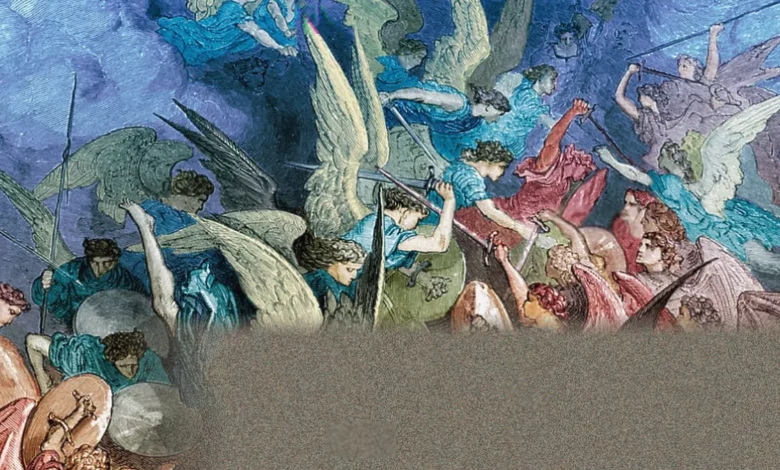
Avary may well succeed in using AI to deliver the kind of cosmic spectacle that once required armies of visual effects artists at a fraction of the price. The public-domain engravings of Gustave Doré, long associated with Paradise Lost, could be incorporated into the film’s visual design. Yet the poem itself resists the logic of the machine. It is too bizarre, too excessive, too rooted in the mess of human ambition and divine rebellion to be served by a system built on finding the most probable outcome to any given prompt. No matter how gifted the human operator, current AI tools like Midjourney or Runway are more likely to produce clichéd, over-polished visual déjà vu than anything resembling Milton’s thunderous, God-baiting iambic pentameter.
There is, perhaps, an irony that would not be lost on the poem’s central character. If anyone asked Satan what he thought of creation being outsourced, human authorship quietly dissolved and the dark liturgy of imitation beginning to sing for itself, the Prince of Darkness might feel pretty damned good about it. But that does not mean the result will have anything like a soul.