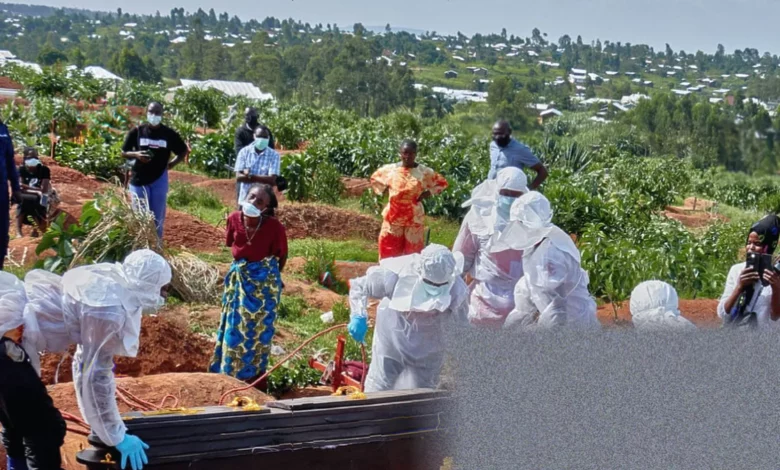
Four hospital staff have died from Ebola in the space of four days at a single medical centre in eastern Democratic Republic of the Congo, as the latest outbreak of the virus continues to exact a devastating toll on frontline healthcare workers.
Dr Vladimir Maduali, a 30-year-old doctor who graduated from the University of Bunia just three years ago, died in the early hours of Sunday at the Rwampara isolation centre after two days on oxygen therapy, according to his family. He was the fourth member of staff at his hospital to succumb to the disease in as many days. Two days later, Dr Tibenderana Katho Blaise also died of Ebola at the Bunia Evangelical medical centre in Ituri province.
Maduali had been working in the Rwampara region, one of the areas worst hit by the outbreak. His younger brother, Josué Maduali, described him as “passionate about medicine” from a young age, having studied maths and physics at secondary school before pursuing medicine at university with the aim of saving lives. The doctor was the main breadwinner for his family; an aunt had opened a small restaurant in his home city of Kisangani to raise money for his school fees.
“He was someone who was deeply committed to making a difference in the lives of communities,” said Dr Richard Lokudu, medical director of Mongbwalu hospital, about 45 miles from Bunia. “He was devoted to his work.”
Lokudu reported that since the outbreak was identified this month, a further five members of his staff are thought to have contracted the virus, three of whom have died, although testing has yet to catch up with the infections or the death toll. “We have already lost three nurses at our hospital. We assume they had been in contact with Ebola carriers; the test results may confirm or refute these assumptions. These nurses worked here with passion and, sadly, they are no longer with us,” he said, adding that two other nurses remain very sick.
‘We work like soldiers’
The conditions under which healthcare workers are operating to combat the virus are “precarious and agonising”, Lokudu said. “We who are fighting Ebola work like soldiers. It may well be that others, myself included, will follow Vladimir tomorrow. We are fighting for the same cause: to save human lives from this Ebola epidemic.”
The risks extend beyond hospital staff. Three volunteers from the Congolese Red Cross working at Mongbwalu hospital have also died over 11 days. The International Federation of Red Cross and Red Crescent Societies said in a statement on Saturday that the volunteers — Alikana Udumusi Augustin, Sezabo Katanabo and Ajiko Chandiru Viviane — “are believed to have contracted Ebola virus on duty, while carrying out dead-body management activities as part of a humanitarian mission unrelated to Ebola”.
The outbreak, caused by the Bundibugyo strain of Ebola for which there is no approved vaccine or specific treatment, was officially declared on 15 May in Ituri province. The World Health Organization has classified it as a Public Health Emergency of International Concern. According to the Congolese health ministry, more than 900 suspected cases and 220 deaths had been reported as of 25 May across the provinces of North Kivu, South Kivu and Ituri. The virus has also crossed into neighbouring Uganda, which has recorded seven confirmed cases and one death.
Health professionals say the outbreak — the 17th in the DRC since the virus was first identified in 1976 — was not detected quickly, a factor they believe contributed to its spread. Lokudu noted: “The problem is that the disease wasn’t recognised at the outset. It was only when we noticed the deaths of people on the frontline, that’s when we realised the problem was becoming increasingly serious and that we needed to investigate to find out what was causing the spate of deaths.”
The earliest known victims are believed to be the three Red Cross volunteers, who died between 5 and 16 May after contracting the virus on 27 March while handling bodies — before the outbreak had even been identified and while the community remained unaware of the danger.
Conflict, hunger and distrust compound the crisis
The response is being severely hampered by persistent insecurity in eastern DRC, where multiple armed groups — including the Allied Democratic Forces, CODECO militias and the Rwanda-backed M23 — are active. Humanitarian access is restricted, contact tracing and isolation of cases has become “nearly impossible”, and health facilities have come under attack. The WHO has called for an immediate ceasefire to allow effective intervention.
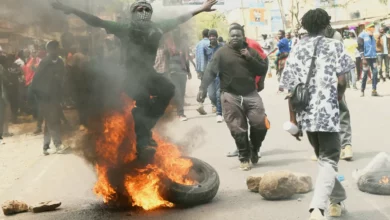
The region is also in the grip of a severe humanitarian crisis, with nearly 10 million people facing acute hunger, a factor that weakens individuals and makes them more vulnerable to infections. Widespread community mistrust towards health facilities and humanitarian organisations, fuelled by rumours, mystical perceptions of the disease and conspiracy theories that the outbreak is a hoax, has led to anger over restrictions on traditional burial practices and, in some cases, attacks on healthcare infrastructure.
Koko Buroko, an international relations analyst, said the dismantling of western development aid programmes has increased the vulnerability of rural communities. “Most African countries whose health sectors have not progressed rely on international aid. In a country like the DRC, health services are run by numerous organisations. Many NGOs in the development sector were funded by USAID, which no longer exists,” he said.
Infection prevention and control gaps within healthcare facilities themselves are a serious concern, with high transmission risks from patient to healthcare worker. Research from the 2018–2020 Ebola outbreak in the DRC identified factors such as high viral load, delayed admission, lack of prior vaccination, confusion, vomiting and sore throat as predictors of death among infected healthcare workers.
Professor Jean-Jacques Muyembe Tamfum, head of the National Institute for Biomedical Research and a co-discoverer of the Ebola virus in 1976, acknowledged the threat to frontline staff. “There is no cure for this disease,” he said. “Together with our partners, we are considering how to protect those on the frontline, including healthcare workers.”
In his final conversations with his brother, Dr Maduali was shocked at the possibility that he might have contracted Ebola. “Among the things he feared most was death. When he was admitted to hospital, he didn’t believe he could be suspected of having Ebola. His jaw dropped,” Josué Maduali recalled. “When he tested positive for Ebola, he was psychologically devastated.” Yet even then, he added, “when he was taken to isolation at Mongbwalu hospital, he told me he had a better chance of surviving this dangerous disease”. Josué Maduali now hopes the DRC’s leaders will honour the work his brother and other healthcare workers have done.