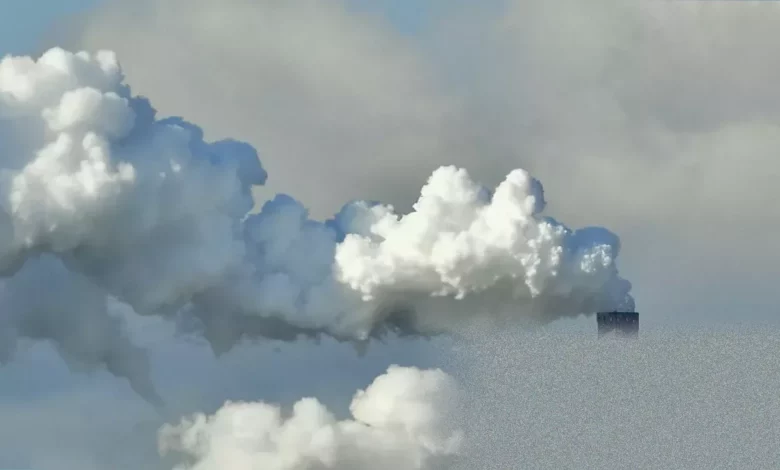
Germany’s efforts to cut its carbon footprint have stalled, with the country’s latest emissions data revealing a rate of progress so slow it raises serious questions about its ability to meet legally binding climate targets. According to the German Environment Agency (UBA), greenhouse gas emissions fell by a negligible 0.1% in 2025, a fraction of the reduction experts had expected and a stark contrast to the 3.4% drop achieved the previous year.
A Massive Gap Opens Between Reality and Target
The figures show Germany released 649 million tonnes of CO2 equivalent into the atmosphere in 2025. This was worse than the forecast by the expert group Agora Energiewende, which had anticipated a 1.5% year-on-year drop. The near-flatlining of emissions leaves the nation facing a daunting arithmetic challenge. To achieve its 2030 target of cutting emissions by 65% compared to 1990 levels, the country must now reduce emissions by an average of 42 million tonnes of CO2 equivalent every year from 2026 onward. That required annual cut is more than 40 times the reduction recorded last year.
Overall, Germany’s greenhouse gas emissions in 2025 were 48% below the 1990 baseline, with total emissions having fallen 49% since then. Projections cited in the research briefing suggest that with current policies, Germany might only achieve around a 63% reduction by 2030, narrowly missing its 65% goal.
Sectoral Failures Undermine Overall Progress
A deeper look at the data reveals where the problem lies. The slight overall reduction was largely due to a decline in industrial output driven by weak global demand and high energy prices—a symptom of economic weakness, not successful climate policy. Meanwhile, emissions in two key sectors, transport and buildings, actually increased in 2025, rising by 1.4% and 3.2% respectively compared to 2024.
Environment Minister Carsten Schneider, a Social Democrat, singled out these sectors as “particularly urgent,” warning that failure to curb their emissions could force Germany into the costly purchase of emission allowances from other EU member states or lead to fines. Under the EU’s Effort Sharing Regulation (ESR), projections indicate Germany could owe up to €16.2 billion due to shortfalls in these areas.
The energy sector, historically the driver of German emissions cuts, saw a 1.5% reduction in 2025 despite a weak year for wind. This was aided by record solar power generation, which made solar the nation’s second most important energy source, surpassing both lignite and gas. The share of renewables in gross electricity consumption rose to 55.3%, part of a national goal to reach 80% by 2030. However, the research briefing notes a concerning 16% decline in renewable energy output in the first half of 2025 compared to the same period in 2024, raising questions about reliability.
Political Winds Shift as Financial Deadlines Loom
The political landscape for climate action has shifted significantly. The pursuit of climate targets was a priority for the previous government of Olaf Scholz, but the current coalition under conservative Chancellor Friedrich Merz, in power since May 2025, has advocated for a more pragmatic approach, easing environmental standards and emphasising technological openness and industrial competitiveness.
Despite this, Minister Schneider struck a note of public optimism, welcoming a “growing enthusiasm for climate protection technologies” like electric cars and heat pumps, and pointing to a record number of newly approved wind power projects. He argued that accelerating the adoption of renewables was critical not just for the environment but for national security and economic strength. “Every additional kilowatt-hour of renewable energy makes our country less dependent on oil and gas and our energy supply more secure,” he stated at a Berlin conference.
Schneider announced plans for a comprehensive Climate Action Programme, legally required to outline measures for the 2030 and 2040 targets, to be adopted by the end of 2025. Critics, however, argue the government’s plans lack a credible implementation strategy. This scepticism is reflected in Germany’s international standing, as the country dropped six places to 22nd in the annual Climate Change Performance Index, with its national climate policy rated as “poor” by experts.
The clock is also ticking on new EU mechanisms. The introduction of the EU Emissions Trading System for transport and buildings (ETS 2), taking full effect in 2027, makes progress in these sectors crucial to avoid further consumer price increases. Furthermore, plans for new gas-fired power plants in Germany have drawn criticism for risking a fossil fuel lock-in.
As Europe’s largest economy and manufacturing powerhouse, Germany’s struggle sends a powerful signal across the bloc. The nation aims for climate neutrality by 2045, but the 2025 data shows that without drastic and accelerated action across all sectors—particularly transport and buildings—that goal appears increasingly distant, and the path to it increasingly expensive.