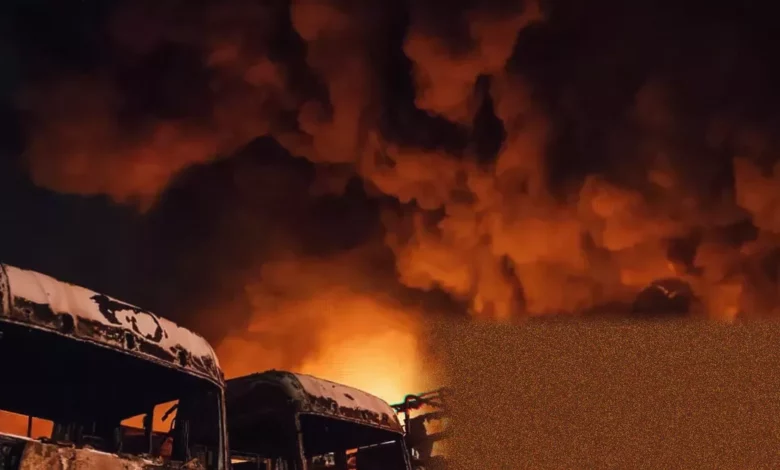
The world’s most important oil chokepoint has become a warzone. For the first time in decades, the Strait of Hormuz—the narrow seaway through which a fifth of the world’s oil and liquefied natural gas flows—has been effectively closed to commercial traffic for a week, stranding hundreds of tankers and triggering a global energy shock of historic proportions.
The closure, enforced by Iran’s Revolutionary Guards’ threat to “set ablaze” any vessel attempting passage, is the most severe consequence of the escalating US-Israel war with Iran. It has severed the primary export route for Gulf energy giants, pushing global oil prices back into triple-digit territory for the first time since Russia’s invasion of Ukraine.
Markets in Turmoil as Supply Vanishes
The immediate financial impact has been violent. Brent crude, the international benchmark, surged as high as $119.50 per barrel in Asian trading—a 29% leap and its highest level in four years. The West Texas Intermediate benchmark followed, hitting $119.48. The spike narrowed slightly to around $108 after reports that G7 finance ministers would discuss a coordinated release of petroleum reserves, but the panic had already infected equity markets.
Japan’s Nikkei 225 dropped 5%, South Korea’s Kospi plunged 6.6%, and Australia’s ASX 200 fell 2.9%, setting up a turbulent week worldwide. Pre-market data pointed to steep losses on Wall Street, with futures for the Dow Jones and S&P 500 down 1.5%.
The crisis has exposed a stark reality: without the Strait of Hormuz, the global oil system cannot function. With storage facilities in Saudi Arabia, the UAE, and Kuwait reaching their limits, major producers have nowhere to put their crude. The result is a cascade of production shutdowns. Kuwait Petroleum Corporation has implemented a precautionary cut and declared force majeure, citing explicit Iranian threats and a lack of available vessels. Iraq has also begun cutting output, while Qatar has already reduced LNG exports.
The physical damage is compounding the logistical blockade. At least five energy sites in and around Tehran were hit by strikes over the weekend, and an Iranian attack set Bahrain’s 350,000-barrel-per-day refinery ablaze, prompting its state oil company, BAPCO, to also declare force majeure.
A Stark Divide in Response
A profound gulf has opened between political rhetoric and market reality. US President Donald Trump described the soaring prices as a “very small price to pay” for “World, Safety and Peace,” claiming they were a “short term” consequence that would “drop rapidly” when the “Iran nuclear threat is over.” He has asserted the US has “no plans to target Iran’s oil industry.”
His energy secretary, Chris Wright, sought to calm nerves, telling CNN the disruption would last “weeks, this is not a months thing,” and attributing price surges to “emotional reactions and fear.”
These assurances are being drowned out by dire warnings from the region and stark analyst assessments. A spokesperson for Iran’s Revolutionary Guards warned the US and Israel: “If you can tolerate oil at more than $200 per barrel, continue this game.” Qatar’s Energy Minister, Saad Al-Kaabi, predicted oil could reach $150 a barrel within weeks if the strait remains closed, forcing all Gulf producers to declare force majeure.
Clayton Seigle, a senior fellow at the Center for Strategic and International Studies, stated the market’s “grace period” for the Trump administration had expired. “A deficit of 20m barrels per day is hitting global [oil market] balances with no sign of relief,” he said, adding that proposed US countermeasures—like rerouting crude or tapping emergency reserves—would be insufficient to offset such a catastrophic loss.
Global Ripple Effects and Stagflation Fears
The economic shockwaves are now crashing ashore, particularly in Asia, which is uniquely reliant on Middle Eastern energy. Approximately 70-78% of the region’s crude imports from the Gulf transit the Hormuz Strait. Japan and the Philippines source nearly 90% of their oil from the region.
Governments are scrambling with emergency measures. South Korean President Lee Jae Myung announced a cap on domestic fuel prices for the first time in nearly 30 years, calling the crisis “a significant burden on our economy.” The country is also searching for energy routes that bypass the strait. Bangladesh is closing all universities to conserve power, bringing forward the Eid al-Fitr holidays. Indonesia will use state funds to absorb price shocks, Vietnam has formed an energy task force, and Laos is working to prevent panic buying.
Economists warn the conflict risks re-igniting inflation globally. A sustained 10% rise in oil prices could push global inflation up by 0.4%, with US inflation potentially surging to 3.7% if prices hold at $100 a barrel. The toxic combination of soaring energy costs and tumbling stock markets has revived fears of 1970s-style stagflation.
The situation remains fluid and perilous. With the Strait of Hormuz—a trade artery vital to the global economy—transformed into a maritime battlefield, the world is now holding its breath, waiting to see whether diplomatic or military developments can reopen the taps before the economic damage becomes irreversible.