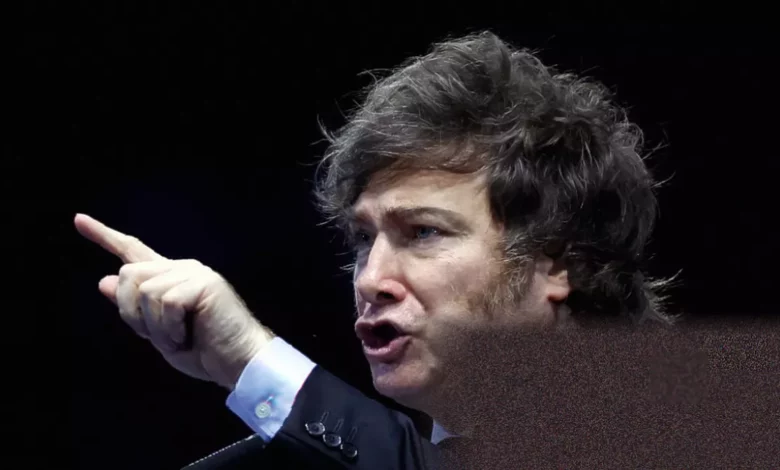
Argentine President Javier Milei is facing the lowest approval ratings of his presidency, a slump directly tied to explosive allegations of a $5 million financial agreement connected to his promotion of a failed cryptocurrency, $Libra, which has plunged the country’s crypto sector into crisis.
The Allegations: Calls, Contracts and “Cryptogate”
At the heart of the scandal, dubbed “Cryptogate,” is a document allegedly recovered by state investigators from the cellphone of crypto lobbyist Mauricio Novelli. This financial agreement, first published by the investigative outlet El Destape, reportedly outlines a $5 million deal, with payments of $1.5 million, $1.5 million and $2 million made in three phases to entities connected to President Milei.
This directly contradicts Mr Milei’s initial claim that he discovered $Libra online and decided to promote it independently. Federal prosecutors, who have obtained phone logs as part of their investigation, assert the president had insider knowledge prior to the token’s public launch. According to those logs, reported by La Nación, Mr Milei communicated with Mr Novelli at least five times—and as many as seven times, according to other reports—in the minutes before his promotional tweet on 14 February 2025. At the time, Mr Novelli was in Texas with colleagues from the $Libra project.
The federal investigation, which identifies the president as a “person of interest,” has also examined draft documents on Mr Novelli’s device detailing potential plans for payments tied to Milei publicly endorsing an American consultant. While no confirmation of funds being exchanged has been made, a separate criminal complaint has been filed against President Milei in Spain, alleging fraudulent operations. Furthermore, a Congressional commission described his involvement as “essential collaboration” and recommended Congress evaluate his actions.
A Token’s Meteoric Rise and Catastrophic Fall
The object of this alleged deal was $Libra, a niche cryptocurrency created by Delaware-registered Kelsier Ventures, whose CEO, Hayden Davis, had previously met with Mr Milei. The president’s tweet endorsing the token, which he claimed was “boosting the growth of the Argentinian economy”, triggered an immediate speculative frenzy.
The price of $Libra quickly soared to a peak of $5 before collapsing to less than $1, wiping out an estimated $250 million in investments held by 13,000 token holders. President Milei later deleted his promotional posts, stating he was not fully informed of the project’s details. American analyst Nick O’Neill has claimed with “100% certainty” that payments were involved in $Libra’s development and launch.
The scandal erupted at a precarious time for Argentina. The libertarian president had introduced strict austerity measures to curb rampant inflation, triggering a recession. While the country is beginning to recover, the $Libra affair has severely damaged the reputation of digital assets, slowing regulators’ efforts to integrate crypto into the mainstream financial system.
Rehabilitation and Regulatory Reality
In the scandal’s immediate aftermath, prominent figures in the crypto world attempted to mount a rescue operation for the sector’s reputation in Argentina. Vitalik Buterin, the founder of Ethereum, made a direct appeal to President Milei via social media, suggesting that hosting Devconnect—a major Ethereum conference—in Argentina could “show the best of what crypto can offer”. Mr Milei responded positively, framing it as an “honor for Argentina”.
The event, described as an “Ethereum World’s Fair”, was ultimately held in Buenos Aires in November 2025, drawing over 17,000 global attendees. Local crypto advocates, primarily from the group Crecimiento, saw it as a crucial opportunity for image repair. Emi Velazquez, an entrepreneur and former director of Crecimiento, stated the group helped secure preferential visa status for attendees, a key factor in deciding the conference’s location.
On stage, Mr Buterin explicitly distanced Ethereum from scams, calling out the bankrupt exchange FTX and its jailed founder, Sam Bankman-Fried, for “currying favor with politicians”. He argued Argentina’s high crypto adoption rate made it a “great place” to see blockchain interact with the wider world.
Argentina's Ethereum community is full of amazing builders, who have already contributed some of the most important software in the Ethereum ecosystem.
The energy and determination to build on Argentina's current momentum and use crypto and other new technologies to build a… https://t.co/E87Mll5nNH
— vitalik.eth (@VitalikButerin) February 20, 2025
According to Maria Milagros Santamaria, who previously led Crecimiento’s regulatory efforts, crypto’s status in Argentina has been tied to three key milestones since Mr Milei took office. The first was the $Libra scandal itself, which caused some regulators to retreat. The second was Devconnect, which helped bring most back to the discussion table. By that point, Argentina’s securities regulator, the CNV, had begun overseeing a regulatory sandbox for crypto and fintech startups—a framework launched in April 2025 to pilot asset tokenization.
The third milestone, the most recent tranche of evidence concerning Mr Milei’s alleged role, has compromised that momentum. Ms Santamaria noted that the Central Bank of Argentina (BCRA) was slated to begin allowing banks to offer crypto services in April 2026, reversing a 2022 ban, but the status of that rollout is now unclear. Despite this, regulatory progress has not fully halted. On 7 April 2026, the CNV recognized cryptocurrencies including ether as counting toward investors’ personal net worth, effectively allowing crypto holders to qualify as “qualified investors” for more sophisticated financial products.
Ms Santamaria said crypto advocates feel “disbelief and disappointment” but are still trying to build despite the scandal. The president’s long-term political prospects remain uncertain, having bounced back from low ratings before. For Argentina’s crypto sector, the dream of capitalising on the country’s economic instability as a “perfect storm” for growth now contends with the lasting shadow of an alleged $5 million deal at the very top.