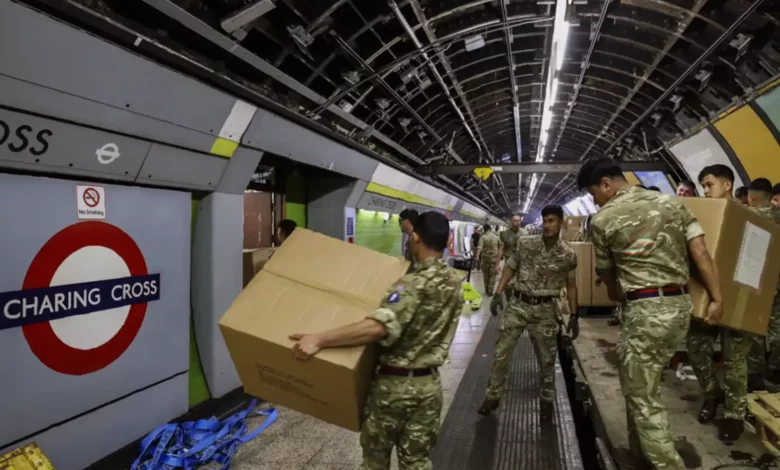
NATO soldiers have been training in a disused London Underground station, transforming the abandoned Jubilee line platforms at Charing Cross into a wartime command bunker for a major military exercise.
The operation, codenamed Arrcade Strike, was led by the Allied Rapid Reaction Corps (ARRC) — NATO’s premier deployable corps headquarters, which is under British Army command. For a week, hundreds of uniformed personnel worked deep beneath central London, rehearsing how to plan and direct a large-scale conflict involving around 100,000 troops from Britain and allied NATO nations. Commanders coordinated operations across land, sea, air, cyberspace and even space from the subterranean headquarters.
The exercise simulated a fictional scenario set four years in the future, in 2030 — a period military planners have identified as potentially the peak of Russia’s threat to NATO. The specific hypothetical scenario involved defending Estonia from a Russian invasion, triggering Article 5, NATO’s mutual defence clause. A senior commander said of the exercise: “Arrcade Strike is not a conceptual exercise. It is a rehearsal of the plans we already have and a demonstration of our ability to fight and therefore to deter.”
Survivability drives shift underground
A central focus of Arrcade Strike was survivability. Modern military headquarters are increasingly seen as vulnerable targets, forcing armies to rethink where and how command centres are based. One commander explained during the exercise: “We have moved from operating in tents and open environments, to commercial buildings, to aircraft hangars, and now to underground locations. Operating below ground significantly reduces our signature, makes us harder to find, and improves our chances of surviving attack.”
That shift reflects lessons already emerging from the conflict in Ukraine and from NATO’s eastern flank, where concealment and hardened infrastructure have become essential rather than optional. The use of the disused Charing Cross platforms was not about preparing to actually use Tube tunnels as a permanent command centre, but about testing and ironing out the difficulties of using tunnels anywhere as bunkers if needed. The location was chosen because the abandoned platforms offered a rare combination of security, enough space for a fully functioning headquarters, and a central urban setting that proved the concept could operate in the middle of a dense city.

The move underground represents a fundamental change in military thinking. In the past, commanders operated from tents in open environments or from commercial buildings and aircraft hangars. Now the emphasis is on hardened, concealed locations that can survive a first strike. The ARRC is part of a broader NATO effort to create a fully mission-capable Strategic Reserve Corps by 2030, and exercises like this are seen as essential to demonstrating that deterrence is active, not passive.
New technologies and formations on show
At its peak, around 500 personnel were working underground, processing more than ten terabytes of operational data every day — roughly equivalent to streaming high-definition Netflix continuously for nearly three months. That data flow was managed with the help of Project Asgard, an AI-powered battlefield management platform that combines information from sensors, satellites and intelligence feeds to help commanders make decisions faster than an opponent can react. Asgard was first announced by the British Army in October 2024 and has undergone testing in Estonia. The army has committed significant funding to its development, aiming to dramatically increase lethality by 2027 and 2030.
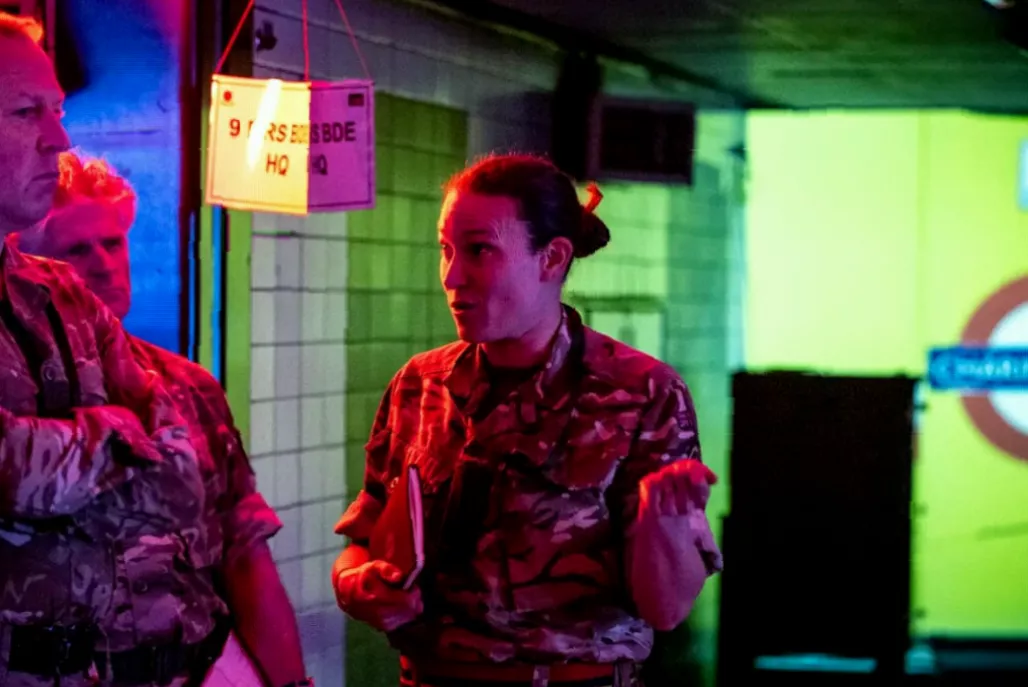
The exercise also served as the public debut of the British Army’s newest formation, 9 Deep Recce Strike Brigade (9 DRS). The brigade is designed to locate enemy forces at long range and destroy them before they can act. Its arsenal includes surveillance drones, long-range precision rockets capable of striking targets up to 150 kilometres away, and one-way attack drones with ranges of up to 600 kilometres. The concept is to combine deep fires with reconnaissance and non-lethal effects, providing persistent surveillance and long-range precision strike capability — effectively blinding the enemy before they can blind NATO forces.
The increased reliance on drones and long-range strike capabilities, however, comes against a backdrop of concern about stockpiles. Reports have suggested the British military may have a significant shortfall in drone stockpiles, potentially being able to sustain operations for only about a week at current levels. The ARRC’s underground exercise did not address that directly, but underlined the growing strategic importance of such systems.
Logistics and secrecy: getting a headquarters into a Tube station
Getting an entire military headquarters into a disused Underground station without attracting attention was itself a complex logistical exercise. Major Joe Harris of 14 Squadron RLC, the logistician overseeing the operation, explained that the equipment was moved in unmarked civilian vans to Ruislip at 1.30am before being transferred onto a specialist Transport for London engineering train — effectively a cargo version of a Tube train fitted with a crane. From there, the equipment was taken directly into Charing Cross, where teams spent a week constructing the underground headquarters alongside 22 Signal Regiment, which installed the communications systems.
The disused Charing Cross Jubilee line platforms have been closed to passengers since 19 November 1999, when the Jubilee line extension bypassed the station in favour of Westminster. They have previously been used for filming, including the James Bond film Skyfall, The Bourne Ultimatum, Thor: The Dark World and Paddington, and are still used by non-passenger Jubilee line trains as sidings for reversing during engineering works. For the exercise, the constrained layout of tunnels and platforms presented a unique challenge compared with the wide-open rectangular spaces of a warehouse, which would be the usual location.
“The difference between being here and in an old warehouse, which would be our usual location, is that a warehouse would be a wide-open rectangular space, and this is a constrained layout with a warren of tunnels and train platforms,” Major Harris said. “We’ve got to get out of the mindset of Afghanistan, where we move in and create a space from scratch. Now we need to find a ready-made safe space and set ourselves up accordingly.”
The ARRC plans to continue testing underground headquarters across Britain and Europe over the coming years as NATO works towards establishing a fully mission-capable Strategic Reserve Corps by 2030. German intelligence has warned that Russia could be ready to attack NATO countries by that date, and the exercise was designed as a direct response to that evolving threat. The systems, command structures and tactics rehearsed during Arrcade Strike are already operational, not conceptual.