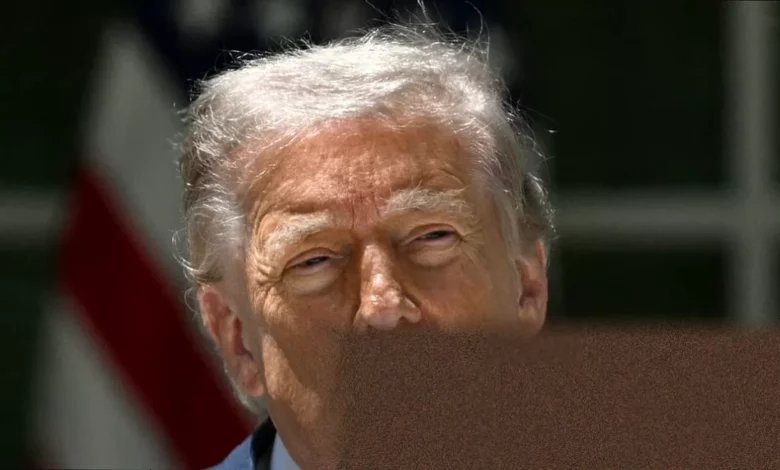
The US blockade on Iranian ports will remain in “full force” until a final agreement is reached, President Donald Trump said in a post on Truth Social, underlining the administration’s insistence on a formal deal before any easing of economic pressure. Trump described the talks as “proceeding in an orderly and constructive manner” and told his representatives not to “rush” because time is on their “side”. “Both sides must take their time and get it right. There can be no mistakes!” he wrote.
Trump’s Stance and the Framework Taking Shape
In his post, Trump echoed the comments already made by US Secretary of State Marco Rubio, declaring that Iran cannot “develop or procure” a nuclear weapon or bomb under any circumstances. He claimed that the US relationship with Iran was becoming much more “professional and productive” and thanked Middle Eastern countries for their “support and cooperation”. The president contrasted his efforts with the 2015 nuclear deal negotiated by Barack Obama – the Joint Comprehensive Plan of Action (JCPOA) – which he called one of the “worst” deals the US had ever made, a “direct path to Iran developing a Nuclear Weapon”. Trump promised that whatever agreement he reaches will be “the exact opposite”. He unilaterally withdrew from the JCPOA in 2018, upsetting European allies, and reinstated sanctions. After the US launched an unprovoked attack on Iran in February, Trump now appears to be chasing a deal along similar contours – and may even be offered worse terms, according to the reporting of Oliver Holmes.
Rubio, speaking to reporters in New Delhi during a diplomatic visit to India, said he believed there was “the possibility that in the next few hours the world will get some good news”. He acknowledged that “significant” progress had been made in the peace talks but cautioned that this was not “final” progress. The secretary of state described the path to a durable agreement as requiring “full Iranian acceptance and then compliance”, with “future work” needed to finalise “the details”. On the nuclear programme, he said, “these are highly technical matters and ones that would probably need to be addressed over some period of time”. Responding to criticism from senior Republicans, Rubio insisted that Trump’s commitment to preventing Iran from ever possessing a nuclear weapon is unwavering and that the idea the president would agree to a deal putting Iran in a stronger position is “absurd”.
The deal being floated with Iran seems straight out of the Wendy Sherman-Robert Malley-Ben Rhodes playbook: Pay the IRGC to build a WMD program and terrorize the world.
Not remotely America First. It’s straightforward: Open the damned strait. Deny Iran access to money. Take out…
— Mike Pompeo (@mikepompeo) May 23, 2026
The Proposed Deal: Strait of Hormuz and Nuclear Programme
Official details of the potential agreement remain scant, but sources have told Reuters that the proposed framework would unfold in three stages: formally ending the war, resolving the crisis in the Strait of Hormuz, and launching a 30‑day window for negotiations on a broader agreement, which can be extended. A US official told Axios that the deal would involve a 60‑day ceasefire extension during which the strait would be reopened, Iran could freely sell oil, and talks on limiting Iran’s nuclear programme would be held. Two Pakistani sources said that, according to the proposed memorandum, the strait would be opened immediately after the US lifted its blockade. Rubio has stated that, if the outline is agreed, it would mean “completely open straits” and “without tolls”.
The detail of the proposed deal’s terms regarding the strait is critical. Under the current draft, Iran would reportedly clear the mines it deployed in the waterway and not impose any tolls on ships. In exchange, the US would lift its blockade on Iranian ports that has been in effect since 13 April. However, Iran’s Tasnim news agency, affiliated with the Islamic Revolutionary Guard Corps, said any changes in navigation through the Strait of Hormuz were conditional on implementation of other commitments by the US, and that some Iranian funds frozen globally as part of sanctions must be released in the first phase. Iranian media also reported that the strait would remain under Iranian control. A senior Iranian source told Reuters that if Iran’s Supreme National Security Council approved the memorandum, it would be sent to Supreme Leader Mojtaba Khamenei for final approval. No verified recording or visual sighting of Khamenei has been broadcast since he was appointed in early March; reports suggest he was severely injured in the February bombing that killed his father, the previous supreme leader. The IRGC‑affiliated Tasnim news agency said Tehran has made no commitments in the draft agreement to hand over any of its nuclear material, and that all issues “regarding the nuclear matter” have been postponed. The current draft, it said, is limited to “ending the war”.
On the nuclear front, a senior Iranian source confirmed to Reuters that Tehran had not agreed to hand over its highly enriched uranium (HEU) stockpile, and that the nuclear issue was not part of the preliminary agreement. This came after the New York Times, citing two US officials, reported that Tehran had apparently expressed a willingness to give up its stockpile. Even if that were to happen, there has been no mention of how this would work in practice. There has also been little mention of Iran’s ballistic missile programme or the curbing of its support for regional allies such as Hezbollah in Lebanon and the Houthis in Yemen.
Not quite the path Wendy, Ben or I would have taken. But if this deal brings an end to an unlawful, unjustifiable war, to the senseless loss of life and destruction, and to the cascading global economic fallout, I am quite sure we’d willingly accept it over the alternative.… https://t.co/4IuGpYBANH
— Robert Malley (@Rob_Malley) May 23, 2026
The Strait of Hormuz is a vital chokepoint for global energy security: more than 20% of the world’s liquefied natural gas and 25% of seaborne oil trade passes through it annually. Major exporters including Saudi Arabia, Iraq, Kuwait, Qatar, the UAE and Iran rely on this route. US intelligence assesses that Iran is not currently building a nuclear weapon but has activities that position it to produce one if it chooses. Iran has increased its stockpiles of enriched uranium and operates advanced centrifuges. The JCPOA, negotiated in 2015, aimed to restrict Iran’s nuclear programme in exchange for sanctions relief, but the US withdrawal in 2018 led Iran to expand its activities. Iran’s ballistic missile programme is the largest and most diverse in the Middle East, intended for deterrence and regional power projection. Meanwhile, Iran remains a key patron of Hezbollah, providing substantial financial, military and training support, and the group is considered part of the “Axis of Resistance”.
International Reactions and Regional Fallout
News of the potential US‑Iran deal triggered dismay among Republican hawks. Mike Pompeo, who served as CIA director and secretary of state during Trump’s first term, denounced the proposed agreement as too close to what Barack Obama’s negotiators had achieved and a boon to Iran’s Islamic Revolutionary Guard Corps. “The deal being floated with Iran seems straight out of the Wendy Sherman‑Robert Malley‑Ben Rhodes playbook: Pay the IRGC to build a WMD program and terrorize the world,” Pompeo wrote on social media. He added that the alternative is “straightforward: Open the damned strait. Deny Iran access to money. Take out enough Iranian capability so it cannot threaten our allies in the region.” Robert Malley, a former Obama negotiator, responded: “Not quite the path Wendy, Ben or I would have taken. But if this deal brings an end to an unlawful, unjustifiable war, to the senseless loss of life and destruction and to the cascading global economic fallout, I am quite sure we’d willingly accept it over the alternative.”
The Israeli government issued its first response via an unnamed official, who told the New York Times that Benjamin Netanyahu had discussed the agreement with Donald Trump by phone last night. The official described the deal as an initial understanding about the reopening of the Strait of Hormuz that would lead to further talks. Netanyahu made clear to Trump that Israel would not be constrained in responding to “all threats”, including across the border in Lebanon. The official indicated that Netanyahu actually wants to resume the war on Iran in order to degrade its military capabilities further and continue attacks on its infrastructure. Netanyahu is expected to convene a “limited” security cabinet meeting this evening to discuss the deal. The draft agreement could include ending the war on all fronts, including Israel’s assault on Lebanon – something Netanyahu, who is pushing for the complete disarmament of Hezbollah, is unlikely to welcome. Israel has continued striking Lebanon regularly, both south and north of the Litani River, despite a US‑brokered ceasefire coming into effect last month. Hezbollah has fired rockets and drones into northern Israel and against Israeli troops in southern Lebanon. According to the Lebanese health ministry, at least 3,111 people have been killed in Israeli attacks since the latest round of fighting between Hezbollah and Israel started on 2 March. More than one million people have been displaced by the renewed Israeli war on Lebanon, which began after Hezbollah launched missiles at Israel on 2 March in response to the US‑Israeli bombing of Iran in late February. International law experts say Israel’s evacuation warnings are inconsistent and often overly broad and open‑ended, with sometimes no warning at all before airstrikes.
I welcome the progress towards an agreement between the US and Iran.
We need a deal that truly de-escalates the conflict, reopens the Strait of Hormuz and guarantees toll free full freedom of navigation.
Iran must not be allowed to develop a nuclear weapon.
It must also end…
— Ursula von der Leyen (@vonderleyen) May 24, 2026
European Commission President Ursula von der Leyen welcomed the progress towards an agreement. “We need a deal that truly de‑escalates the conflict, reopens the strait of Hormuz and guarantees toll‑free full freedom of navigation. Iran must not be allowed to develop a nuclear weapon,” she wrote on X. She added that Iran must also end its “destabilising actions in the region, directly or through proxies, as well as its unjustified and repeated attacks on its neighbours.” UK Prime Minister Keir Starmer also voiced support, saying: “I welcome the progress towards an agreement between the US and Iran. We need to see an agreement that brings the conflict to an end and reopens the strait of Hormuz, with unconditional and unrestricted freedom of navigation. It’s vital that Iran must never be allowed to develop a nuclear weapon.” Starmer said his government would “continue to do everything we can to protect British people from the impact of this conflict” and work with international partners to “seize this moment and achieve a long‑term diplomatic settlement.”
In a separate development, a Bahraini court sentenced nine defendants to life in prison and two others to three years in jail for collaborating with Iran’s Revolutionary Guard Corps to carry out what the state news agency described as “hostile and terrorist acts” against the kingdom. The defendants were involved in gathering information on sensitive sites and facilitating related financial transfers. Bahrain’s interior ministry had earlier said on 9 May that it had arrested 41 people linked to the IRGC. Those arrests followed a wave of Iranian strikes on Bahrain after the US and Israel launched their war on Iran in late February.
Amid all this, Rubio struck a cautious tone. “When you are talking about a nuclear programme, as an example, these are highly technical matters and ones that would probably need to be addressed over some period of time,” he said. He reiterated that the conflict will be “solved one way or the other”, with diplomacy the preferred method. Despite heavy waves of US and Israeli airstrikes that have degraded Iran’s military capabilities, many of Trump’s core objectives remain unfulfilled. A stockpile of highly enriched uranium is still believed to remain buried following US and Israeli airstrikes last June, and Iran reportedly retains much of its pre‑war missile stockpile despite the attacks.