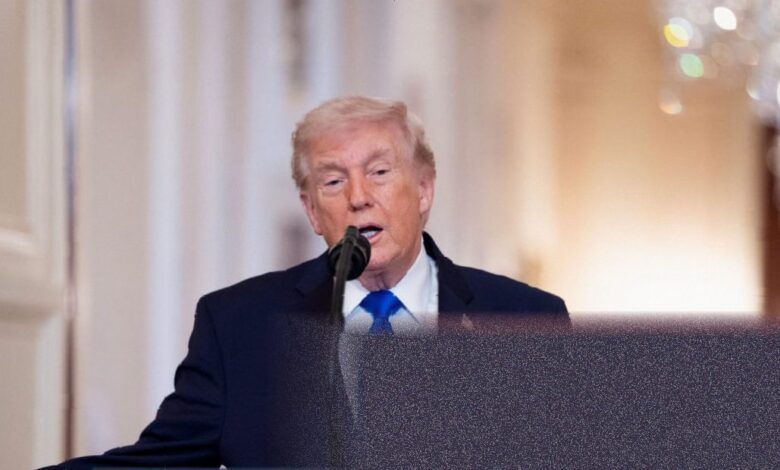
President Donald Trump’s new global tariffs have come into force at a rate of 10%, a direct response to a US Supreme Court ruling that struck down his previous “reciprocal” import taxes. The 6-3 decision on Friday found the president had overstepped his authority under the International Emergency Economic Powers Act, affirming that the power to tax lies with Congress. Hours after the ruling, Mr Trump signed an executive order authorising the fresh 10% levy, which took effect at 12.01am on Tuesday in Washington. He has since threatened to raise the rate to 15%, and officials in the White House are working on a formal order to that effect, according to a Bloomberg report.
The new duties are being applied under Section 122 of the 1974 Trade Act, a rarely used provision that allows the president to impose tariffs of up to 15% for a maximum of 150 days to address balance-of-payments problems. This legal manoeuvre, considered unprecedented by trade experts, has triggered immediate uncertainty among key US trading partners. The president has declared he can now use tariffs in a “much more powerful and obnoxious way”.
International Partners Seek Clarity
The European Union has paused the ratification process of its trade deal with the US for the second time in a month, citing a departure from the terms agreed at Turnberry, Scotland, last July. That deal aimed for a maximum tariff of 15% on most European imports. Bernd Lange, chair of the EU Parliament’s trade committee, stated that the new US duties could result in higher levies on some EU products and that the bloc seeks clarity from Washington. Meanwhile, the UK government, which had negotiated a 10% rate with the US last year, has not ruled out retaliation. A spokesperson for Keir Starmer said “nothing is off the table,” but emphasised a priority for “constructive engagement” to avoid escalation.
China, a major beneficiary of the Supreme Court’s ruling against the earlier tariffs, said it would decide whether to retaliate “in due course”. A commerce ministry official told Reuters that Beijing consistently opposes unilateral tariff measures and urged the US to cancel them. Last year, China had retaliated with counter-tariffs on American agricultural and energy goods. President Trump is scheduled to visit China from 31 March to 2 April for talks with President Xi Jinping.
Market Jitters and Economic Warnings
European markets opened lower, with the UK’s FTSE 100 down 0.25%, Germany’s Dax off 0.2%, and the continent-wide Stoxx Europe 600 slipping 0.2%. The UK’s Unite Group was the worst performer, its shares falling more than 8% after reporting weaker demand from international students. William Bain, head of trade policy at the British Chambers of Commerce, warned that the persistent uncertainty makes it “very difficult for firms” to plan exports and could hit the economy.
Concerns over credit quality weighed on banking shares, with Lloyds, NatWest, and Barclays all down between 1.5% and 2%. These fears echoed warnings from Jamie Dimon, chief executive of JPMorgan, who told investors he was starting to see parallels with the pre-2008 financial crisis era, noting “a couple people doing some dumb things” to boost net interest income. However, Kathleen Brooks of broker XTB suggested markets might be overreacting, pointing to low European corporate default rates of 4.4% at the end of 2025 and only $3.9bn in high-yield debt defaults last year.
Oil prices touched seven-month highs, with Brent crude reaching $72.50 a barrel, as traders priced in a risk premium ahead of nuclear talks between the US and Iran in Geneva on Thursday. Analysts at Shore Capital and Phillip Nova cited fears of military escalation disrupting global supplies. In other markets, Bitcoin continued its slide, falling 2% to $63,149 and heading for its worst monthly performance since June 2022.
On the UK high street, the CBI’s distributive trades survey showed retail sales volumes fell at a sharp pace in February, with the balance slumping to -43 from -17, which it attributed in part to the relentlessly soggy weather dampening footfall. Its economist, Martin Sartorius, noted that while online shopping was up, it was insufficient to offset the decline. More optimistic forward-looking indicators suggested expected sales volumes for March were at their strongest in six months.
Tech Sector Sees Major Deal and AI Anxiety
In a blockbuster move for the artificial intelligence sector, Meta has agreed to a multi-billion dollar deal with Advanced Micro Devices (AMD) to purchase $60bn worth of AI chips over five years. The agreement will enable Meta to deploy six gigawatts of computing power, starting with one gigawatt of AMD’s forthcoming MI450 flagship hardware in the second half of this year. AMD chief executive Lisa Su said the social media giant was “making a big bet on AMD,” with the deal also including customised central processors tuned for performance and energy efficiency. As part of the pact, Meta receives a performance-based warrant to acquire up to 160 million AMD shares. AMD’s stock was poised to jump, trading 10% higher in pre-market trading.
Separately, a stark report on AI risks has injected volatility into tech stocks. The research firm Citrini published a “thought experiment” titled “The 2028 Global Intelligence Crisis,” which outlined a hypothetical scenario where rapid AI adoption leads to a 10.2% unemployment rate, a 38% stock market crash, and a systemic mortgage crisis by 2028. The report, which warned of “ghost GDP” from displaced white-collar jobs, triggered a sell-off in software and payment stocks. In a related development, IBM’s shares suffered their worst single-day drop in 25 years, plummeting 13% after AI startup Anthropic announced its Claude Code tool could modernise COBOL systems, a core business for IBM.
Legal and economic debates continue to swirl around the tariff measures. Logistics giant FedEx has sued the US government, seeking a refund of duties paid under the now-invalidated reciprocal tariffs, naming US Customs and Border Protection and its commissioner as defendants. Some economists have contested the premise of the new tariffs. Gita Gopinath, a former International Monetary Fund first deputy managing director, told Reuters that the US is not facing a balance-of-payments crisis, rejecting the White House’s use of trade deficit figures to justify the move. Analysts like Neil Wilson of Saxo Markets warn that the Supreme Court ruling may have the “unintended consequence” of escalating a trade war, as President Trump has warned countries not to “play games” with the decision.
Investors are now awaiting President Trump’s State of the Union address tonight for further clues on trade policy. Susannah Streeter, chief investment strategist at Wealth Club, noted the administration is also considering new tariffs under national security pretexts on sectors including batteries, chemicals, and telecoms equipment. Jim Reid of Deutsche Bank suggested the effective tariff rate may still fall this year, but acknowledged the situation is “more ambiguous” than a week ago.