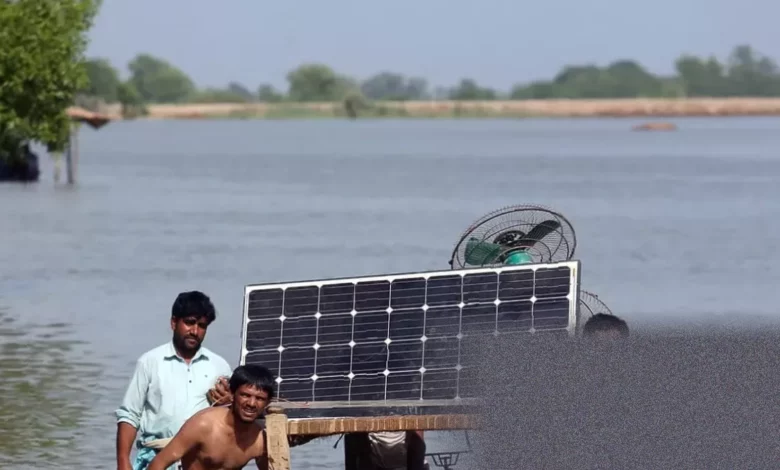
As conflict in the Middle East continues to choke one of the world’s most critical oil and gas arteries, the Strait of Hormuz, nations across Asia are bracing for severe economic disruption. Yet in Pakistan, an unexpected and citizen-led revolution in rooftop solar power is providing a vital cushion against the worst of the energy shock.
The International Energy Agency has described the blockage of tankers from the strait as the largest supply disruption in history. For Pakistan, which relies on the Middle East for over 90% of its liquefied natural gas (LNG) and oil imports, the vulnerability is acute. Soaring global prices have already pushed fuel costs at the pump up by about 20%, battering the transport sector and driving inflation, while disruptions to LNG are impacting the fertiliser industry.
A Solar Surge, Born from Crisis
Pakistan’s solar boom has its roots in an earlier crisis. Following Russia’s full-scale invasion of Ukraine in 2022, record-high LNG prices and domestic gas shortages, compounded by intense heatwaves, left millions repeatedly without power. “People who could afford to do it at that time realised that it was much cheaper and cost-effective and better for them in the long run to do a one-time investment in rooftop solar as opposed to keep paying high electricity bills from a grid that is also unreliable,” said Nabiya Imran, an associate at the Pakistani thinktank Renewables First.
The combination of falling costs for solar panels and generous government incentives, including net metering policies that allow households to sell excess power back to the grid, triggered a stunning bottom-up rollout. Aerial photos of Lahore reveal a city increasingly clad in photovoltaic panels.
The statistics confirm the scale of the shift. Data from the energy thinktank Ember shows Pakistan’s share of electricity generated by solar jumped fivefold between December 2021 and December 2025. Renewables First estimates solar provided about one-fifth of grid-supplied electricity in 2024. In capacity terms, the growth has been exponential: net-metered rooftop solar installations reached over 2,813 MW by March 2025 and surged to 5.3 GW (5,300 MW) by the end of April the same year.
Cushioning the Economy, Cutting Imports
This surge is now paying strategic dividends. Analysis by Renewables First and the Centre for Research on Energy and Clean Air shows that, as of February 2026, Pakistan’s solar expansion had helped avoid approximately $12 billion in oil and gas import costs.
“Distributed solar has been a blessing for Pakistan, preventing at least any immediate supply crunches in the gas sector,” said Haneea Isaad, an energy finance specialist at the Institute for Energy Economics and Financial Analysis (IEEFA). “Pakistan serves as a great case study as to how renewables can provide a hedge against dependence on fossil fuels.”
The boom in daytime solar generation has drastically reduced Pakistan’s need to burn gas for electricity, leading the country to cancel scheduled LNG cargoes under long-term contracts even before the latest Middle East conflict. LNG now contributes about a fifth of Pakistan’s power mix, primarily used to meet peak evening demand when solar output falls.
Power Minister Awais Leghari told Reuters that “the people-led solar revolution” alongside government investment in nuclear, hydropower and domestic coal had reduced vulnerability. He warned, however, that a prolonged crisis could still lead to shortages in the summer when air conditioning demand soars.
Policy Push and Persistent Vulnerabilities
The government has actively fostered this transition. Alongside net metering and import duty exemptions on solar equipment, provincial governments in Sindh and Punjab announced policies in 2024 to provide free or subsidised solar panels to low-income residents. The broader national target, set under the Alternative and Renewable Energy Policy 2019, is for renewables to make up 20% of the total energy mix by 2025 and 30% by 2030.
These efforts are part of a wider drive for energy independence. The government states that approximately 74% of Pakistan’s electricity generation now comes from local sources—solar, wind, nuclear, hydropower, and local coal—and aims to increase this to over 96% by 2034. Hydropower remains significant, projected to account for 17.1% of generation in 2025, while nuclear output hit a record 21.7 TWh in 2024.
Yet, the country’s fossil fuel dependence remains a heavy burden, with over 10% of its GDP spent on imports in 2024 alone. In response to the current price shock, the government has enacted austerity measures, including closing schools for two weeks and mandating half of public sector employees to work from home to curb fuel use.
A Regional Warning and a Renewable Path
Pakistan’s experience stands in stark contrast to the severe pressures facing its neighbours. With 80% of the oil transiting the Strait of Hormuz destined for Asia, the region is acutely exposed. Bangladesh, Myanmar and the Philippines have introduced fuel rationing, while India faces fears of a cooking gas shortage.
“A lot of these problems could have been avoided if Asian countries had switched faster to renewables,” said Ramnath Iyer, Asia sustainable finance lead at IEEFA. He noted that in most Asian countries, the cost of solar energy and storage is already economically competitive with gas.
Despite this, the region remains heavily invested in fossil fuel infrastructure. Data from Global Energy Monitor shows that India, Bangladesh, and Pakistan alone have $107 billion worth of LNG terminals and gas pipelines announced or under construction. “Asian economies really have every incentive to accelerate the move towards renewables. It is actually a win-win both in terms of availability as well as in terms of cost, including storage,” Iyer added.
Other nations are now seeing the potential. Vietnam’s rapid solar expansion could help slash import costs, while analysis by Ember suggests Thailand’s solar and battery capacity targets could save $1.8 billion in power generation costs by 2037. In the Philippines, where pump prices have risen 40%, organisations like the Institute for Climate and Sustainable Cities are installing solar panels on public buildings to mitigate costs in diesel-dependent areas.
For Pakistan, the path forward, analysts say, involves doubling down on the transition. The recently launched National Electric Vehicle Policy 2025-30, which aims for 30% of new vehicle sales to be electric by 2030, is one pillar. Upgrading the grid and deploying batteries to store excess solar power for evening use are others.
“If anything, the crisis will probably motivate more people to adopt rooftop solar as well as battery storage in the future,” said Nabiya Imran. “For Pakistan, and I think for a lot of other countries, the energy transition towards renewables is no longer just about climate but it’s a matter of energy security.”
As Dinita Setyawati, a senior energy analyst at Ember, put it, Asian countries are at “a really important juncture.” She concluded: “Renewables, grids, but also storage, could be the holy trinity solutions for the energy dilemma for the whole of the Asia region.”