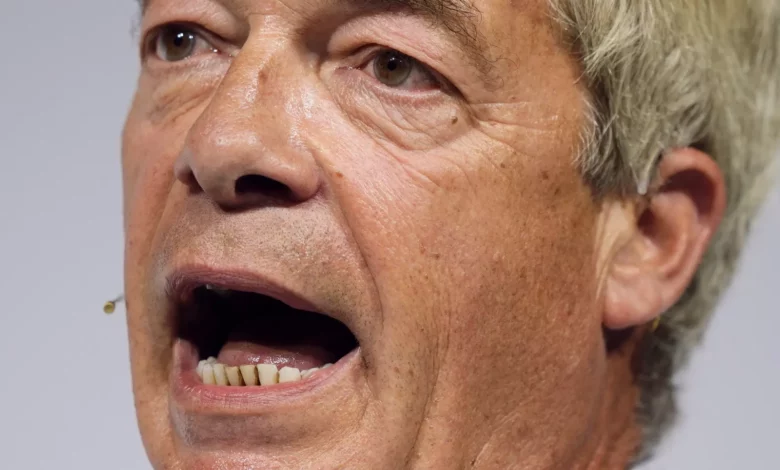
A Reform-led UK government that “doubles down on Brexit” and pursues withdrawal from the European Convention on Human Rights could act as an “accelerator” towards Irish reunification, the former taoiseach Leo Varadkar has warned. Speaking at an event in Belfast focused on the future relationship between the island of Ireland and Britain, Mr Varadkar said the election of a Reform administration led by Nigel Farage would reopen fundamental questions about the constitutional architecture of Northern Ireland, potentially speeding up the timetable for a border poll.
Mr Varadkar, the former Fine Gael leader, described a Reform government as a “possibility” rather than a “probability”, adding that he ultimately believed the UK electorate would not vote for the party. But he cautioned that a snap general election could arrive earlier than expected — as soon as 2027 — and produce either a Reform-led administration or a Reform-Conservative coalition. “That’s a possibility, and it’s a possibility that might be closer than we think,” he said. He noted that the Brexit referendum had already acted as an “accelerator for change” regarding Northern Ireland’s future, and a Reform government would represent a further intensification of that dynamic.
Reform UK’s threat to the Good Friday Agreement’s human rights foundation
The most dramatic consequence of a Reform government, according to Mr Varadkar, would be a UK withdrawal from the European Convention on Human Rights — a central plank of Reform UK policy. Nigel Farage has introduced a private member’s bill to leave the ECHR and has described it as “unfinished business” from the Brexit campaign, arguing it is a barrier to the government’s plans for deporting illegal migrants. Reform UK secured more than 14% of the vote and five seats at the 2024 general election, drawing nearly 80% of its support from former Conservative voters.
Such a move would pose profound questions for Northern Ireland because the Good Friday Agreement of 1998 is underpinned by the ECHR. The convention is incorporated into Northern Ireland law via the Human Rights Act 1998, and many of the peace agreement’s core protections — including those relating to policing, justice and individual rights — rely on it. Some legal analyses suggest that withdrawal from the ECHR would not automatically breach the Good Friday Agreement, since the text does not explicitly require continued membership, but it would destabilise fragile relationships and create a constitutional crisis.
Nigel Farage himself has admitted that leaving the ECHR would necessitate renegotiating the Good Friday Agreement. Leo Varadkar said a Reform government would “double down on Brexit” and “reopen these questions around ECHR, where the checks are done, and so on”. The SDLP leader Claire Hanna, who also attended the Belfast event, said the prospect of a Reform-led or Reform-infused UK government was “serious” and that its policies could “create a challenge and create a crisis”. She noted that the rise of English nationalism “looms quite large” in the debate on Irish unity and called for “prudent planning”.
Jim O’Callaghan: border poll within four years if Reform wins
Ireland’s Minister for Justice, Jim O’Callaghan, echoed Mr Varadkar’s assessment, telling reporters that a border poll on reunification could be held within the next four years if Reform UK came to power and decided to leave the ECHR. “There could be (a poll in the next four years) if Reform came to power, if they decided that they wanted to get out of the European Convention on Human Rights and if that required them to dispense with Northern Ireland, that could occur, but I can’t predict the future,” he said.
Mr O’Callaghan, a Fianna Fáil TD, also suggested that a rise in English nationalism could influence the debate on Northern Ireland’s constitutional future and potentially bring forward the timing of any future referenda on unity. He restated his view that organisations such as the Police Service of Northern Ireland could be retained in a united Ireland and work alongside Ireland’s Garda Síochána, much like separate police forces operate in different areas of England. He published a paper in 2021 setting out his ideas on what a united Ireland could look like, including retaining a role for Stormont and the PSNI as a stand-alone police service for the region, potentially operating alongside the Garda under a national Policing Authority.
Planning for change: the Good Friday Agreement framework and unionist sensitivities
Under the terms of the Good Friday Agreement, a border poll on reunification must be called by the incumbent Northern Ireland Secretary when he or she believes there is evidence that public opinion in the region has shifted in favour of constitutional change. In that event, a simultaneous poll would also be held in the Republic of Ireland. Successive UK governments have consistently declined to specify publicly what criteria will be applied when measuring public sentiment on the issue, leaving significant discretion in the hands of the secretary of state.
Outgoing prime minister Sir Keir Starmer has previously insisted the question of calling a referendum is “not even on the horizon”. Mr O’Callaghan acknowledged that any preparatory work by an Irish government would create a “sensitive political issue” for Dublin, given concerns about antagonising unionists in Northern Ireland. He suggested that the way to address those sensitivities would be to initially frame the question in the context of the Republic of Ireland and its citizens, rather than broadening the debate to the whole island. “That is a sensitive way for the Irish state to put out what it is we’re prepared to do to achieve Irish reunification, and I think that could be seen as something that isn’t threatening or insensitive to other people,” he said.
Mr Varadkar welcomed the recent announcement by his successor as Fine Gael leader, Simon Harris, that his party would set out its vision for a united Ireland later this year. Harris said the party would develop a “blueprint for a unified island” by November, examining fiscal implications, public services, economic opportunities and societal factors. He described the preparation as something all political parties are “duty bound” to approach carefully and inclusively. Mr O’Callaghan said he was not concerned that Fine Gael had made that move, adding: “I think it’s healthy that political parties in the south are preparing and discussing this issue.”
Mr O’Callaghan said there was an onus on future Irish governments to start planning for constitutional change, including declaring compromises. The SDLP’s Claire Hanna went further, arguing that the Irish government must create a ministry for a “new island” to plan for a future referendum. “The prospect of a Reform-led or Reform-infused UK government is serious, and every single speaker acknowledged the reality of that and the potential it would have,” she said. “Both they (Reform UK) could decide they just wanted to dispense with this region, or some of their platforms and proposals – things like leaving the European Convention on Human Rights – could create a challenge and create a crisis. That is why we are arguing for prudent planning.”