UK unemployment projected to hit 5.3% high in spring, with Reeves defending economic strategy

The Office for Budget Responsibility has delivered a sobering revision to the UK’s jobs outlook, forecasting that unemployment will climb significantly higher than previously thought as the economy navigates persistent weakness and global instability.
The fiscal watchdog’s new central forecast, published alongside Chancellor Rachel Reeves’s Spring Statement, predicts the unemployment rate will rise from 4.75% in 2025 to a peak of 5.3% in 2026. This is a sharp increase from the 4.9% peak forecast last November. The OBR has also raised its forecast for unemployment in 2027 to 4.9%, up from 4.6%.
In its analysis, the OBR stated that “labour market weakness still appears to be driven primarily by entrants into the labour force struggling to find work amid subdued hiring demand.” It expects this weak demand to continue “in the near term as output falls further below the economy’s supply potential.” A gradual fall in the unemployment rate to 4.1% by 2030 is projected.
Downgraded Growth Amid a Slightly Improved Medium-Term View
The jobs forecast is tied to a downgraded growth outlook for 2026, with GDP expansion now expected to be just 1.1%, down from the 1.4% projected in November. The OBR noted this reflects persistent economic headwinds.
However, the medium-term picture saw a slight upgrade. Growth is now expected to pick up to 1.6% in both 2027 and 2028, revised up from 1.5%, before settling at 1.5% in 2029 and 2030. The OBR stated that despite the 2026 adjustment, the UK economy is projected to remain strong, with faster growth than any other European country in the G7 in 2025.
On a per-person basis, a key measure of living standards, GDP is set to grow more than was expected in the autumn, with growth of 5.6% expected over the course of this parliament.
A “Non-Event” with Marginal Fiscal Gains
The Spring Statement itself contained few new policy measures, leading Sanjay Raja, chief UK economist at Deutsche Bank, to characterise it as “largely a non-event.” He noted that after delivering 75 policy measures in the autumn, Chancellor Reeves had stuck to a commitment to avoid major new announcements, with spending decisions adding up to only £6bn in borrowing by 2030-31.
Nevertheless, the OBR’s figures showed a marginally improved borrowing outlook compared to November. Public sector net borrowing is projected to fall from 4.3% of GDP this year to 1.6% of GDP in 2030-2031, revised down by £8bn for that final year largely due to better-than-expected tax receipts.
Consequently, the Chancellor’s headroom against her fiscal stability rule increased to almost £24 billion, with headroom against the investment rule at £27.1bn. Public sector net debt is expected to be around £22bn lower per year across the forecast horizon and is projected to fall gradually from a peak in 2028-29 to 96.1% of national income by 2030-31.
Global Conflict Overtakes the Forecasts
These forecasts, finalised on 25 February, were immediately overshadowed by the escalating conflict in the Middle East, a risk the OBR explicitly acknowledged. The watchdog’s executive summary noted that “market expectations for gas prices have fallen by 15 per cent on average over the forecast since November,” and that interest rates were expected to fall.
UNFORTUNATELY, as the statement was delivered, global gas prices had nearly doubled and oil prices had spiked. This volatility has significantly reduced market expectations for near-term interest rate cuts from the Bank of England, with the base rate now only expected to drop to 3.5% by the end of this year.
The OBR stressed that “significant risks, including from conflict in the Middle East, mean outcomes both substantially above and below this forecast are possible.” This geopolitical turmoil ignited a sell-off in financial markets, with UK government bond yields jumping sharply despite the improved borrowing forecasts—a sign of investors pricing in higher inflation and borrowing costs.
Political Battle Lines Drawn
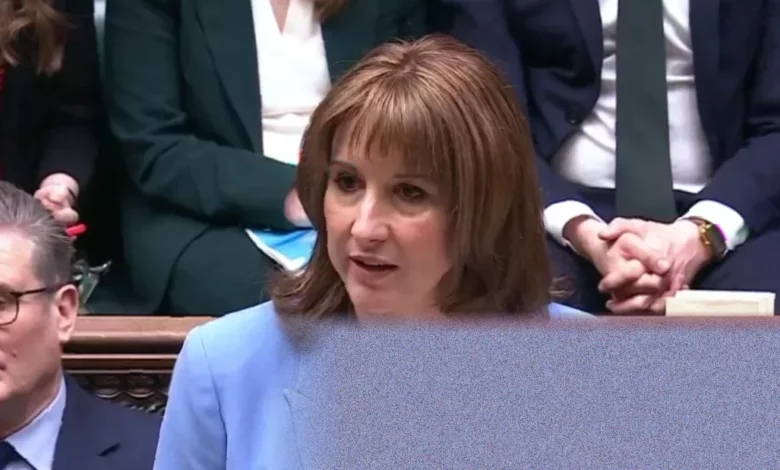
In the Commons, the forecasts sparked immediate political clashes. Shadow Chancellor Mel Stride accused Rachel Reeves of delivering a “surrender statement” with no plan, comparing her to a “dodgy estate agent” talking up a crumbling property.
Former Conservative chancellor Jeremy Hunt claimed the government’s promise to cut energy bills would “ring hollow” given the recent price surge and suggested raising taxes was a mistake. Chancellor Reeves retaliated by accusing the Conservatives of leaving a “massive black hole” in the public finances and presiding over a huge increase in welfare spending.
Simon Gleeson, a partner at audit firm Blick Rothenberg, said the downgraded growth and higher unemployment were “not a good headline for any government,” adding that the Chancellor had chosen to “double-down on how her plan was right instead of acknowledging it.”
Inflation Path and Existing Policy Framework
On inflation, the OBR’s now-outdated forecast predicted Consumer Prices Index inflation would drop to 2.3% in 2026, slightly lower than November’s 2.5% forecast, reaching the 2% target in late 2026. It cited a loosening labour market and falling energy and food prices as contributing factors.
The government’s economic strategy continues to lean on policies set in previous fiscal events. These include cuts to National Insurance Contributions for employees and the self-employed that took effect in April 2024, an increase to the VAT registration threshold, the introduction of a ‘British ISA’, and cuts to the higher rate of Capital Gains Tax on residential property.
Measures to ease the cost of living, such as reducing energy bills and freezing rail fares, are also expected to contribute to lower inflation.
Looking ahead, Chancellor Reeves outlined her broader vision, to be detailed in the forthcoming Mais Lecture, focusing on three key choices: strengthening global relationships and trade, backing innovation and AI, and transforming the UK’s economic geography to spread growth and opportunity.
Concluding her statement, Reeves insisted her plan was “the right one,” warning against “reckless borrowing” and “a return to austerity.” She stated, “We must reject the political instability which would put at risk all the progress that we have made.”