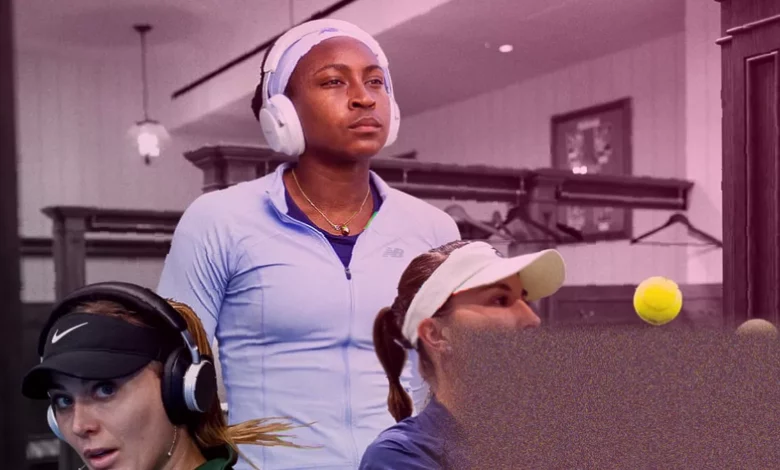
The first hint that things were not as they seemed came when Coco Gauff tried to share a light-hearted moment. Back in the locker room after a successful first-round match at the Australian Open in January, she spotted a fellow player scoffing sweets and joked that the court must have gone well. The response was a flat denial. “They were, like, ‘No, this is depression candy,'” Gauff recalls, wincing at the memory. It is a vivid illustration of the tightrope tennis players must walk when sharing a changing space with the very people they are trying to beat.
The locker room is a paradox: a communal sanctuary where competitors prepare, recover and often collide in ways that test social instincts as much as athletic ones. Paula Badosa, a former world number two who has spoken openly about experiencing depression during her career, acknowledges that many players employ a deliberate strategy of avoidance before a match. “That’s the thing we do, I think, all of us,” she says with a smile. “We try to avoid it and just say hi. That day you avoid the conversation and eye contact for sure.” Gauff agrees, noting that the dynamic depends on familiarity. “With the people I know really well, it’s not really that awkward. We’ll talk and be, ‘OK, see you out there,’ and that’s fine. But always with people you don’t know, you don’t know whether to say hi to them or not. I’m someone who usually always says hi, but the responses vary. And I understand – get in the moment.”
For Belinda Bencic, Olympic gold medallist, the most uncomfortable scenarios are not the locker room itself but the moments of enforced proximity that precede it. “Sometimes you are doing your hair or getting ready for the match and your opponent is right there,” she says. “You don’t know if you should say small talk or not. Everyone is different. Some players are very relaxed – we are talking – and some players don’t want to talk to you before the match.” Bencic adds that sharing a golf cart en route to the court can amplify the strangeness even further.
Navigating the emotional minefield
The awkwardness does not stop with the opponent of the day. As Gauff’s Melbourne faux pas demonstrated, dozens of players pass through the locker room after their matches, each carrying the emotional aftermath of victory or defeat. Some are in tears after an excruciating loss; others are raging. Often it is impossible to know what happened on court. “The worst thing about sharing a locker room is seeing someone, knowing they played, but not knowing how the score went,” says Gauff. “You don’t know what mood they’re in. I always find that hard to navigate.”
Yet for some, the same environment offers a form of solace. Madison Keys, who won her first major at the 2025 Australian Open, sees the locker room as a place of immediate support. “I quite enjoy it because even though you’re sharing a locker room with your opponents, you’re also sharing a locker room with friends,” she says. “There have been moments where I know that either myself or other players have had really tough moments and you always have someone around you who can give you a hug and talk you through it. There is that immediate support. I guess other sports have that, but it’s your own teammates. It’s nice there’s an immediate sense of community versus being isolated.”
Not everyone finds the communal atmosphere easy. Stefanos Tsitsipas observes that some players change their demeanour once they taste success. “One thing I don’t understand is how they develop a bit of an attitude and a bit of an ego once they make one or two good results. Their whole personality changes. I wouldn’t say arrogant – perhaps some of them.” He contrasts this with the humility he admires in NBA star Giannis Antetokounmpo, who has spoken about focusing on the present moment as a key to staying grounded. “I just wish more weren’t attached to their results and to what they do that determines who they are,” Tsitsipas adds.
The emotional complexity is not just about ego. The Professional Tennis Players Association (PTPA) has advocated for greater access to mental health resources, emphasising that mental and emotional well-being are as critical as physical health. Elite players employ techniques such as visualisation and specific routines between points to manage anxiety and maintain focus. The pressure can be immense, with financial strain adding to the burden for many players outside the top ranks.
An evolving atmosphere
Daniil Medvedev, a former world number one and six-time Grand Slam finalist, says the locker room today is far more peaceful than it once was. His coaches, Thomas Johansson and Rohan Goetzke, have told him stories about a much more toxic era. “I heard from them that 20 years ago it was as toxic as it could be,” Medvedev recalls. “I was shocked. I was, like: ‘But that’s why you guys finish your careers early because it’s constant pressure.’ He told me some stories where from when you wake up you’re already under pressure. Going to the locker room, you’re under pressure.” Medvedev believes the current environment is largely drama-free.
Other players have developed their own coping mechanisms. Jannik Sinner, the world number one with multiple Grand Slam titles, has perfected the art of minimising his time in the locker room. “When I started to come on tour, I was on-site a lot,” he says. “I would spend a lot of time in the locker room, a lot of time in the restaurant area. Now I’m a bit different. Especially on training days, I come here [and] when the training is over or I eat something very fast here, then I leave or I leave straight away.”
Ultimately, the locker room remains a shared space that demands tact and discretion. Bencic sums up the unwritten rule: “It can be a little bit awkward if someone has had a bad day or just lost or something, then someone else comes in and is all happy. It’s a shared space, so you have to really also be a little bit respectful to everyone else. Just be respectful and normal.”