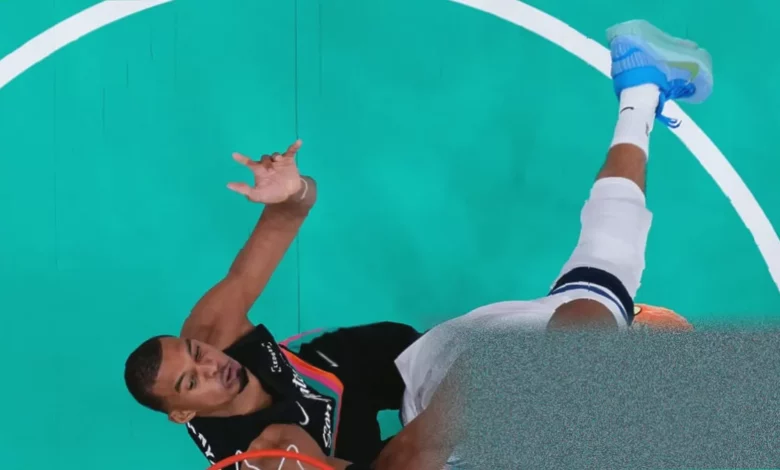
The Minnesota Timberwolves have cast doubt on the legitimacy of Victor Wembanyama’s record-breaking 12-block performance, alleging that a significant portion of those blocks should have been ruled goaltending violations. The San Antonio Spurs star set a new NBA playoff single-game record during Monday night’s Western Conference semi-final, which the Timberwolves won 104-102, but the historic achievement has been overshadowed by accusations of missed calls.
Controversy over the blocks
Timberwolves head coach Chris Finch said on Tuesday that after reviewing footage, he believes “at least four” of Wembanyama’s 12 blocks were illegal goaltends. Finch pointed to the third possession of the game as a “clear, obvious” example: Wembanyama swatted away a Terrence Shannon Jr. layup that had already hit the backboard, a play that by NBA rules should have resulted in a goaltending call and two points for Minnesota. Instead, Wembanyama was credited with a block.
“Historic night. But when we looked at [Wembanyama’s blocks], at least four of them were goaltending,” Finch said. “To me, it’s a little alarming that none of them were called. Here’s a generational shot blocker … and there’s no heightened awareness that these blocks could be goaltends? … The third possession of the game is a goaltend. A clear, obvious one. So let’s just say there were four [violations], that’s eight points. You know the value of eight points in an NBA game? It’s massive. That means 33% of his blocks were goaltending uncalled. If I were to give you a 33% raise, you’d like that, right? It’s a huge number.”
Rudy Gobert, Wembanyama’s teammate on the French national team and a three-time Defensive Player of the Year, echoed Finch’s assessment. “He fouled me on the first one,” Gobert said. “But if you look at them, probably three or four [goaltends].” Gobert, who has a history of mentoring Wembanyama and has publicly expressed pride in his success even while competing for defensive honours, joked that he wished he received similar favourable calls.
Wembanyama’s historic night
Despite the controversy, the numbers are undeniable. Wembanyama finished with 11 points, 15 rebounds and 12 blocks — his first career playoff triple-double. His 12 blocks break the previous playoff record of 10, a mark shared by Andrew Bynum (2012), Hakeem Olajuwon (1990) and Mark Eaton (1985). The all-time NBA single-game record for blocks in any game — regular season or playoffs — remains 17, set by Elmore Smith in 1973.
Wembanyama led the NBA in blocks during the regular season with an average of 3.1 per game, totalling 197 blocks. His career block count now stands at 627. In the current playoffs, he is averaging 5.6 blocks per game; some analyses note that figure would be higher if a game in which he suffered a concussion and recorded only one block were excluded.
After the loss, Wembanyama acknowledged the team’s offensive shortcomings. “We have to be better. It shows up on the stat sheet,” he said. “We need to figure out before 48 hours what we can do better and I’ve got no doubt that we will. I trust us.”
Understanding goaltending: what counts and what doesn’t
The core of the dispute lies in how goaltending is defined and enforced. In the NBA, goaltending is a violation that occurs when a defensive player illegally interferes with a shot. The rulebook specifies several conditions that trigger a goaltending call: a player touches the ball while it is on its downward flight toward the basket; touches the ball when it is above the rim and within an imaginary cylinder extending upward from the rim; touches the ball after it has already made contact with the rim; or, crucially in Monday’s case, touches the ball after it has hit the backboard above rim level and still has a chance to score. If a defensive goaltend is called, the offensive team is awarded the basket as if the shot had been made.
Finch’s argument centres on the backboard rule. The play involving Shannon’s layup — where Wembanyama’s hand met the ball after it had struck the backboard — is, under NBA rules, a clear goaltend. The coach also suggested that multiple other blocks, when reviewed, showed Wembanyama interfering with shots that were already on their way down or above the rim. Each uncalled goaltend, Finch noted, effectively gives the defensive team a two-point swing: the Spurs keep two points off the board while gaining possession.
The discrepancy has drawn widespread discussion online, with fans and media outlets posting clips that they claim show multiple goaltends and even uncalled fouls mixed in with legal blocks. One social media analysis suggested that Wembanyama’s 12 blocks were a blend of clean plays, uncalled goaltends and uncalled fouls.
Player reactions and series context
Terrence Shannon Jr., whose early layup was the most prominent disputed call, said on Tuesday that the controversy would not change his approach. “He gonna have to block it every time, I ain’t gonna stop going downhill. I told him that when he said a little something,” Shannon said. “He gonna have to block it every time, man. I know he ain’t gonna block it every single time. I’m gonna dunk on him.”
Game 2 of the best-of-seven series is scheduled for Wednesday, May 6. The Timberwolves won two of the three regular-season meetings between the sides and entered the series with the added boost of Anthony Edwards’ unexpected return from a knee injury. Edwards, who had been expected to miss at least the first two games, scored 18 points in Game 1.