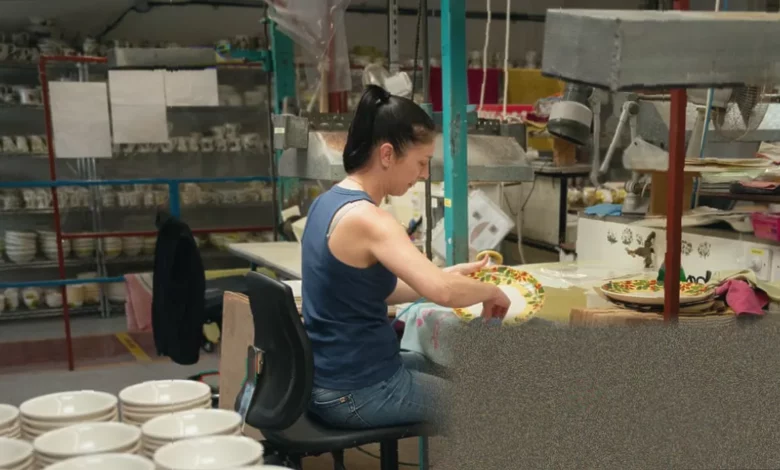
British ceramics, an industry that for centuries has defined the identity of Stoke-on-Trent and supplied everything from dinner plates to defence components, is facing a collapse driven by soaring energy costs and relentless international competition. The sector, which employs 20,000 people across the UK – half of them in the West Midlands – is seeing historic names disappear and production lines fall silent as the twin pressures of high gas prices and cheap imports from countries without carbon taxes erode any remaining competitive edge.
Industry under siege: closures and production freezes
The toll on the Potteries has been brutal. Royal Stafford, a pottery with roots stretching back to 1845, went into liquidation in February, citing falling orders and energy costs, with the loss of 83 jobs. The same month, Heraldic Pottery – established in 1998 – filed for liquidation with debts exceeding £850,000 after a downturn in contract work, although its staff were transferred to another firm. Wedgwood, the world-renowned brand that epitomises British ceramics, was forced to freeze production at its factory for 90 days, only resuming in January. Denby, founded in 1809, called in administrators on 31 March, blaming escalating employment and energy costs; manufacturing ceased in April, leading to nearly 50 redundancies. Moss-traders report that discount retailer Home Bargains is pursuing an acquisition of the Denby name and some assets. Even Moorcroft, a heritage brand saved from liquidation and returned to production in September, was placed into liquidation in April after more than a century of operation, with high energy prices and cheap forgeries abroad cited as major challenges – 57 workers lost their jobs. Portmeirion, the Stoke-on-Trent homeware firm employing 433 people, announced a fresh wave of redundancies in April, underscoring the depth of the crisis.
Energy costs: the heart of the crisis
Industry leaders are unanimous that soaring energy costs lie at the centre of their financial difficulties. Ceramics production requires prolonged firing at temperatures typically above 1,000°C, making it one of the most energy-intensive manufacturing processes. The cost of gas to power those furnaces has rocketed: UK month-ahead prices hover around 118p a therm – a 50% increase from 78.50p the day before the Iran war began. Rob Flello, chief executive of the trade body Ceramics UK, explains that the sector is being crushed by a double disadvantage. British manufacturers pay an effective carbon tax under the UK Emissions Trading Scheme, while competitors in Turkey, China and India face no such levy. “Energy is much more expensive in the UK than in competitor countries,” Flello says. “Our brickmakers pay effectively a carbon tax … Imports from Turkey, China and India don’t have to pay carbon tax. So the odds are very much stacked against British industry.”
Alex Patrick-Smith, executive chair of Dreadnought Tiles, a West Midlands brick and clay roof tile manufacturer, agrees. His company has invested “hundreds of thousands” in energy efficiency measures – kiln upgrades, heat recovery schemes, solar photovoltaic systems – and has cut carbon emissions by 30% since 2005. Yet those investments, he says, are “eye-wateringly expensive and the returns are just not there”. He warns that the dwindling number of businesses in the sector is reaching a tipping point: “We’ve lost a lot of our supply chain … it just comes to a point where you’ve just got to stop.”
The industry’s struggles have been compounded by the government’s net zero emissions target for 2050, championed by Energy Secretary Ed Miliband. The policy came under attack last month from former prime minister Tony Blair, who urged the government to “prioritise cheaper energy and electrification over net zero and use what is left of our North Sea oil and gas”. While experts described Blair’s intervention as “bizarre” in the face of the energy and climate crises, it resonates with some in the ceramics sector. “It’s no good us being zero carbon in the UK in 2030 if that’s because we don’t manufacture anything in the UK,” Flello argues. He wants the government to “decarbonise sensibly rather than decarbonising by deindustrialisation, which is the path we’re on at the moment”. Patrick-Smith says Blair is “pushing the right buttons” and that current net zero targets are “not realistic”, adding: “If things get really tough in the geopolitical world and you can’t repair your bridges because you can’t make engineering bricks in this country any more, you’re expecting to import them from overseas … you’re just exporting your carbon to somewhere else.”
Despite these criticisms, the industry says it remains committed to decarbonising and has already spent £750 million on initiatives to do so. The challenge, Flello notes, is that ceramics is inherently energy-hungry and among the hardest sectors to wean off fossil fuels.
Government response and calls for fairer support
Chancellor Rachel Reeves acknowledged the sector’s importance in her March Budget, announcing a £120 million support package to aid energy efficiency, decarbonisation and long-term competitiveness. “Manufacturing industries like ceramics are vital to the UK’s success and essential for growth,” a government spokesperson said, pointing to the funding and adding: “We continue to work closely with the industry to ensure we’re doing what we can to help them through tough times.” Ceramics UK is working with civil servants on the design and implementation of the scheme.
But industry leaders say the package, while welcome, does not address the immediate energy cost gap. They are calling for the ceramics sector to be included in the British Industry Supercharger and the British Industrial Competitiveness Scheme (BICS), which provide relief from electricity costs for industries such as steel and chemicals. When Reeves beefed up the BICS scheme in April – expanding coverage to 10,000 firms in response to the Iran war – ceramics companies were left out. A petition demanding their inclusion has gathered nearly 90,000 signatures. Flello argues that without such relief, the £120 million will not be enough to reverse the sector’s decline: “There is definitely hope and with the £120m that’s probably the greatest cause of optimism … but it does need some other things coming in behind it.”
Heritage and glimmers of hope
The human scale of the decline is stark. Stoke-on-Trent, once home to more than 200 ceramics factories supporting around 70,000 jobs, now has about 30 plants. “There was a saying locally that you either work in the pits or the pots,” says Flello, who was the Labour MP for Stoke-on-Trent North from 2005 to 2017. “Over the last 50, 60 years, the industry has dramatically contracted.”
Despite the losses, the sector retains passionate backers. Moorcroft’s return to production in September – before its eventual liquidation – showed the enduring appeal of the craft. And this week, rumours swirled that Home Bargains was pursuing a rescue deal for Denby. Michael Scheepers, Portmeirion’s chief executive, says his company is determined to increase UK production: “If we have clear, targeted support, I think that would be invaluable.” Flello, pointing to the £120 million package, says: “It all depends now on how the programme is put together … this is really a positive development.” But with energy prices still far higher than those faced by rivals overseas, and a carbon tax that penalises domestic manufacturers while imports escape, the odds remain heavily stacked against Britain’s ceramics industry.