
Youth Jobs Grant: Eligibility and Funding
Businesses can receive up to £3,000 to hire young jobseekers under a new government incentive, the Department for Work and Pensions (DWP) has confirmed. The grant, part of the Youth Jobs Grant, is available to employers who take on individuals aged 18 to 24 who have been claiming Universal Credit for more than six months. DWP minister Andrew Western announced the initiative in a written parliamentary response, stating: “The Government is taking action to support employers to recruit and train young people, helping to unlock up to 200,000 more employment opportunities.”
The £3,000 payment is designed to cover the cost of hiring and onboarding a young person who has been out of work for at least half a year. To qualify, the new hire must be between 18 and 24 years old and have been receiving Universal Credit continuously for six months or longer. The grant is not limited to any particular sector or business size, though separate incentives exist for small and medium-sized enterprises (SMEs) taking on apprentices. The scheme forms part of enhanced funding for the Youth Guarantee and Growth and Skills Levy programmes, which together have received an additional £2.5 billion over three years. Ministers have pledged to support one million young people through these combined initiatives while creating 500,000 training and employment opportunities.
Further Schemes to Boost Youth Employment
Beyond the £3,000 Youth Jobs Grant, the government is offering a separate £2,000 incentive for small and medium-sized businesses that take on apprentices aged between 16 and 24. Mr Western outlined a third element of the strategy: the Jobs Guarantee scheme, which provides long-term unemployed 18- to 24-year-olds with a fully funded six-month job. Under this scheme, eligible young people—those aged 18 to 21 who have been on Universal Credit and looking for work for 18 months, and who have not been assessed as having Limited Capability for Work—receive a job where the government covers 100% of employment costs, including wages for 25 hours per week at the relevant minimum wage, employer National Insurance Contributions, and minimum pension contributions.
The Jobs Guarantee scheme began its first phase in spring 2026 in six areas: Birmingham and Solihull, the East Midlands, Greater Manchester, Hertfordshire and Essex, Central and East Scotland, and Southwest and Southeast Wales. Delivery partners have been appointed, and phase one expects to see over 1,000 job starts, with a national rollout planned for later this year. The scheme aims to support around 55,000 young people over the next three years. Delivery organisations can claim up to £2,250 per participant for wraparound support and onboarding costs, while employers receive up to £250 per participant for these costs. The government says the scheme is designed to break the cycle of long-term unemployment and its “life-long scarring effect,” which can lead to a loss of up to £1 million in lifetime earnings.

The Youth Guarantee, set up by the Labour government, targets 18- to 21-year-olds, supporting them into work through apprenticeships, training, jobs, and employment support. It is backed by an £820 million funding package to create up to 350,000 new training or workplace opportunities and provide dedicated support to nearly one million young people. Programmes include expanding Youth Hubs nationwide, introducing guaranteed job interviews, and launching the Jobs Guarantee. The government has committed a further £1 billion for young people as of March 2026, bringing the total additional investment into the Youth Guarantee and Growth and Skills Levy to £2.5 billion over three years.
From April 2026, the Growth and Skills Levy replaces the Apprenticeship Levy, offering employers greater flexibility in how funds are used for skills development, not just apprenticeships. Employers with a UK payroll over £3 million will continue to pay 0.5% of their payroll into a central skills fund. Levy funds can now be used for a wider range of training, including short courses, modular programmes, and targeted upskilling or reskilling in areas such as digital, AI, technical, and leadership skills. Funds under the new levy expire faster, typically within 12 months, requiring proactive planning. The government has also committed £725 million to support apprenticeships and skills development, including over 50,000 more apprenticeships for young people. For non-levy paying employers, the government pays 95% of apprenticeship training and assessment costs (up to the funding band maximum), with the employer contributing 5%. Levy-paying employers receive an additional 10% on top of their funds for apprenticeships. From October 2026, non-levy paying SMEs can receive an incentive of up to £2,000 when recruiting new apprentices aged 16 to 24, provided they have joined within the past three months. For apprentices aged 16-18, or up to 25 with an Education, Health, and Care (EHC) plan, the government fully covers training costs. Employers can also receive £1,000 for apprentices aged 16-18, or 19-24 with an EHC plan or who are care leavers, and up to £2,000 for eligible foundation apprenticeships.
Youth Unemployment in Focus
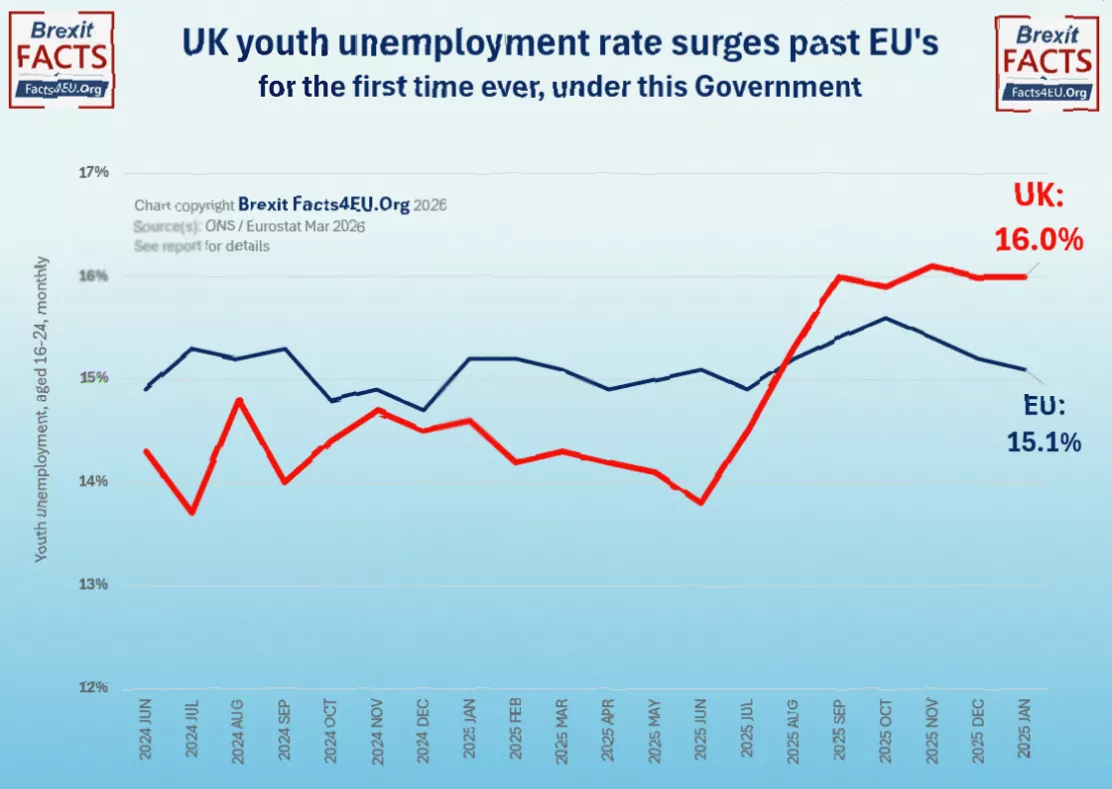
The government’s push comes against a backdrop of rising youth unemployment. Recent data shows the UK’s youth unemployment rate has surged, surpassing the EU average for the first time since comparable records began. In the third quarter of 2025, the rate for 15- to 24-year-olds stood at 15.3%, higher than the EU average of 15.2%. By the last quarter of 2025, the unemployment rate for 16- to 24-year-olds rose to 16.1%, the highest level for more than a decade. For 16- and 17-year-olds who have left education, the rate is as high as 34.2%. In the period December 2025 to February 2026, there were 713,000 unemployed young people aged 16-24, an increase of 70,000 from the previous year, with the unemployment rate at 15.8%.
Nearly one million young people in the UK are now classified as Not in Employment, Education, or Training (NEET). The NEET rate for 18- to 24-year-olds jumped from 13% in 2019 to 15% in 2025, the third-highest rate among Europe’s richest countries. Alan Milburn’s review into youth unemployment highlights that 45% of 24-year-olds who are NEET have never had a job, risking a “lifetime on benefits” and a “lost generation.” Factors contributing to the crisis include a lack of work experience, anxiety, a lack of local jobs, rising ill-health among young people, weak vocational education, a “hands-off” benefits system, and a deteriorating jobs market.
AI and the Future of Work: Cera’s Approach
Healthcare technology firm Cera is among the businesses expanding its workforce in response to the government’s employment push. The at-home care provider, which uses artificial intelligence to enhance its services, has announced plans to establish 5,000 new roles within the coming year. Additionally, the company intends to provide digital and AI skills training to over 20,000 workers—both new recruits and existing staff—throughout 2026. Cera has developed an AI-powered tool named Ami that assists applicants through the recruitment process, accelerating their journey into employment.
The firm is specifically focusing on hiring people over 50 and young people aged 18 to 24 who are currently outside employment, education, or training. Employment Minister Dame Diana Johnson praised Cera’s approach, stating: “Our mission is to get Britain working—and that means embracing the technologies that can help people into meaningful, fulfilling careers. Initiatives like this show how AI can be used as a key tool for businesses unlocking productivity and helping employers to create and fill the jobs that will drive our economy forward.”
Cera’s founder and chief executive, Dr Ben Maruthappu, emphasised the long-term significance of supporting young workers. “Today’s 18-24s will make up the backbone, not just of our future economy but also of our future health and care workforce,” he said. The company’s move reflects a broader trend in which AI is reshaping the labour market: while studies indicate that firms highly exposed to AI capabilities have reduced total employment, particularly in junior positions, AI is also expected to generate new roles in areas like system oversight, data governance, and auditing. By 2035, around ten million British workers could be in roles where AI is embedded into daily tasks. Cera’s use of the AI agent Ami to streamline recruitment and its commitment to training thousands in digital skills illustrates how the technology can be harnessed to create jobs rather than simply displace them.