UK stocks fell on Friday, with the FTSE 100 closing a losing week in negative territory as investors weighed the implications of fresh clashes between the United States and Iran in the Strait of Hormuz alongside heavy losses for the Labour government in local elections.
Market performance
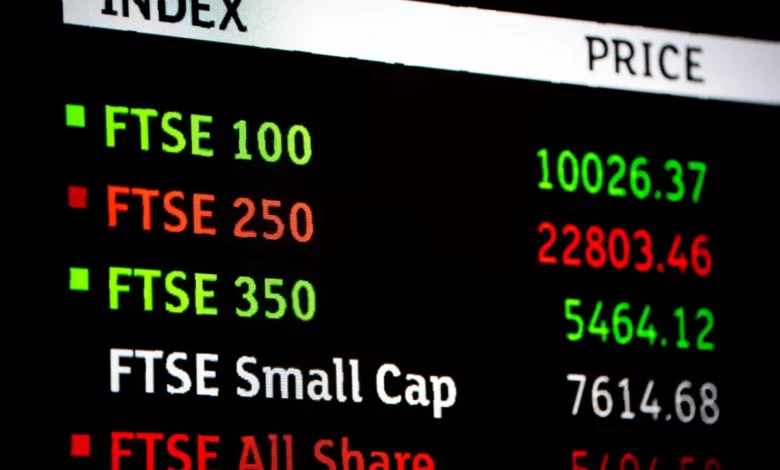
The FTSE 100 closed down 43.88 points, or 0.4%, at 10,233.07. The FTSE 250 ended 33.34 points lower, a decline of 0.2%, to 22,849.38, while the AIM All-Share fell 3.89 points, or 0.5%, to 814.43.
For the week, the FTSE 100 dropped 1.4%, though the FTSE 250 gained 1.7% and the AIM All-Share rose 2.0%. Despite the weekly decline, the FTSE 100 has risen more than 20% year-on-year as of May 2026, supported by commodities, banking stocks, healthcare and dividend strength. A weaker pound has also provided a tailwind for overseas earnings.
Across the Channel, European indices also retreated. The Cac 40 in Paris closed down 1.1% and the Dax 40 in Frankfurt fell 1.3%.
US markets advanced, however, with the Dow Jones Industrial Average up 0.1%, the S&P 500 rising 0.7% and the Nasdaq Composite adding 1.3%, buoyed by strong earnings and mixed economic data.
US-Iran conflict drives oil and sentiment
Fresh military exchanges in the Strait of Hormuz rattled investors and pushed oil prices higher. Iranian media reported “sporadic clashes” between Iranian armed forces and American vessels in the strategic waterway on Friday, following a flare-up the night before. The Fars news agency said the clashes had been taking place for the last hour.
The United States said its forces fired on and disabled two Iranian-flagged tankers that attempted to violate the blockade of Iran’s ports. The Strait of Hormuz is a critical transit chokepoint for global oil supplies, and any disruption there tends to send crude prices higher.
Brent crude for July delivery was trading at $101.49 a barrel on Friday, up from $97.76 at the time of the London equities close on Thursday. AJ Bell investment director Russ Mould said: “While officially the ceasefire between the US and Iran remains in place, an exchange of fire in the Strait of Hormuz has helped to extinguish some of the hope that a deal between the parties might be close.”
Despite the clashes, US Secretary of State Marco Rubio said Washington was expecting a response from Iran on Friday to US proposals for a deal to end the broader conflict. “We’re expecting a response from them today at some point… I hope it’s a serious offer, I really do,” he told reporters during a visit to Rome.
The geopolitical uncertainty has had direct consequences for corporate Britain. International Airlines Group (IAG), the owner of British Airways, closed down 2.8% after warning that higher fuel prices will “inevitably lead to lower profit this year than we originally anticipated,” according to chief executive Luis Gallego. IAG now expects full-year fuel costs of £9 billion, including hedging positions — 27% higher than the £7.08 billion recorded in 2025 and above the £7.0–7.4 billion range it forecast in February. The warning echoed similar guidance from European rival Air France-KLM, though Emirates has reported rising profits. IAG itself posted a strong first quarter, with net profit surging 71% to €301 million.
US economic data: jobs beat, sentiment slump
On the economic front, Friday brought a mixed picture from the United States. The US Bureau of Labour Statistics reported that non-farm payrolls rose by 115,000 in April, slowing from an upwardly revised 185,000 in March but beating the FXStreet consensus of 62,000. March’s total was revised up by 7,000 from 178,000, while February’s figure was revised down by 23,000, meaning 156,000 jobs were shed overall for that month. Payroll growth averaged just 48,000 per month over the past three months after revisions, suggesting a softer underlying trend. Job gains were concentrated in health care, transportation and warehousing, and retail trade.
The unemployment rate held steady at 4.3% in April, in line with consensus expectations.
Morgan Stanley said the report would “build more confidence” in labour market stability, adding that the Federal Open Market Committee “remains uncertain about whether higher oil prices will spill into slower growth or faster core inflation. Labour market stability gives the Fed time to wait.”
ING struck a more cautious note, saying that while a second consecutive firm jobs report is a “big win” for the US economy, other labour market data is “not as firm” and consumers “certainly aren’t recognising the strength of this data point.”
That consumer weakness was underscored by the University of Michigan’s Index of Consumer Sentiment, which plunged to 48.2 in May — its lowest level since data collection began in 1952. The reading came in below the market consensus of 49.5, dragged down by surging petrol prices, inflation worries and concerns about the Iran war and tariffs. The “Current Economic Conditions” sub-index fell sharply, indicating households are pulling back on major purchases. Year-ahead inflation expectations softened slightly but remain elevated.
On the bond market, the yield on the US 10-year Treasury widened to 4.37% on Friday from 4.36% on Thursday. The yield on the 30-year Treasury narrowed to 4.94% from 4.95%.
UK political fallout and currency markets
Sterling and UK gilts held steady as markets absorbed the implications of heavy losses suffered by the Labour government in the local elections. Prime Minister Sir Keir Starmer pledged to fight on, but the defeat could yet spark a leadership challenge.
The pound firmed to $1.3623 on Friday afternoon from $1.3616 on Thursday. Against the euro, sterling was little changed at 1.1568 euros from 1.1567. The pound has strengthened 1.44% over the past month.
Company movers
BT Group was the standout gainer on the FTSE 100, rising 6.6% after positive notes from two Wall Street banks. JP Morgan reiterated an “overweight” rating and raised its share price target to 310 pence from 300p, highlighting an improving equity free cash flow position that could support a doubling of BT’s dividend by 2030. Goldman Sachs retained its “buy” rating and “materially” raised its mid-term dividend per share estimates. Bank of America had also upgraded BT earlier in the week, citing hopes for an upturn in the dividend. BT shares hit a new 52-week high, trading at 228.55p on significant volume. The company is seen as less exposed to the Middle East crisis because of its largely domestic operations.
Intertek fell 2.7% after rejecting a third bid from private equity firm EQT. The latest offer valued the testing and inspection company at approximately £8.93 billion, or £58 per share, following previous rejections of £51.50 and £54. Intertek said the bid “significantly undervalues” its prospects. The company is prioritising a strategic review that could lead to the separation of its Energy & Infrastructure arm. Some top investors are pushing Intertek to engage with EQT, believing the offer is close to an acceptable valuation. EQT has until 14 May to announce a firm intention to make an offer or withdraw.
Other big risers on the FTSE 100 included Whitbread, JD Sports Fashion, Vodafone and Entain. The biggest fallers were Lion Finance, Babcock International, Metlen Energy & Metals, Rolls Royce and BAE Systems. BAE Systems and Babcock International fell on peace deal hopes related to the US-Iran conflict.
Gold traded lower at $4,711.50 an ounce on Friday, down from $4,742.97 on Thursday.
Monday’s global economic calendar features China CPI and PPI data, as well as US home sales figures. On the corporate front, contract caterer Compass Group will report half-year results.