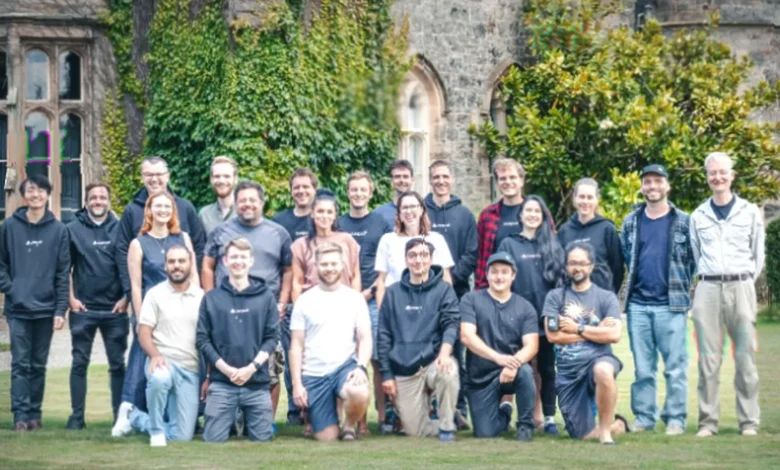
A British artificial intelligence startup, CuspAI, is in discussions to raise at least $200 million in new funding, a move that would see its valuation surge beyond $1 billion, according to a report by Bloomberg. No term sheet has yet been signed, but the potential deal represents a rapid ascent for the Cambridge-based company, which was only founded in 2024.
This latest funding push follows a significant Series A round of over $100 million in September 2025, co-led by New Enterprise Associates (NEA) and Temasek, which valued CuspAI at approximately $520 million. The company’s valuation was subsequently bolstered to around $800 million by new commercial contracts, setting the stage for the current negotiations that aim to catapult it into unicorn status.
The company’s funding journey began with a $30 million seed round in June 2024, led by Hoxton Ventures and Basis Set Ventures. Its Series A round also attracted participation from heavyweight corporate venture arms, including NVentures (NVIDIA’s venture capital arm), Samsung Ventures, and Hyundai Motor Group.
The “search engine for the material world”
CuspAI aims to tackle one of science’s most protracted challenges: the discovery of new materials. Traditionally, finding advanced semiconductors, sustainable battery chemistries, or compounds to filter harmful “forever chemicals” like PFAS can take a decade or more of costly trial-and-error, with a price tag often between $10 million and $100 million. CuspAI’s platform seeks to compress this timeline to mere months.
Founded by Dr Chad Edwards, a chemist and deep-tech entrepreneur with experience at quantum computing firm Quantinuum, and Professor Max Welling, a former AI expert at Microsoft Research and Qualcomm, the company has developed what it calls a “search engine for the material world.” Users input desired properties—such as strength, conductivity, or thermal tolerance—and the system suggests viable chemical compositions up to ten times faster than conventional methods.
The core of its technology is a generative AI model that is “synthesis-aware.” Unlike pure simulation tools, these models are designed to propose materials that are not only theoretically stable and high-performing but are also realistically manufacturable, overcoming a major bottleneck in the field. The company employs an “inverse design” approach, starting with the target properties and working backward to candidate materials, which are then rigorously evaluated.
This focus on practical creation is a key strategic advantage, supported by proprietary datasets. The company claims its models, such as MOFGEN for metal-organic frameworks, achieve high rates of generating materials that are “valid, unique, and novel” (VUN), reportedly outperforming similar models from giants like Microsoft and Meta.
Strategic alliances and expert guidance
CuspAI’s technology has attracted a roster of high-profile partners tackling critical global issues. It is collaborating with Meta on carbon capture technology, contributing to the world’s largest direct air capture database, ODAC25. A partnership with chemical company Kemira focuses on removing PFAS from water supplies, while Hyundai Motor Group is working with the startup on sustainable energy and next-generation mobility materials.
Further bolstering its credentials, CuspAI has assembled a distinguished advisory board featuring AI pioneers Yann LeCun and Geoffrey Hinton, alongside materials science and industry leaders such as Martin van den Brink, former President and CTO of chip equipment maker ASML, and Lord John Browne, the former CEO of BP.
The company operates in a fast-evolving and competitive landscape, alongside firms like Schrödinger, PhaseCraft, and PASQAL, as well as other AI-driven discovery platforms such as Citrine Informatics and Kebotix. The sector faces inherent challenges, including the scarcity of high-quality data, the high cost of advanced solutions, and the critical gap between AI prediction and successful lab synthesis. A recent academic study also highlighted that AI tools can produce unreliable predictions by overlooking structural disorder in materials, underscoring the need for robust, interdisciplinary approaches.
The proposed new capital is intended to fuel platform development, a hiring spree, and geographic expansion into the US and Asia to meet rising customer demand. The company expects its dual business strategy—crafting custom materials for enterprise partners and pursuing in-house development—to accelerate as its platform and datasets mature.