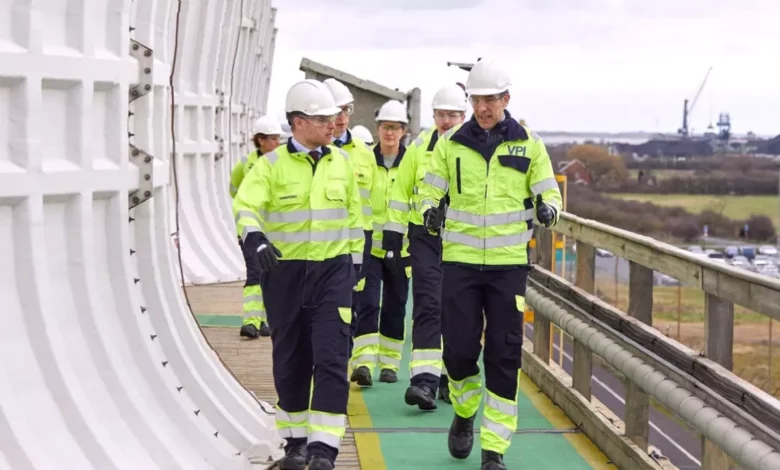
Energy Minister Michael Shanks’s visit to VPI’s Immingham Combined Heat and Power Plant this week placed a spotlight on a £1.5 billion industrial decarbonisation project that is central to the UK’s net-zero ambitions and the economic future of the Humber.
The Immingham facility, a 1,240 MW plant originally developed by ConocoPhillips and now owned by Vitol, is a cornerstone of regional industry. It provides essential electricity and steam for operations including refining, sustainable aviation fuel production, and battery material manufacturing, with the capacity to power up to 1.2 million homes.
The Capture Plan and Humber Zero
VPI’s plan, under the Humber Zero initiative it runs with Phillips 66 Limited, involves retrofitting carbon capture technology onto two of the plant’s three generating units. The project is considering Shell’s Cansolv post-combustion capture system, which aims to capture up to 95% of CO2 from flue gases. If realised, it would capture up to 3.3 million tonnes of CO2 annually by 2028, building to 3.8 million tonnes by 2029. The wider Humber Zero project aims to capture up to 8 million tonnes of CO2 each year from critical local industry.
This initiative has already secured planning consent and, notably, the UK’s first environmental permit for its post-combustion capture technology. VPI’s £1.5bn investment is projected to create around 1,500 jobs during peak construction, alongside numerous skilled permanent operational roles.
The Viking CCS Network: Scale and Infrastructure
The captured carbon from VPI and other emitters is destined for the Viking Carbon Capture and Storage (CCS) network. Led by Harbour Energy with bp as a non-operated partner, and with Technip Energies handling the Front-End Engineering Design, this transport and storage system has been awarded “Track 2” status by the government, marking it for development.
Viking CCS aims to store up to 10 million tonnes of CO2 per year by 2030, scaling to 15 million tonnes annually by 2035. Its infrastructure plan involves constructing a new 55km onshore pipeline from Immingham to the former Theddlethorpe Gas Terminal, and repurposing the existing LOGGS offshore pipeline to carry CO2 to depleted Viking gas fields in the North Sea. Furthermore, Associated British Ports (ABP) plans a CO2 import terminal at the Port of Immingham, the UK’s largest port by tonnage, which could generate new import revenue for the UK.
The cluster is forecast to attract approximately £13 billion in investment to the Humber region, supporting around 20,000 construction jobs at its peak. Harbour Energy states the project could unlock up to £7 billion in investment between 2025 and 2035 and generate an estimated £4 billion in Gross Value Add for the region.
Government Backing and Regional Transformation
The UK government has committed £9.4 billion over this parliament to carbon capture projects. Minister Shanks, who has recently engaged with other energy initiatives like the Westmill farms, stated during his visit: “This Government is delivering first of a kind carbon capture projects in the UK… Immingham has the potential to play a vital role in Britain’s clean energy future.”
This support is underpinned by new “decarbonisation readiness” regulations, enforced by the Environment Agency in England from 28 February 2026, which require new and substantially refurbished power plants to be designed for future carbon capture retrofits.
The Humber, as the UK’s largest industrial hub and a significant CO2 emitter, faces a critical decarbonisation challenge. Viking CCS is positioned as a key solution. Graeme Davies, executive vice president for CCS at Harbour Energy, said: “Viking CCS has the potential to transform the Humber into a world leading net zero industrial region, while supporting jobs and long-term economic growth.”
Other developments are aligning with this shift. Altalto (Immingham) Ltd. plans a plant to convert waste into sustainable aviation fuel, expected by 2030. Proposals for hydrogen production and storage networks in the Humber are also advancing, involving companies like National Gas, Centrica, Equinor, and SSE Thermal.
The Immingham plant’s role in powering battery material manufacturing links to a growing UK sector, with firms such as Lithion and Volklec focusing on lithium-ion batteries and energy storage, and Anaphite developing LFP cathode technology.
VPI CEO Jorge Pikunic noted the plant’s evolving role: “Through Humber Zero… it now has the potential to be among the first sites delivering low‑carbon, dispatchable power and steam, as one of the initial users of the Viking CCS transport and storage network.”
With its Front-End Engineering Design completed in early 2025 and a Development Consent Order for the onshore pipeline granted in the second quarter, the Viking CCS project anticipates a Final Investment Decision within the current parliamentary term. Construction is slated to begin from 2028, marking a tangible step towards decarbonising one of the nation’s most vital industrial regions and positioning the UK as a potential global hub for carbon storage services.