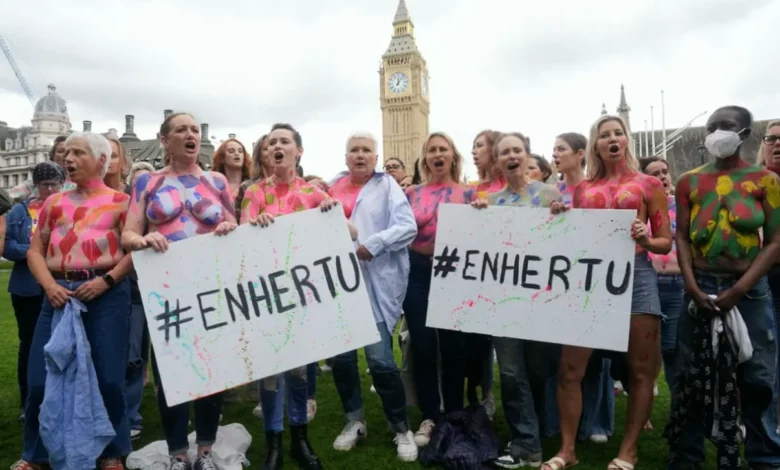
Breast Cancer Now has issued a fresh demand for the immediate NHS availability of Enhertu, the antibody-drug conjugate that extends life for women with certain advanced breast cancers but remains locked in a pricing stalemate in England. Claire Rowney, the charity’s chief executive, said: “We’re here, once again, asking for Enhertu to be made available for those who need it, and we urgently need to see this happen, now.”
The campaign
For two years, Breast Cancer Now – which launched the “Enhertu Now” campaign – has pressed the National Institute for Health and Care Excellence (Nice), NHS England and the drug’s manufacturers, AstraZeneca and Daiichi Sankyo, to reach an agreement that would allow routine prescribing. The charity has highlighted the human cost of the delay: patients exhausting their life savings to pay for private treatment, others considering moving to Scotland – where the drug was approved for NHS use in December 2023 – to access it publicly. The resulting “postcode lottery” means eligibility depends on where a patient lives, not on clinical need. Breast Cancer Now estimates that around 1,000 patients per year in England would be eligible for Enhertu.
The campaign has involved multiple rounds of negotiations, interventions by the Health Secretary Wes Streeting, and repeated breakdowns. As of November 2024, a third attempt to secure a pricing arrangement for England had failed. Nice’s primary objection has been cost-effectiveness: despite acknowledging that Enhertu significantly improves progression-free and overall survival, the watchdog concluded that the price – around £1,455 per 100mg vial (excluding VAT) – was too high relative to the benefit for the NHS.
The Nice stalemate
Enhertu (trastuzumab deruxtecan) is a targeted therapy for breast cancers that are HER2-positive or HER2-low. It was first recommended for NHS use in England in April 2021 under the Cancer Drugs Fund, specifically for patients with HER2-positive unresectable or metastatic disease who had already received two or more prior anti-HER2 therapies. That managed-access arrangement allowed data collection. But for HER2-low breast cancer, Nice issued draft guidance in September 2023 stating it would not recommend the drug, a decision confirmed in final draft guidance in March 2024. The agency said the companies had not offered a price that represented value for money for taxpayers.
Meanwhile, the Medicines and Healthcare products Regulatory Agency (MHRA) has approved Enhertu for several indications. In April 2025, it extended approval – via the global Project Orbis initiative – to treat solid tumours with HER2-positive mutations that have spread or cannot be removed by surgery, or for which no alternatives exist. European regulators have also approved the drug for HER2-low breast cancer.
A drug that works
Enhertu is an antibody-drug conjugate (ADC) that combines trastuzumab, which binds to HER2 proteins on cancer cells, with a potent chemotherapy called deruxtecan. It delivers the toxic payload directly to the tumour and also has a “bystander effect”, killing neighbouring cancer cells even if they have low HER2 expression. Clinical trials have demonstrated striking results. The DESTINY-Breast03 trial showed a significant reduction in the risk of disease progression or death compared with trastuzumab emtansine (T-DM1) in HER2-positive metastatic breast cancer. The DESTINY-Breast04 trial found that Enhertu provided an additional 4.8 months of progression-free survival and 6.4 months of overall survival versus chemotherapy in patients with HER2-low disease. The earlier DESTINY-Breast01 trial recorded an objective response rate of 61.4% in heavily pre-treated HER2-positive patients.
Real-world data from UK cancer centres has shown an overall response rate of 63% for Enhertu in HER2-positive metastatic breast cancer, though dose reductions and interruptions are common because of toxicity. Adverse events are reportable to the MHRA’s Yellow Card scheme.
The urgency
While Enhertu remains unavailable routinely in England, patients continue to face impossible choices. The charity has stressed that women are dying while waiting. In April 2026 the government increased the cost-effectiveness thresholds Nice uses for new medicines – a change Breast Cancer Now has welcomed as a potential opening for manufacturers to resubmit Enhertu for approval. But as of the latest reports, no resubmission has been announced, and the deadlock persists.
Claire Rowney’s plea – “we urgently need to see this happen, now” – reflects the frustration of a two-year campaign that has seen a drug proven to extend life blocked not by clinical evidence but by a price tag the NHS has so far refused to pay.