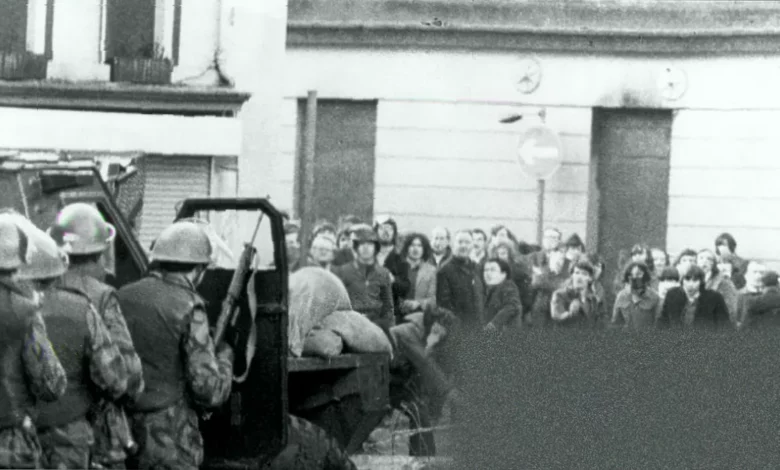
Kemi Badenoch has apologised after footage from the Bloody Sunday massacre was used in a social media video attacking Labour’s plans for dealing with the legacy of the Northern Ireland Troubles. The Conservative leader said she did not approve the clip, which was created and distributed by “very young people” who failed to recognise the source material.
The video, posted on Badenoch’s social media channels on Tuesday, accused Labour of seeking to “drag” British veterans back to court and subject them to “fresh legal battles” over their service during the Troubles. It drew immediate condemnation from politicians in Northern Ireland, most notably Colum Eastwood, the SDLP MP for Foyle, the constituency that includes Derry. Eastwood described the use of Bloody Sunday footage as “disgusting”, “disgraceful” and an “insult to the innocent civil rights protesters who were murdered”. He argued the video placed the interests of British soldiers above the needs of victims and survivors who have spent decades seeking truth and justice.
Speaking during a visit to a hairdresser in south-east London, Badenoch said: “I have apologised. I did not sign off the video. It was about a vote in parliament where Labour are putting in legislation that is hounding the very elderly veterans for things that happened decades ago, often under the instruction of political leaders who are no longer around. We support our veterans, but the video was done by very young people who did not recognise the footage as being from Bloody Sunday. So I apologise as well that that video went out in error. It was removed as soon as the party understood that that was what had been put out.”
The bill at the centre of the row
The controversy has brought renewed attention to Labour’s Northern Ireland Troubles Bill, which aims to repeal and replace the legacy legislation introduced by the last Conservative government. That earlier Act contained a conditional immunity scheme: veterans and other individuals could avoid prosecution for Troubles-era crimes if they provided information to a truth recovery body. It also halted future inquests and civil actions. The law was widely opposed by victims’ groups and political parties across Northern Ireland, and was declared unlawful by the High Court in Belfast in 2024.
Labour’s proposed changes would end the immunity scheme and lift the ban on inquests and civil cases. The government says its replacement will establish a reformed Legacy Commission with enhanced powers, while including protections for veterans such as the right to give evidence remotely and anonymously, and consideration of age and welfare. The Conservative Party, however, argues that the new bill will expose elderly former servicemen to undue legal scrutiny. The broader political debate has also drawn in Reform UK: Nigel Farage has stated that a Reform government would pardon convicted Troubles veterans and end all prosecutions related to their service.
Bloody Sunday: A pivotal event
Bloody Sunday, 30 January 1972, is widely regarded as the worst mass shooting in Northern Ireland’s history and one of the most significant flashpoints of the Troubles. During an anti-internment march in the Bogside area of Derry, members of the British Army’s Parachute Regiment opened fire on unarmed civil rights demonstrators. Thirteen people were killed outright; a fourteenth man, John Johnston, aged 59, died of his injuries four months later. Many of the victims were shot while fleeing or trying to help the wounded.
The events of that day dramatically escalated the conflict. Bloody Sunday led to a surge of support for the Provisional IRA and boosted recruitment to the paramilitary group. The year 1972 remains the bloodiest of the Troubles, with 479 deaths recorded.
Two major inquiries examined what happened. The first, the Widgery Tribunal, reported in 1972 and largely exonerated the soldiers involved. However, it has been widely condemned as a whitewash, with allegations that evidence was ignored or altered. After decades of campaigning by victims’ families, a second inquiry chaired by Lord Saville reported in 2010. It concluded that the soldiers’ actions were “unjustified and unjustifiable”, that the victims were unarmed and posed no threat, and that soldiers had lost control and fired without warning.
Following the Saville Report, then Prime Minister David Cameron issued a formal apology on behalf of the UK government, stating: “Some members of our armed forces acted wrongly. The government is ultimately responsible for the conduct of the armed forces and for that, on behalf of the government, indeed, on behalf of our country, I am deeply sorry.” Cameron added that the killings were “wrong”.
Only one British soldier, known as Soldier F, was ever charged with murder in connection with Bloody Sunday. He was acquitted by a judge in October 2025 after a non-jury trial in Belfast. The judge cited insufficient evidence and the passage of time as factors making a conviction difficult. The verdict drew sharply polarised reactions: victims’ families felt justice had been denied, while supporters of the veteran hailed the end of what they called a “witch-hunt”.