Britain’s terror threat level has been raised to severe after two Jewish men were stabbed in Golders Green, north London, as the government faces mounting pressure to tackle a surge in antisemitism.
The Joint Terrorism Analysis Centre (JTAC) upgraded the national threat from “substantial” to “severe” on Friday, meaning an attack is considered “highly likely” within the next six months – the highest alert in more than four years. MI5 said the decision reflected a gradual increase in terrorist threats driven by both Islamist extremism and extreme right-wing ideology.
The stabbing, which occurred on 29 April 2026, has been formally declared a terrorist incident by the Metropolitan Police. Two Jewish men, aged 34 and 76, were attacked in the street. The suspect, a 45-year-old British national born in Somalia named Essa Suleiman, was arrested after being detained by Shomrim volunteers. Police confirmed Suleiman had been referred to the government’s Prevent counter-extremism programme in 2020, but his case was closed the same year.
The attack was the latest in a series of incidents targeting the Jewish community, including arson attacks on Jewish sites in London in the weeks beforehand, with two earlier fires in Golders Green itself in March 2026.
Starmer calls for crackdown on protests
Prime Minister Sir Keir Starmer has responded by urging a ban on some pro-Palestine protests, suggesting there are “instances” where preventing such marches on UK streets is appropriate, as has been done in France. Speaking to the BBC’s Today programme, he said he would fight “with every breath I have” for a decent, tolerant and diverse Britain.
Starmer singled out the chant “globalise the Intifada” as a key concern, arguing that those who hear it must “stop and ask yourself, why am I not calling this out?” He went further, suggesting people using the phrase should be prosecuted, describing it as “calling for terrorism against Jews” and “extremely racist”. The prime minister also indicated a desire for “tougher action” against certain slogans used at demonstrations and highlighted the “cumulative effect” of repeated marches on the Jewish community.
The slogan “globalise the Intifada” is widely interpreted as a call to replicate the violence of past Palestinian uprisings against Israeli occupation on an international scale. The term “intifada” historically refers to campaigns that have involved bombings, shootings and suicide attacks. While some pro-Palestine activists deny the phrase is antisemitic or a call for violence, it has become a flashpoint in UK protests. In December 2025, two people were arrested in London for allegedly chanting slogans involving “intifada”, and in January 2026 three protesters were charged for the same offence. Police in London and Greater Manchester have since announced they will arrest anyone chanting the slogan or displaying it on placards. In New South Wales, Australia, legislation has been proposed to ban public displays of the phrase, with the state Premier describing it as hate speech that encourages violence.
Starmer urged those attending marches but not chanting to reflect on their role, saying: “If you are on a march or a protest where people are chanting ‘globalise the Intifada’ you do have to stop and ask yourself, why am I not calling this out?” He also criticised the display of images of paragliders – a reference to the Hamas attack on Israel – describing it as “venerating the murder of Jews”.
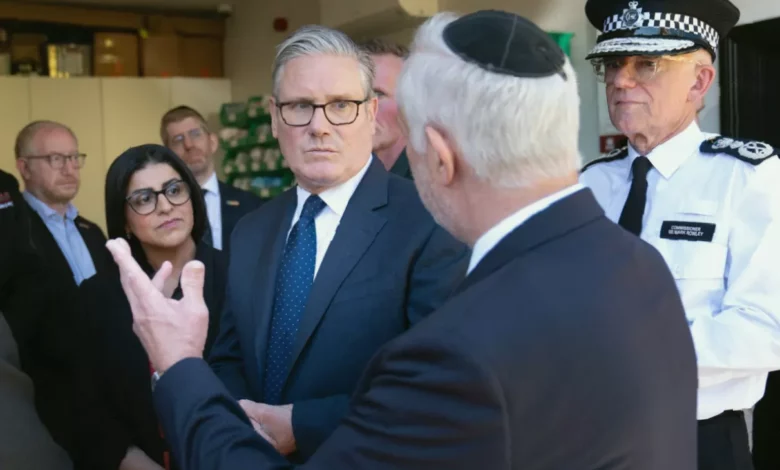
The prime minister’s intervention came days after he was heckled during a visit to Golders Green, where protesters held signs and chanted “Keir Starmer, Jew Harmer”. He called for a “whole of society response” to antisemitism, saying “too many people are not seeing anti-Semitism or they don’t want to see it.”
However, his stance has drawn criticism. Green Party leader Zack Polanski accused the government of “using the pain of the Jewish community to restrict our right to peaceful protest”. Activist groups have also rejected attempts to link pro-Palestine demonstrations to antisemitic attacks, insisting the marches are directed against Israeli policy rather than the Jewish community. British Jews have themselves been prominent in some pro-Palestine protests.
The government has pledged an additional £25 million in funding to protect Jewish communities, including increased security at synagogues, schools and community centres. Starmer vowed to introduce stronger powers to shut down charities promoting antisemitic extremism, prevent hate preachers from entering the UK, and speed up sentencing for antisemitic attacks. Legislation is also being fast-tracked to tackle threats from states such as Iran, which are suspected of seeking to harm British Jews.
France, which Starmer referenced as a model, has previously banned pro-Palestinian demonstrations on public order grounds, though the French Council of State later ruled that bans must be decided on a case-by-case basis rather than as a blanket measure.
Police review two upcoming protests
Metropolitan Police Commissioner Sir Mark Rowley has called for 300 extra officers to tackle what he described as a “pandemic of antisemitism”, warning that British Jews face their “greatest ever threat”. He said Jewish people are on the “list of hate” for a range of extremist groups, including the far right, Islamists and some hostile states.
Sir Mark confirmed he is considering whether to use police powers to limit two upcoming protests in London. The first is a pro-Palestine march, organised by groups including the Palestine Solidarity Campaign and the Stop the War Coalition, which have previously drawn crowds of up to 300,000. The second is a rally led by the far-right activist Tommy Robinson, who held a “Unite the Kingdom” event in September 2025 that attracted over 110,000 people and led to clashes with police. Robinson is planning another rally, “Unite the West”, in May 2026.
Assistant Commissioner Laurence Taylor said the force is reviewing all events to ensure appropriate security measures are in place, given the elevated terror threat. There have been calls from some politicians and community leaders for a “moratorium” on pro-Palestine marches, with suggestions that such events inevitably “incubate” antisemitic language.
The arrest of the Golders Green suspect has itself generated controversy. Green Party leader Zack Polanski shared a social media post accusing officers of using excessive force. Sir Mark Rowley defended the officers’ actions, emphasising the “difficult and dangerous” circumstances. The commissioner has also faced accusations of bias for engaging with pro-Israel groups while allegedly not engaging sufficiently with pro-Palestine and Muslim organisations.
The Community Security Trust charity has reported a significant surge in antisemitic attacks since the October 7th attacks and the subsequent Gaza war, a trend that the Golders Green stabbing has now brought to the forefront of national security concerns.