Senior pro-Palestine organisers convicted over a London protest have issued a defiant statement that the right to choose where they demonstrate lies with their movement alone, not with established Jewish community groups.
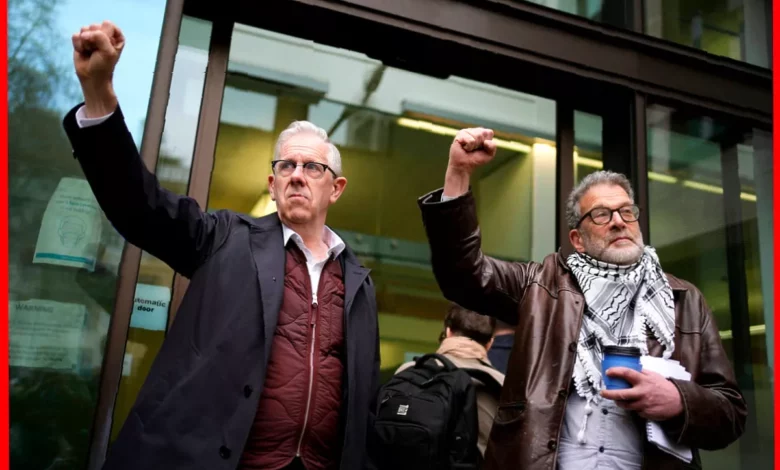
Benjamin Jamal, director of the Palestine Solidarity Campaign (PSC), and Christopher Nineham, vice-chair of the Stop the War Coalition, were found guilty at Westminster Magistrates’ Court on 1 April 2026 of failing to comply with police conditions imposed on a demonstration in central London on 18 January 2025. The court heard that the pair had organised a static rally on Whitehall but then intended to march towards the BBC headquarters in Portland Place, breaching conditions that required them to remain static. Jamal was also convicted on two counts of inciting others to breach the conditions.
‘A shocking decision’
Both men, who received conditional discharges of 18 and 12 months respectively and were ordered to pay £7,500 each in prosecution costs, have vowed to appeal. Nineham described the verdict as a “shocking decision” and a “huge setback for civil liberties in this country,” while supporters outside court labelled it “grotesque” and a “disgraceful assault on the right to protest.”
The campaigners argue the case is part of a wider criminalisation of the Palestine solidarity movement. “Decisions like this are designed to repress support for the Palestinian struggle for liberation and our campaign to end all UK complicity in Israel’s ongoing genocide,” stated Jamal, who has been director of the PSC since 2016. Former Labour leader Jeremy Corbyn, present at the hearing, said the demonstration had been “entirely peaceful” and that protesters had ended it by laying flowers to mourn Palestinian children.
Police and judicial reasoning
The Metropolitan Police stated the convictions reinforced the necessity of upholding lawful protest conditions. A spokesperson said Parliament had given police powers to impose conditions to balance the right to protest with the rights of others. Commander Adam Slonecki, who managed the protest policing, cited concerns that national demonstrations “had a severely adverse impact on a significant portion of the Jewish community who had become fearful of attending the synagogues during protest.”
District Judge Daniel Sternberg found the conditions imposed were lawful and necessary and that both defendants clearly knew them. He ruled they had “knowingly” breached the rules, stating that “protest rights, while fundamental, are not absolute and do not permit breaching lawfully imposed conditions.”
This perspective is supported by leading Jewish community institutions. The Board of Deputies of British Jews and the Jewish Leadership Council have expressed concern that protest activities have a “practical impact… on Jewish communal life,” targeting institutions and businesses in ways that “cause fear and disruption.” The Chief Rabbi, Sir Ephraim Mirvis, has questioned why protests containing “outright antisemitism, outright support for Hamas” are allowed to proceed.
The core accusations: genocide and apartheid
The protesters’ central claim, and the foundational reason for their activism, is the accusation that Israel is committing genocide and has maintained a system of apartheid for 76 years. This language, used by Jamal in his statement, forms the bedrock of the PSC’s campaigning work. The organisation, founded in 1982 and funded solely by member donations, campaigns for the boycott, divestment, and sanctions (BDS) movement against what it terms Israeli apartheid.
These accusations inform their specific targets. The PSC runs active campaigns calling to “Don’t Buy Apartheid,” to “Boycott Barclays,” and to divest Local Government Pension Schemes from companies it says are complicit in Israel’s actions. In 2020, the PSC won a landmark Supreme Court case defeating government regulations that restricted such pension scheme divestments. The group also campaigns against UK arms sales to Israel.
The protest on 18 January 2025 was one of 34 national demonstrations since the war in Gaza began in October 2023. The campaigners’ resolve appears undimmed. “We will not be silenced,” Jamal stated, while Nineham said any financial penalties would be “met with donations from the supporting public.” Their stance remains that, as Jamal declared, “We, the Palestine Solidarity Movement, decide where we protest not the Board of Deputies, not the Chief Rabbi, not the Community Security Trust, not any Zionist group that has supported Israel’s genocide and its 76 years of apartheid.”